
Fixed braces & clear aligners · Amman
Braces and aligners in Amman, one gentle step at a time. American braces, digital aligners.
Teeth can be moved. In fact, with light, steady pressure, your own teeth glide into better positions, and your natural enamel stays untouched. At Magic Tooth we therefore offer two proven ways to do it: fixed braces with brackets and wires from American Orthodontics, and clear aligners planned on a 3D scan of your mouth.[5][6]
Why patients choose braces and aligners here
- Your natural teeth, kept whole
- Children, teens & adults
- Brackets & wires made in the USA
- A written plan before you start
First orthodontic check-up recommended around age 6 · Braces and aligners are planned for your own smile, never off the shelf

Dr. Bashar Momani
Consultant orthodontist for fixed braces and clear aligners
Jordan Board of Orthodontics · Craniofacial fellowship
- Fixed braces and clear aligners for children, teens and adults
- Early (interceptive) orthodontics with our pediatric dentists
- An honest opinion on braces, aligners or both, and a written plan before you start
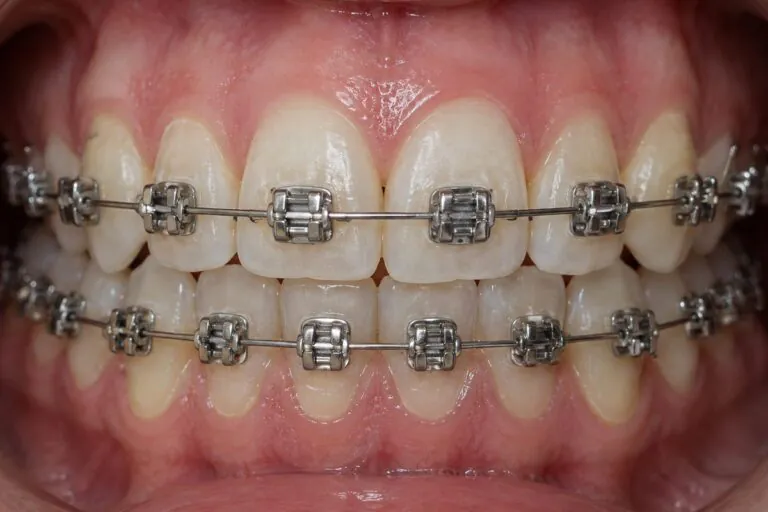
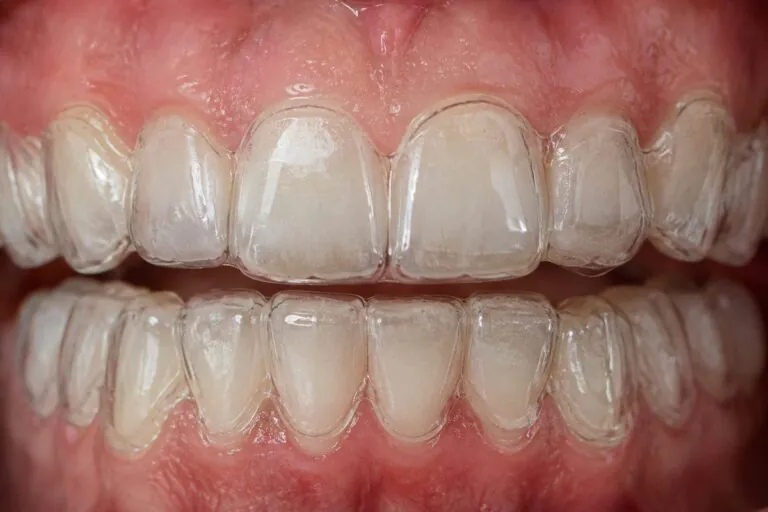
First, small brackets hold a thin wire against your teeth. Over time, the wire slowly springs back toward its ideal curve and guides each tooth along with it.Instead, a clear tray fits snugly over your teeth. Then each new tray is a tiny step closer to the final plan; small tooth-colored bumps help it grip.
Example photos for illustration. Your own treatment is planned for your smile.
Braces and aligner cases in Amman: real patients, real results.
Braces and clear aligner cases treated here at Magic Tooth Dental Center in Amman, photographed before and after treatment. These are our own patients, not stock photos.
Crowded teeth and high canines, lined up with fixed braces
A young patient came to us with crowded upper and lower front teeth. In addition, both upper canines had erupted high up and outside the line of the arch. Fixed braces then guided the canines gently down into place and lined up every tooth into a smooth, even smile.
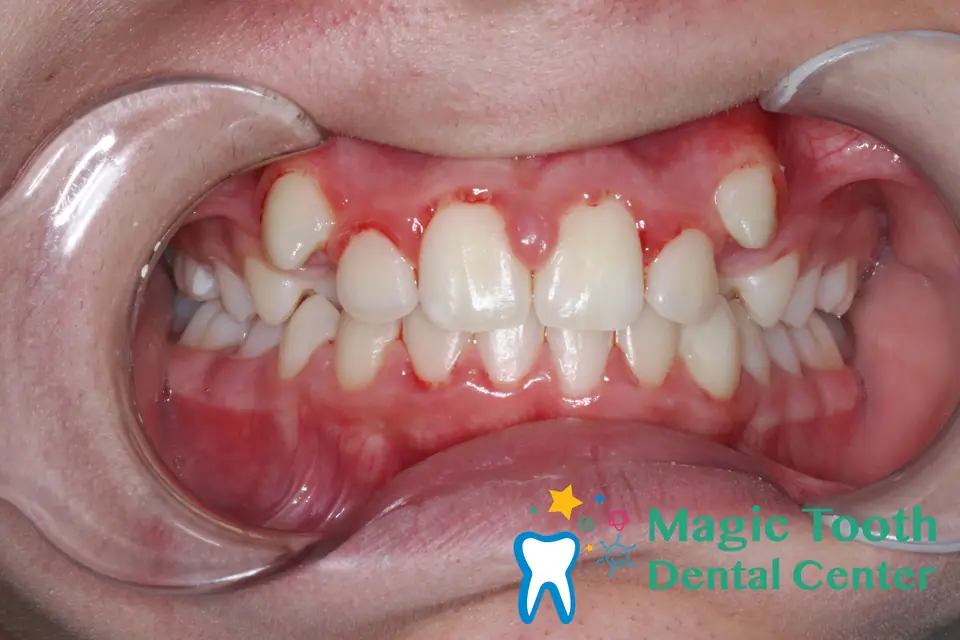 Before
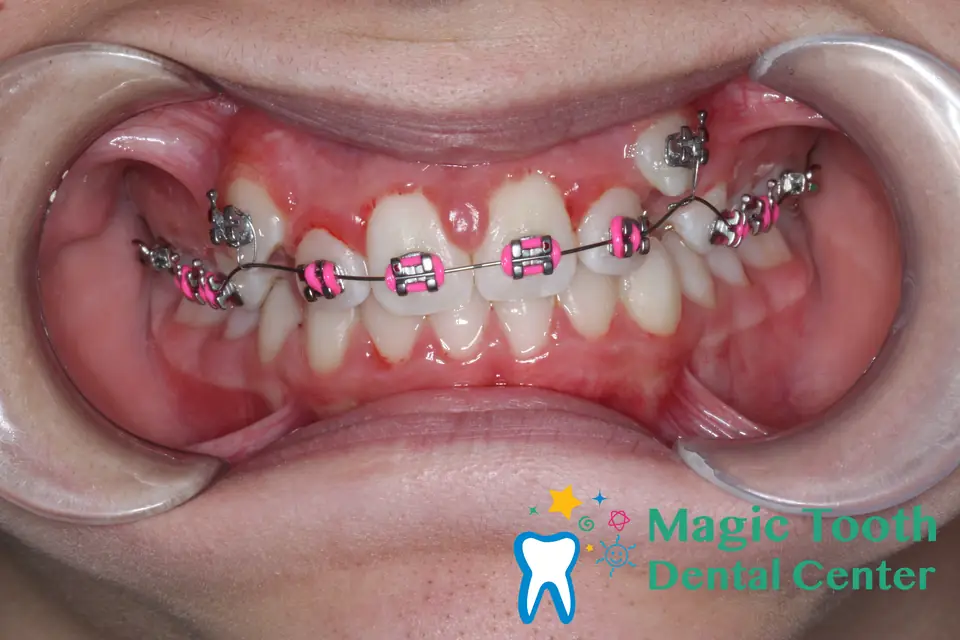 During treatment
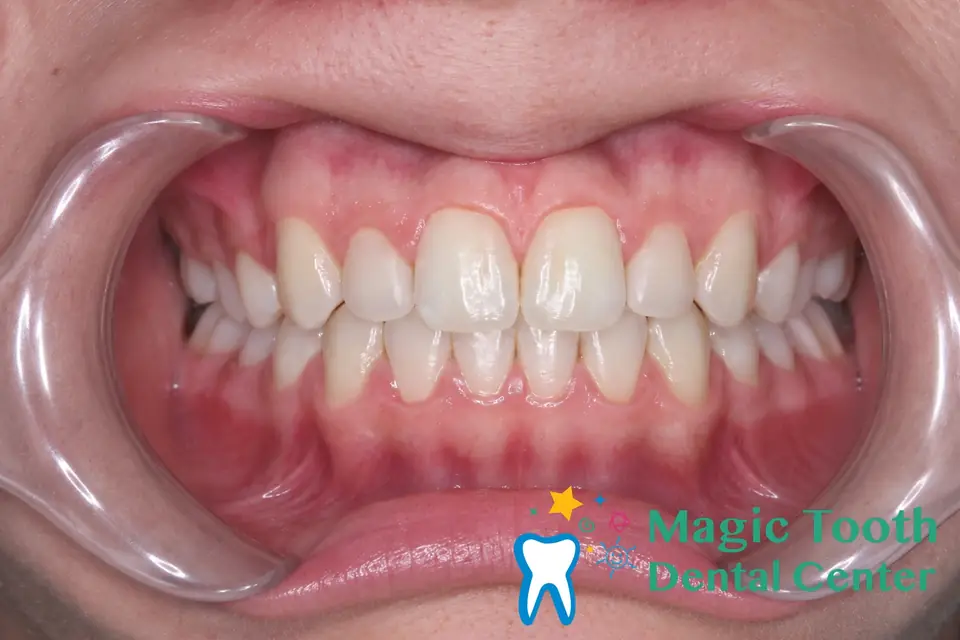 After
Crowded teeth straightened with clear aligners
A young man came to us with crowded front teeth, especially in the lower jaw, where several teeth were overlapping and turned. Clear aligners then gradually moved each tooth into line, without brackets or wires.
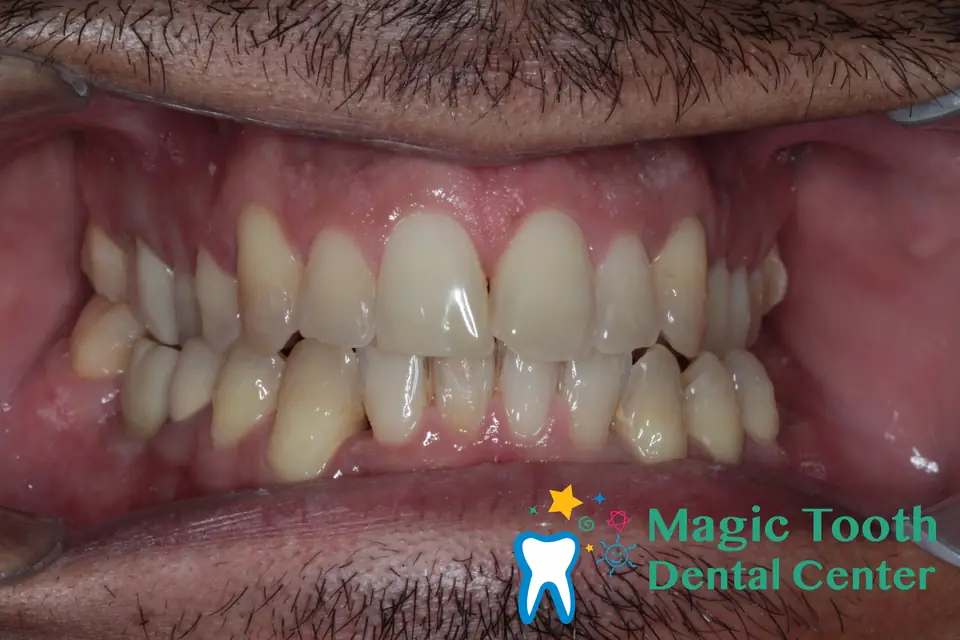 Before
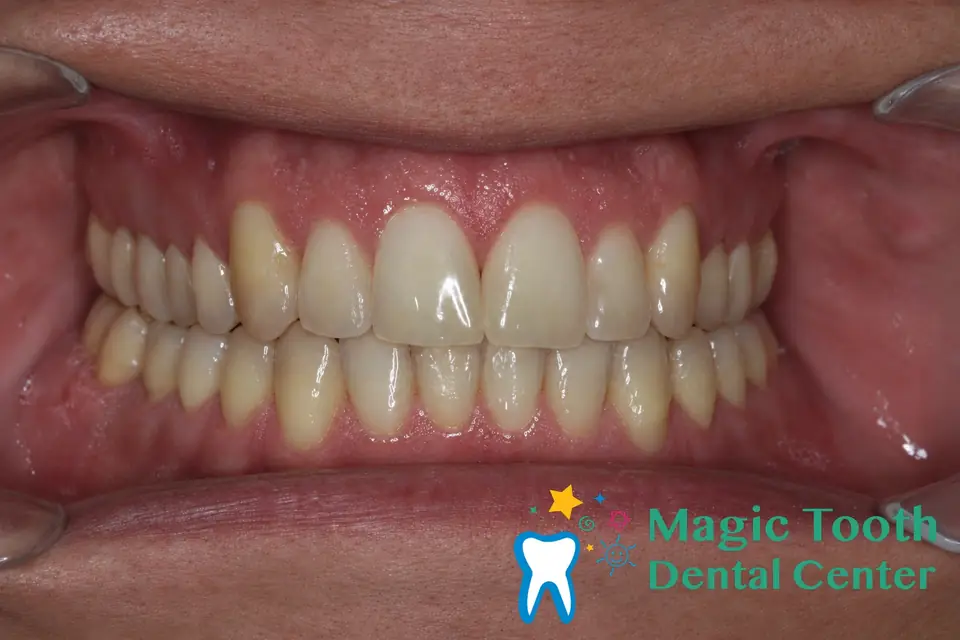 After
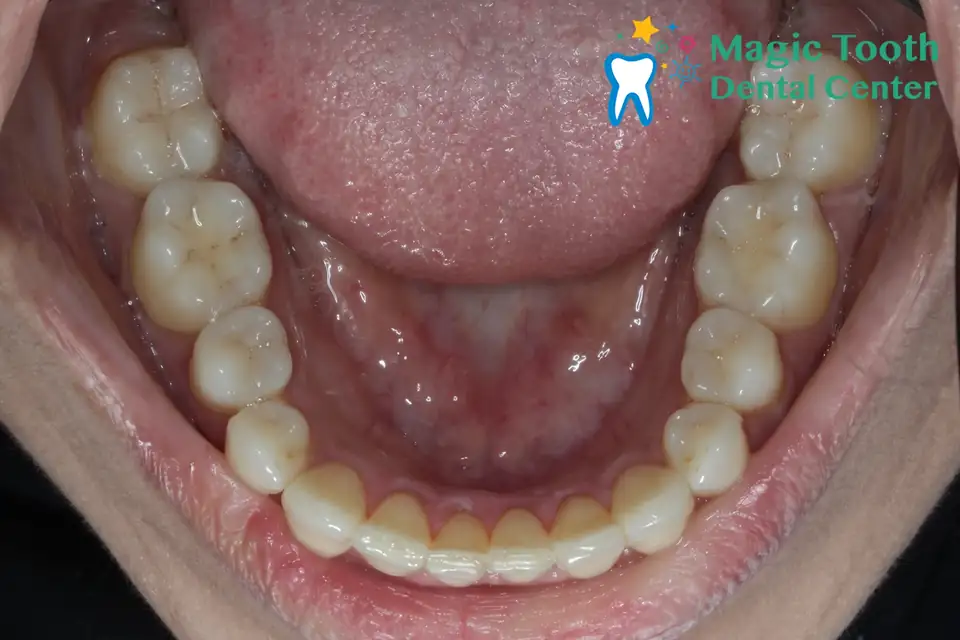
A crowded lower incisor, brought back into line with clear aligners
This patient had crowding of the lower front teeth: one lower incisor was pushed back behind its neighbours, and the teeth around it overlapped. Clear aligners made room and brought the incisor forward, so it now sits in line with the lower front teeth around it in a smooth, even arch.
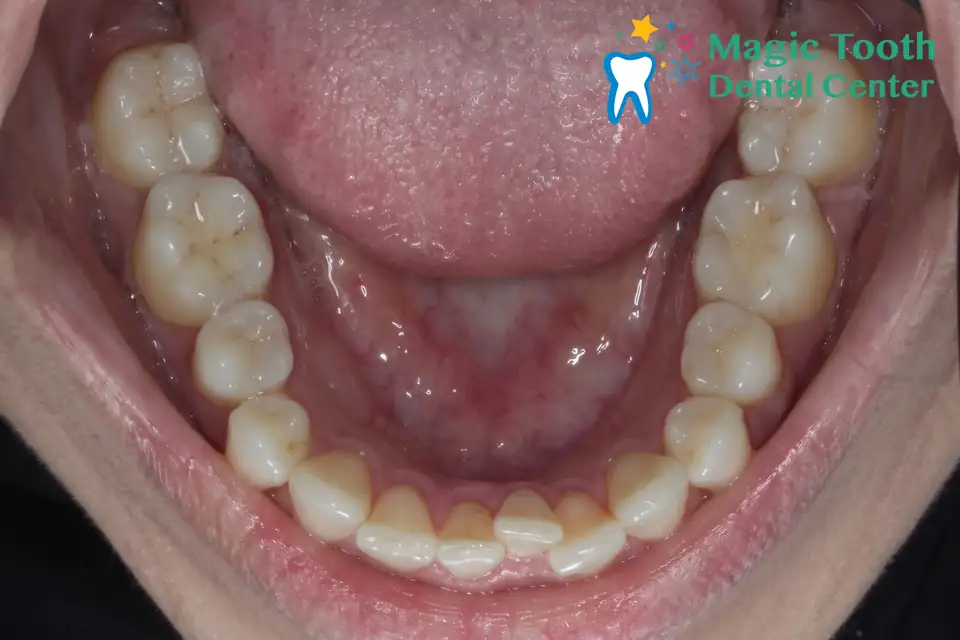 Before
 After
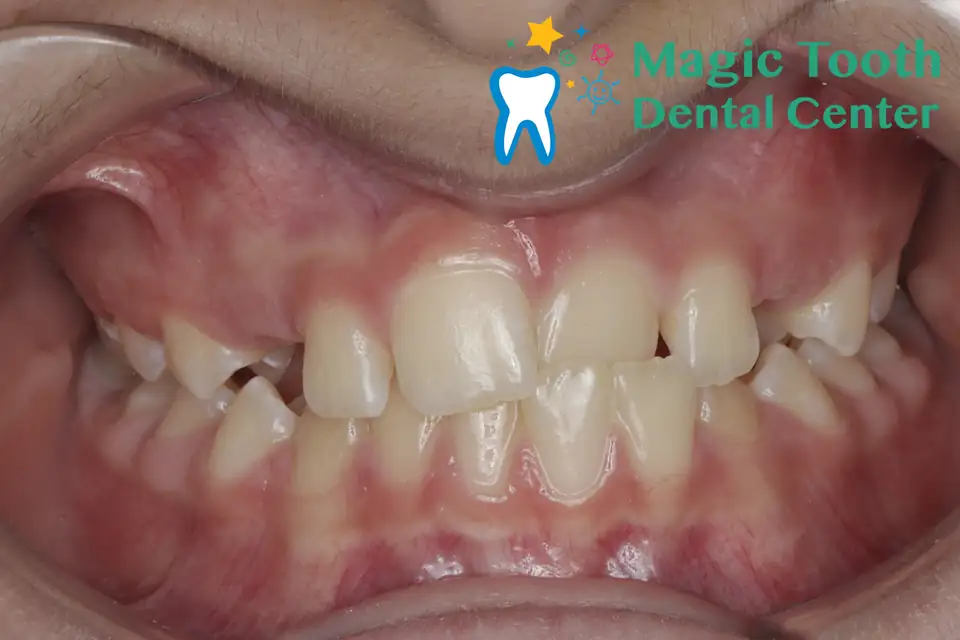
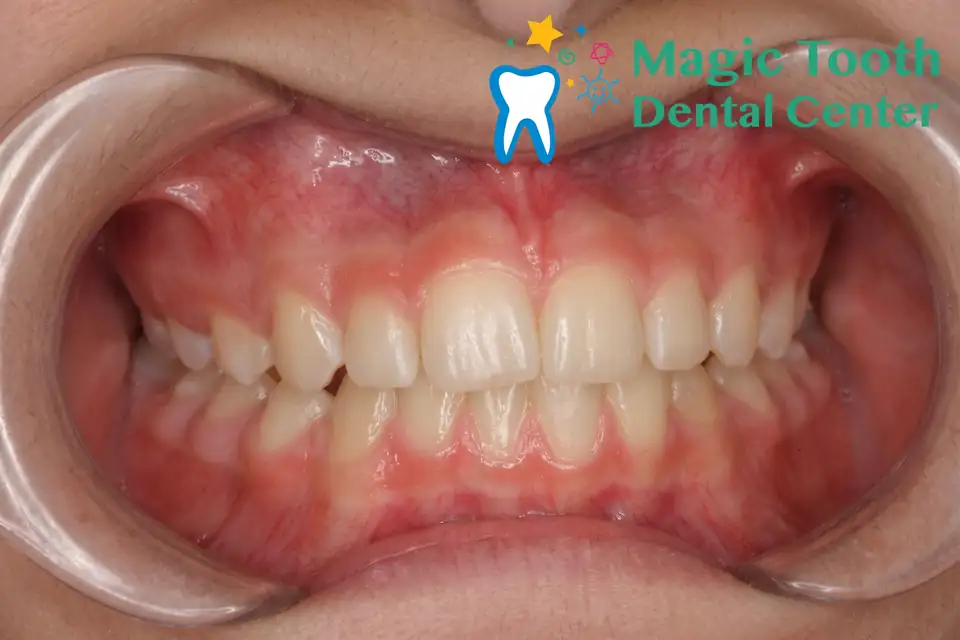
Anterior crossbite corrected with fixed braces: upper front teeth back in front
A young patient came to us with an anterior crossbite: when biting, some upper front teeth sat behind the lower front teeth instead of in front of them. Fixed braces moved the upper incisors forward over the lower ones, giving a natural, corrected front bite. Crossbites like this are best checked early, while the teeth and jaws are still growing.
 Before
 After
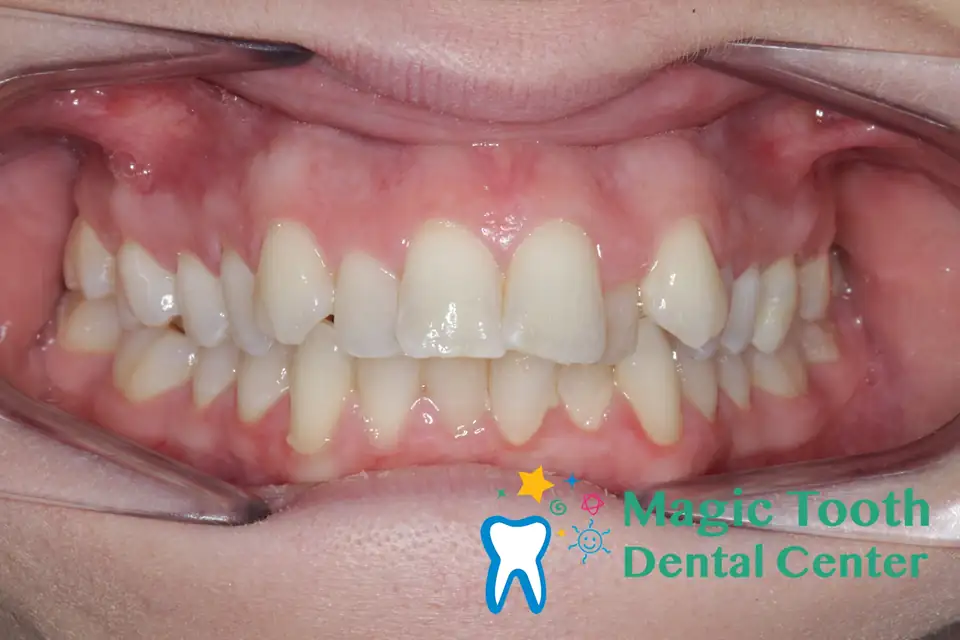
Crowded upper and lower teeth, evenly aligned with clear aligners
This patient had crowding in both the upper and lower front teeth: several teeth overlapped, some sat out of line, and the arches looked uneven. Clear aligners made room and moved each tooth into place, so the upper and lower teeth now sit in even, well-aligned arches.
 Before
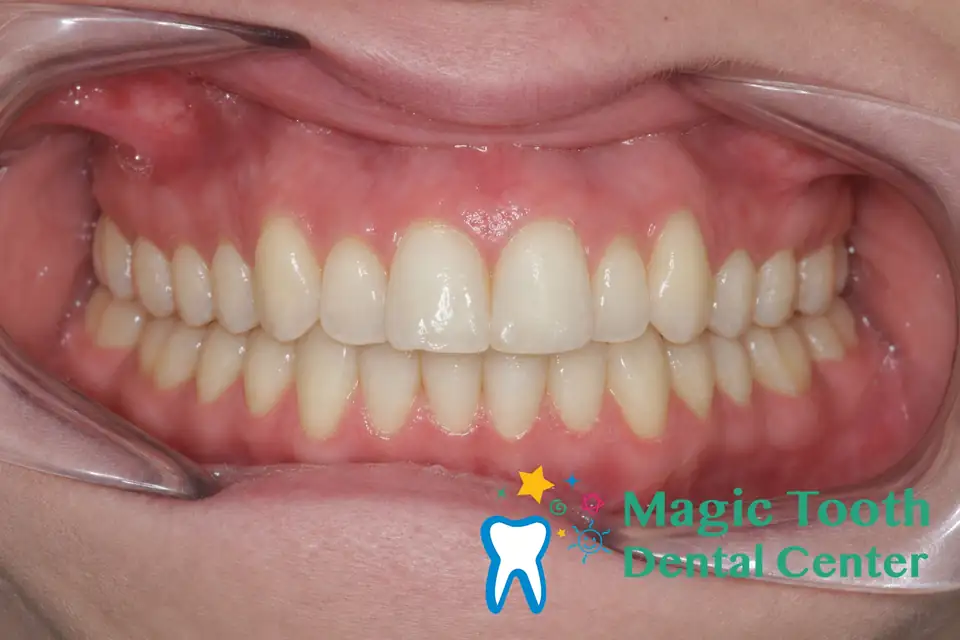 After
Crowded upper teeth, aligned into a smooth arch with fixed braces
This young patient’s upper teeth were crowded: several front teeth were turned or pushed out of line, and the arch was uneven. Fixed braces made room and guided each tooth into place, so the upper teeth now sit side by side in a smooth, evenly rounded arch. Checking crowding early, while a child is still growing, gives more options for making space.
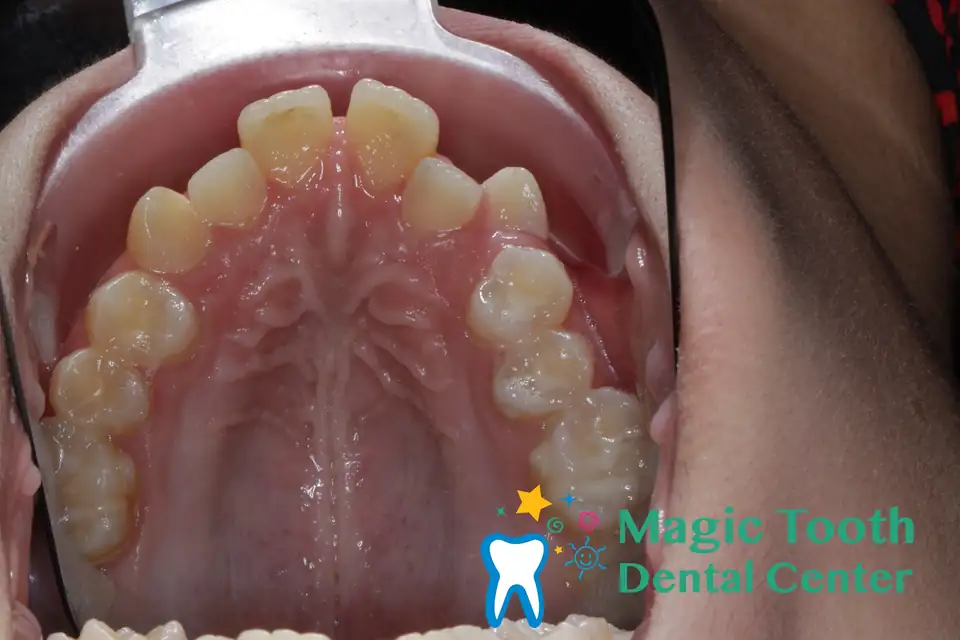 Before
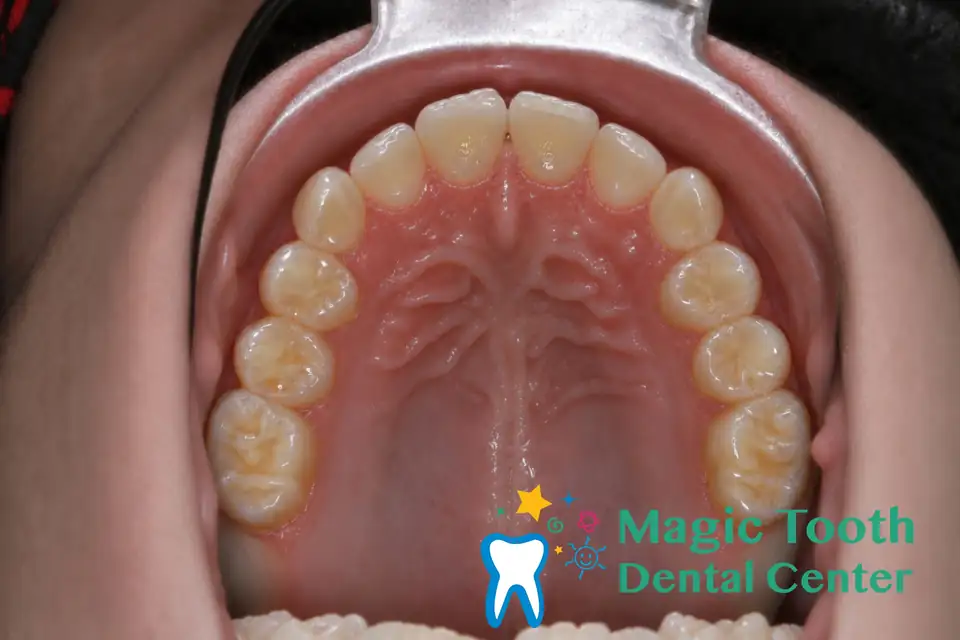 After
Photos of patients treated at Magic Tooth Dental Center. Treatment time and results vary from person to person.
Smile preview · free and privateNew
See your straighter smile, then try braces or aligners on it
Add a smiling photo and our simulator maps your face, checks your smile (midline, gaps, tilt and even edges), lines your teeth up with your face midline and shows the result on a before-and-after slider. Then try clear aligners or braces on your own smile, pick a whitening shade, and make a short smile video to share. It takes a minute, and your photo never leaves your device.
The science, simply
How do braces and aligners move teeth?
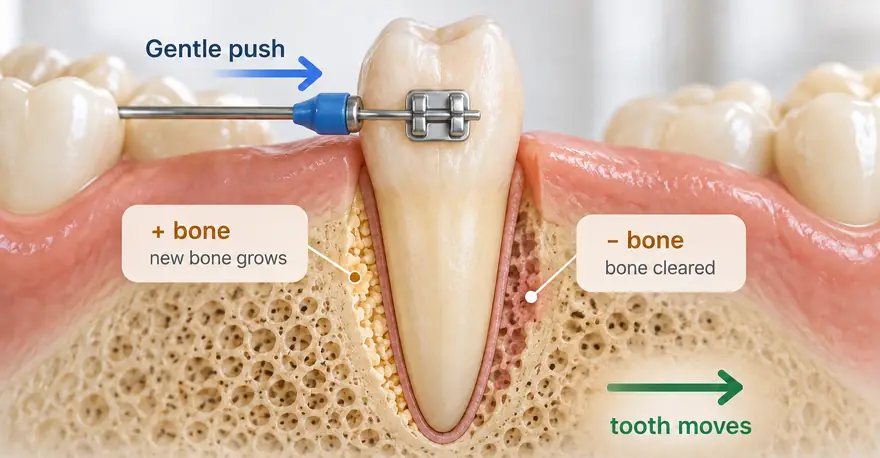
Braces and aligners push teeth with a light, steady force. The bone around each root slowly reshapes, clearing on one side and growing on the other, so the tooth moves into its new place.
Teeth are not fixed in the jaw like nails in wood. Instead, each tooth sits in a tiny cushion of fibers, and the bone around it is alive and constantly renewing itself. Whenever a brace or an aligner pushes gently and steadily, the body responds: bone is cleared away on the side being pressed and new bone grows on the other side. As a result, little by little, the tooth glides into its new place.[5]
The right amount of force
Too little and nothing happens; too much, however, is uncomfortable and can harm the root. Therefore light and continuous is best, which is exactly what modern wires and trays are designed to give.
The right direction
For example, a tooth can be tipped, rotated, pushed in or out, or moved bodily with its root. Because of this, a precise appliance lets your dentist choose exactly which movement happens.
Time and check-ups
Bone remodels slowly, however, so treatment is measured in months. Meanwhile, regular visits let your dentist see how your teeth are responding and adjust the plan.
In short, this is why the quality and accuracy of what is on your teeth matters: braces and aligners are the tools that turn the plan into real, controlled movement.
Option 1 · Fixed braces
Fixed braces: precision you can understand
Of braces and aligners, fixed braces are certainly the more versatile tool for moving teeth. Tiny brackets and a carefully chosen wire work as a team, and consequently their accuracy depends on how well each part is made. For this reason, we use brackets and archwires from American Orthodontics, a family-owned company making orthodontic appliances in Sheboygan, Wisconsin, USA since 1968.[1][2]
Brackets: the “address” on each tooth
Put simply, a bracket is a tiny block bonded to the front of a tooth with a precisely cut slot inside. In addition, the exact angle and tilt the tooth needs is built into the bracket itself, so when it is placed correctly the tooth is steered to its final position with fewer wire bends.[3]
Wires: the engine of movement
The archwire, meanwhile, connects the brackets and delivers the force. First, treatment starts with very flexible nickel-titanium wires that “remember” their ideal arch and gently pull crowded teeth into line; later, stiffer wires give fine control over the bite. Above all, consistent, well-made wires keep the force light and even, which makes movement predictable and more comfortable.[4]
Why “made in the USA” matters to you
American Orthodontics reports that more than 98% of its products are manufactured at its own Wisconsin headquarters, where, in particular, design, machining and quality inspection happen under one roof. For you, that means consistency: in other words, every bracket behaves the way the plan expects, from the first wire to the last.[1]
American Orthodontics braces in numbers
making braces in Sheboygan, Wisconsin ever since[2]
of its products made at its own US facility, according to the company[1]
prescription built into every bracket: the tooth’s angle, tilt and rotation[3]
Manufacturer figures describe American Orthodontics products and origin; however, they do not by themselves prove better clinical results, and no bracket or wire can guarantee a perfect result. Therefore, ask us to confirm the exact bracket and wire models planned for you.
Three styles of fixed braces
Classic metal
Small, strong and reliable, and also the most economical choice. Besides, colored ties make them fun for children and teens.
Clear ceramic
Tooth-colored brackets that blend in, especially for patients who want braces that are harder to notice.
Self-ligating
A tiny built-in clip holds the wire instead of elastic ties. In this case, your dentist will advise whether this suits your case.
Option 2 · Clear aligners
Clear aligners: almost invisible, carefully planned
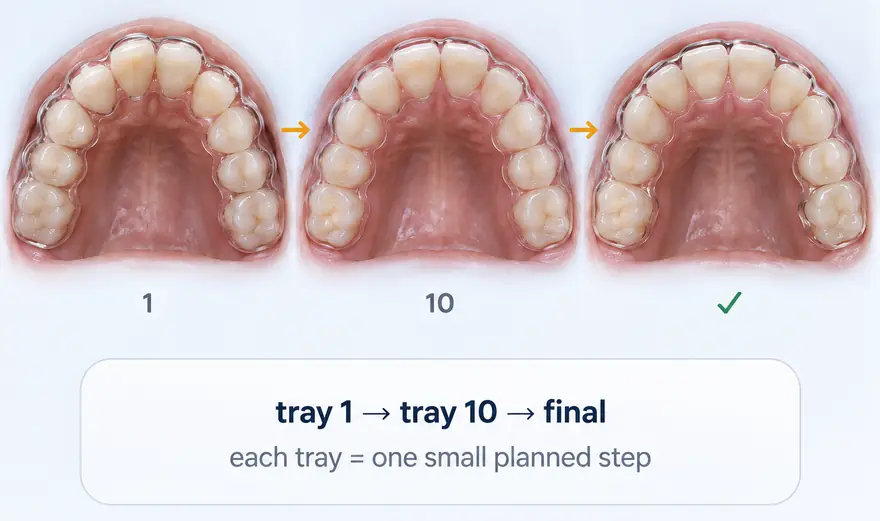
Clear aligners are thin, transparent trays made to fit your teeth. Unlike braces, aligners have no brackets or wires: instead, the shape of each tray delivers the force. First, we take a 3D digital scan of your mouth (no messy impressions). Then your dentist plans the final result on screen, the software divides the journey into small steps, and a custom tray is made for each one.[6][11]
Invisalign® at Magic Tooth: we also offer Invisalign clear aligners. Before you start, you can see a simulation of your final result, planned tooth by tooth by our orthodontist, Dr. Bashar Momani.
What makes clear aligners different from braces
- Accurate by designSpecifically, each tray is shaped to move specific teeth a tiny, measured distance. In some cases, small tooth-colored “attachments” are bonded to some teeth to give the tray a better grip for rotations or lifting movements.[7]
- Fits into everyday lifeNearly invisible, smooth with no wires to poke the cheeks, and above all removable, so you eat, brush and floss as normal. As a result, daily life barely changes.
- Planned movement, real-life checksA digital preview is, of course, a treatment goal, not a promise. For that reason, your dentist checks how your teeth actually respond; some movements need extra attachments, elastics, more trays, or a combined plan of braces and aligners.[6][11]
Mail-order “DIY” aligner kits, by contrast, skip the examination, the X-rays and the in-person checks. Consequently, orthodontic associations and the US FDA advise that aligners should always be prescribed and monitored by a dental professional.[11]
Side by side
Braces vs clear aligners: which fits your life?
Both braces and clear aligners can certainly deliver carefully controlled tooth movement in suitable cases. Research comparing braces and aligners finds that braces give the finest control of complex movements and the bite, whereas aligners score higher on comfort, appearance and ease of cleaning.[9][10][12]
Results: how precisely braces and aligners move teeth
| What matters to you | Fixed bracesAmerican Orthodontics brackets & wires | Clear alignersDigitally planned trays |
|---|---|---|
| Precision of movement | Highest Above all, fine control of rotations, root position and the bite. | High For most movements; attachments help with harder ones, although some cases still need braces. |
| Suitable cases | Simple to complex, including, for example, severe crowding and bite problems. | Mild to moderate, as well as many complex cases with careful planning. |
Daily life with braces or aligners
| What matters to you | Fixed braces | Clear aligners |
|---|---|---|
| Appearance | Visible (metal) or, alternatively, discreet (clear ceramic brackets). | Nearly invisible Attachments, however, may still show a little. |
| Comfort | Occasional rubbing from brackets or wires; however, orthodontic wax helps. | Smooth, no wires |
| Eating & brushing | Extra care around brackets; also avoid hard and sticky foods. | Remove to eat and brush normally |
| Depends on your cooperation? | Minimal Braces work 24/7; elastics, however, may still need your help. | Yes Must be worn 20–22 hours a day, every day. |
Visits, retainers and who each option suits
| What matters to you | Fixed braces | Clear aligners |
|---|---|---|
| Check-ups | Usually every 4–8 weeks at the clinic to change wires. | Regular visits, too, to hand over the next trays and confirm progress. |
| After treatment | Retainers are always needed to hold the result. | Retainers are needed here as well, to hold the result. |
| Often best for | Children and teens, complex cases, as well as anyone who prefers a “fit and forget” approach. | Adults and teens who want discretion and easy hygiene, provided they can commit to the wear time. |
In the end, neither braces nor aligners are the best option for everyone. Instead, treatment time, cost and the final result depend on your individual case and on following your dentist’s instructions.[9][12]
Braces, clear aligners & crowns
Braces and aligners vs crowns: keep what makes your tooth yours
Some patients ask whether crooked teeth could simply be covered with crowns in a few days. Crowns are certainly vital for repairing broken, worn or root-canal-treated teeth. However, using them to disguise healthy crooked teeth means permanently removing enamel, and the roots stay crowded underneath. Moving the tooth with braces or clear aligners, by contrast, keeps your natural enamel intact for life.[13][14]
Orthodontics or crowns: what each one does
| Feature | Braces & clear aligners | Crowns on healthy crooked teeth |
|---|---|---|
| Natural tooth | Kept whole Enamel stays untouched; at most, some plans use small amounts of enamel polishing between teeth. | Reduced permanently In contrast, fitting a full crown removes a large part of the healthy outer tooth. |
| Roots & bite | Moves the whole tooth, root included, into healthy bone and, as a result, a balanced bite. | Changes only the outer shape; meanwhile, the root stays where it was. |
| Long term | Simply maintained with normal hygiene and a retainer. | Crowns wear and eventually need replacing; likewise, margins near the gum need careful cleaning. |
Different treatments, different jobs. Braces and clear aligners do not replace a needed restoration; equally, crowns do not correct root alignment. For example, some patients benefit from orthodontics first, followed by far more conservative ceramic crowns or veneers.
Which one is right for me?
Braces or clear aligners? Try the smile finder
First, choose who the treatment is for and what matters most to you. Then you will see whether braces or clear aligners are often recommended, and a ready WhatsApp message to send us. It is a general guide, of course: the right answer comes from an examination.
What we check first
Opens WhatsApp with a message you can edit before sending.
What to expect
Your braces and aligners journey at Magic Tooth
Select a step to see what happens with braces or aligners, as well as how you can prepare.
We get to know your smile
First, we examine your teeth, gums and bite, take photos and a 3D digital scan, and X-rays when needed, including 3D imaging for complex cases. Finally, we explain which option suits you and why.
Healthy first. Decay and gum problems are always treated before any tooth movement begins.
A clear plan before anything starts
Next, we show you the planned movements, the expected changes, risks, how long treatment should take and the cost, in writing. In short, nothing starts until you are happy with the plan.
Good to ask: whether attachments, elastics, enamel polishing or extractions are part of your plan, and also what the alternatives are.
Fitting day for braces or aligners
Braces are simply bonded in a single visit. For aligners, meanwhile, you receive your first trays and any attachments are placed. Teeth may feel tender for a few days afterwards; in fact, this is the first sign that they are starting to move.[8]
Anxious child? In that case, ask about laughing gas and our pediatric team.
Move & review
Every 4–8 weeks we change wires or hand over the next set of trays and confirm that your teeth are moving as planned. If something responds differently, we adjust the plan immediately rather than hoping for the best.
Keep your appointments. After all, missed visits are the most common reason treatment takes longer than planned.
The reveal, then retainers
Finally, braces come off, or the final tray is reached, and we polish your teeth. Then comes the part people forget, however: teeth have a “memory” and tend to drift back, especially in the first year. Fortunately, a retainer, removable or a thin wire bonded behind the front teeth, keeps them where they belong.[8][16]
Night-time wear is often enough in the long term; in any case, follow the schedule we give you and call us if a retainer no longer fits.
Both braces and clear aligners can, of course, cause temporary soreness. Likewise, poor cleaning during treatment can lead to decay or gum problems, and small amounts of root shortening are possible. Before you start, your dentist will explain the risks relevant to you.[8][15][16]
Myth or fact?
Braces and aligners myths: tap a card to find out
Myths about who braces and aligners are for
Myths about crowns and retainers
Sources: American Association of Orthodontists, NHS and also British Orthodontic Society patient guides.[6][8][16]
Daily care
Caring for braces and aligners every day
A few habits make braces and aligners work faster and, at the same time, keep your enamel and gums safe. Tick the ones you already do.
Your braces and aligners habits
For braces and clear aligners alike.
If something goes wrong
Fortunately, most problems are small and easy to fix. Simply call or WhatsApp the clinic and we will tell you what to do.
- Loose bracket: not an emergency. Meanwhile, cover any sharp edge with orthodontic wax and we will re-bond it at a short visit.
- Poking wire: first press it flat with a clean pencil eraser or cover it with wax, then call us.
- Lost aligner: go back to the previous tray or move to the next one as we advise; meanwhile, we will replace it if needed.
- Soreness: a soft diet and, if needed, a simple pain reliever are usually enough. However, contact us if pain is severe or lasts longer than a few days.
- A knocked tooth: first see our Tooth Trauma SOS guide, then call us straight away.
Questions parents & patients ask
Braces and aligners: frequently asked questions
Honest answers about braces and clear aligners, always in plain language. Your own plan will always be tailored to your smile.
Comfort, age and the clinic
Do braces or clear aligners hurt?
Neither is painful to fit. However, for a few days after braces are placed or wires are changed, and for a day or two with each new aligner tray, teeth can feel tender when biting. This mild soreness is simply a sign the teeth are starting to move, and it settles quickly. Meanwhile, a soft diet and, if needed, a simple pain reliever are usually enough. Still, contact us if pain is severe, lasts longer than expected, or an appliance breaks.[8][16]
At what age can my child start?
The American Association of Orthodontists recommends a first orthodontic check-up around age 7, when the first adult teeth have come through. In fact, most children do not need treatment that early. However, some bite and jaw problems are far easier to guide while the jaws are still growing. Full braces, on the other hand, are usually fitted once most adult teeth are present, typically between 11 and 14. In any case, our pediatric dentistry team can tell you when the right time is for your child.[5]
Are American Orthodontics braces really made in the USA?
The company reports that more than 98% of its products are manufactured at its headquarters in Sheboygan, Wisconsin, and it specifically identifies its NT3® and Tanzo™ archwires as made there. Ask our team to confirm the exact bracket and wire models in your plan, because a company-wide statement does not establish the origin of every single component.[1][4]
Why does the brand of bracket matter?
The bracket is, in effect, the connection between the treatment plan and your tooth. If, for example, the slot is cut slightly off or the built-in angles vary from bracket to bracket, teeth can end up in slightly different positions than planned, which means more wire bends, more visits and a longer treatment. Well-made brackets, by contrast, behave consistently. Still, country of manufacture alone does not prove better results, though, and your dentist’s planning matters at least as much as the appliance.[3]
Choosing between braces and aligners
Do you offer Invisalign in Amman?
Yes. Magic Tooth offers Invisalign® clear aligners with our consultant orthodontist, Dr. Bashar Momani. Before treatment starts, he plans every tooth movement in Invisalign’s digital planning software, so you can see a simulation of your final result first. That simulation is a treatment goal, not a promise, so we check how your teeth respond at each visit.
Will clear aligners work as accurately as braces?
For mild-to-moderate crowding, spacing and many bite issues, modern aligners combined with small attachments certainly move teeth very accurately. However, braces still hold an edge for large rotations, lifting teeth, widening the arch and major bite corrections. If aligners would compromise your result, we will tell you clearly and may instead suggest braces for part or all of the treatment.[9][10][11]
Will I need attachments or enamel polishing?
Some aligner plans use small tooth-colored attachments, elastics, or alternatively carefully measured enamel polishing between teeth to make space. These are not needed in every case. Either way, we will explain why they are proposed for you and discuss the alternatives before treatment starts.[7]
How long does treatment take, and what does it cost?
Most cases take 12–24 months. Simple alignment can be quicker; complex bite corrections, in contrast, can take longer. Published comparisons found aligner treatments were on average somewhat shorter than braces for the cases studied; on the other hand, braces achieved more precise bite contacts. Cost, meanwhile, depends on the appliance, the complexity and the number of visits. After your assessment, therefore, you receive a written plan with the estimated duration, fees, retainers and any extra stages.[9][16]
Living with braces and aligners
What can I eat with braces?
Almost everything, cut into smaller pieces. However, avoid very hard foods (ice, nuts, hard candy), very sticky foods (toffee, chewing gum) and biting directly into apples or corn on the cob. Otherwise, these can bend wires or break a bracket off. With aligners, by contrast, there are no food limits, because you remove the trays to eat.[8]
How do I clean my teeth with braces or clear aligners?
With braces, brush after every meal, angling the brush above and below each bracket, and also use interdental brushes or floss threaders daily. With aligners, brush and floss normally, and then rinse the tray before putting it back; clean the tray itself with a soft brush and cool water, never hot. Finally, we also recommend a professional cleaning every 4–6 months during treatment.[8]
Can a child with a disability or additional support needs have braces?
Often, yes. We plan around each child’s needs: for example, shorter visits, familiar routines, and extra help with cleaning at home. In most cases fixed braces are preferred, because nothing has to be remembered each day. Read about our special care dentistry approach, and let us meet your child before any decision.
Will my teeth stay straight afterwards?
Only if you wear your retainer. Otherwise, teeth naturally tend to drift back towards their old positions, especially in the first year. A retainer, removable or a thin bonded wire behind the front teeth, therefore keeps them where they belong. In short, think of it as the final, lifelong part of the treatment, and contact us if a retainer no longer fits or is damaged.[8][16]
Your smile, your decision
Ready to start braces or aligners?
Simply book an orthodontic consultation at Magic Tooth Dental Center in Amman. First, we will examine your teeth and take a 3D scan. Then we will show you exactly how braces or clear aligners would work for you or your child, with a clear plan and cost before anything begins.
- Visit usBuilding 192, first floor, Princess Basmah Street, Abdoun, Amman
- Opening hoursSaturday to Wednesday, 9 am to 7 pm · Thursday, 9 am to 2 pm · Friday closed
Good questions to ask your dentist
- “Are braces or aligners better for my case, and why?”
- “Which bracket and wire models will you use?”
- “Will I need attachments, elastics, polishing or extractions?”
- “How long will it take, what will it cost, and what about retainers?”
References & further reading
Manufacturer sources for our braces
American Orthodontics: company news and manufacturing statement
Manufacturer reports that more than 98% of its products are made in Sheboygan, Wisconsin; in particular, design and inspection happen there.American Orthodontics: company website
Family-owned manufacturer based in Sheboygan, Wisconsin, USA since 1968.American Orthodontics: Master Series® brackets
Bracket design, built-in prescription and, in addition, positioning features.American Orthodontics: NT3® and Tanzo™ archwires
Manufacturer description of force delivery as well as USA manufacturing for these wires.
Patient guides on braces and aligners
American Association of Orthodontists: How do braces work?
Biological tooth movement, bone remodeling and also the age-7 check-up recommendation.American Association of Orthodontists: Clear aligner therapy
Planning, wear time, advantages as well as limitations of aligners.British Orthodontic Society: Aligners patient leaflet (PDF)
Attachments, enamel reduction and treatment considerations.NHS: Braces and orthodontics
Treatment experience, soreness, cleaning, food and finally retainers.
Research comparing braces and aligners
Ke Y, Zhu Y, Zhu M. A comparison of treatment effectiveness between clear aligner and fixed appliance therapies. BMC Oral Health, 2019
Systematic review and meta-analysis: aligners shorter on average; braces, however, more precise for bite contacts. DOI: 10.1186/s12903-018-0695-zEfficacy of clear aligner therapy over conventional fixed appliances in controlling orthodontic movement: a systematic review. J Orthod Sci, 2024
Which tooth movements aligners control well, and also where fixed braces keep an advantage.U.S. Food and Drug Administration: Clear dental aligners
Treatment steps, professional monitoring, benefits as well as limitations.American Association of Orthodontists: Braces vs. clear aligners
Appearance, daily routines and finally how to choose.
Crowns, risks and retention
American Dental Association (MouthHealthy): Crowns
What crowns restore and protect, as well as the tooth preparation they need.Edelhoff D, Sorensen JA. Tooth structure removal associated with various preparation designs for anterior teeth. J Prosthet Dent, 2002
A full crown, for example, removes roughly two-thirds or more of the visible tooth structure. DOI: 10.1067/mpr.2002.124094Leeds Teaching Hospitals NHS Trust: Benefits and risks of orthodontic treatment
Gum health, root shortening and also relapse.British Orthodontic Society: Risks of orthodontic treatment (PDF)
Treatment risks, retention and finally timing.
Sources checked: 28 October 2026. Links open in a new tab, while the sources themselves are in English. Manufacturer sources describe American Orthodontics products and origin; they do not establish superiority over other brands. American Orthodontics®, Master Series®, NT3® and Tanzo™ belong to their respective owner. Likewise, illustrations are original educational schematics and do not depict an exact branded product. Finally, research figures describe groups of patients and are not a guarantee for any individual case.
