
NewFree online tool
See your smile with less gum, before any treatment
Upload a smiling photo or take a selfie. In about a minute, our free gummy smile preview shows how lip repositioning or gum contouring could change how much gum you show.
- Free and instant
- Works on phone and computer
- Your photo stays on your device
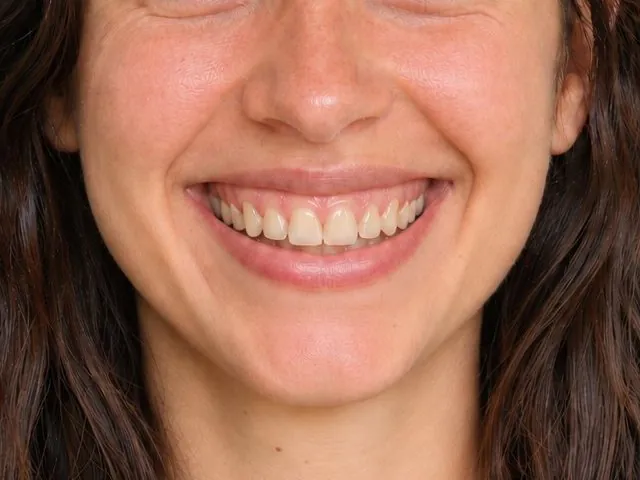
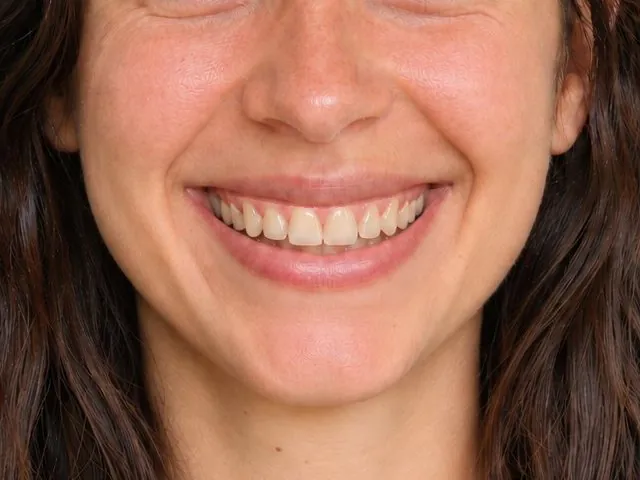
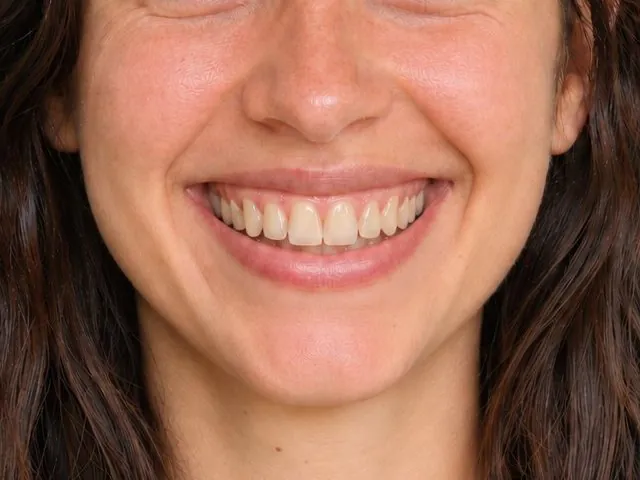
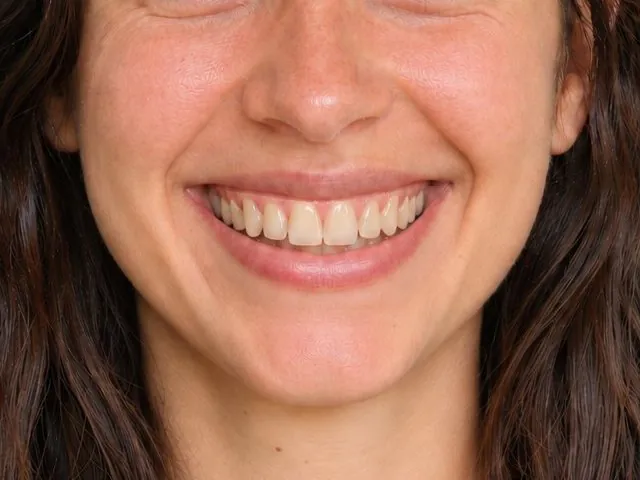 BeforePreview
Made with the online preview on a sample photo
Before & after · Gummy smile treatment
A higher, even gum line and a more balanced smile
A wide band of gum showed above the upper teeth, so the front teeth looked short. After treatment, the gum line sits higher and evenly, and the teeth show their natural length. The right treatment depends on the cause, so we always find the cause first.
How we treat a gummy smile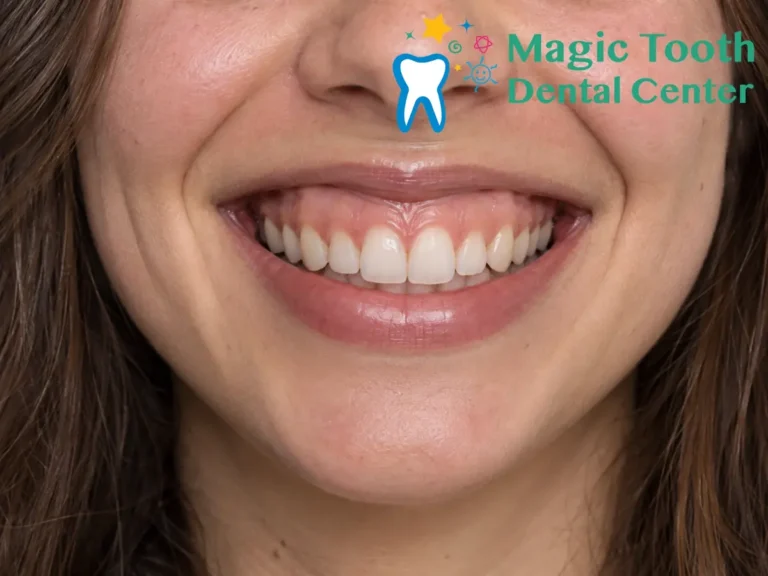 Before
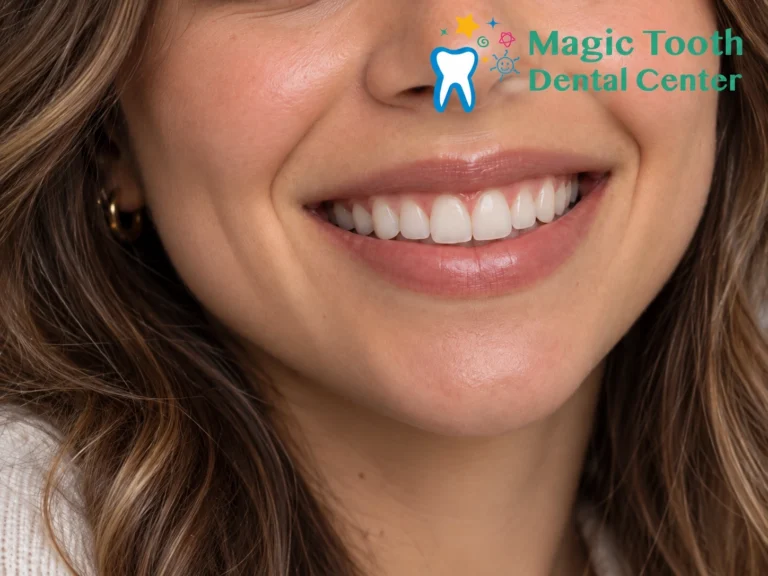 After
Before & after · Combined smile treatment
Open bite, gummy smile and old veneers, treated step by step
This patient came to us with an anterior open bite (the front teeth did not meet), a gummy smile and old, faulty veneers on the upper front teeth that looked opaque and artificial. First, fixed braces closed the open bite. Then surgical lip repositioning reduced how high the upper lip lifts, and crown lengthening gave the front teeth their natural length. Finally, we replaced the old veneers with lithium disilicate ceramic veneers, which let light through like natural enamel, for a natural, youthful smile.
About lip repositioning and gummy smile treatment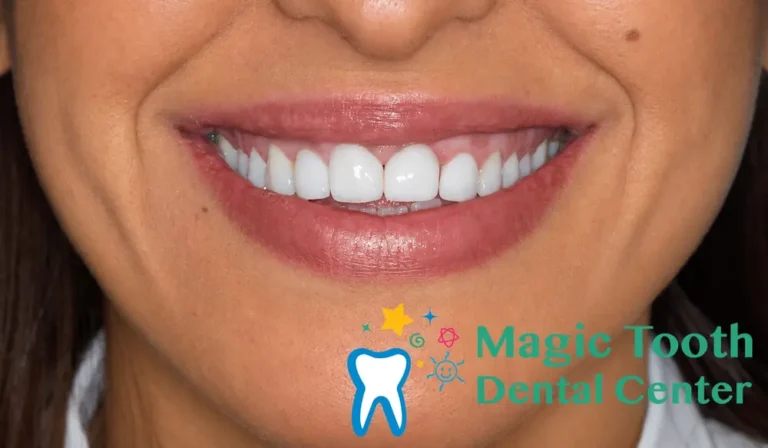 Before
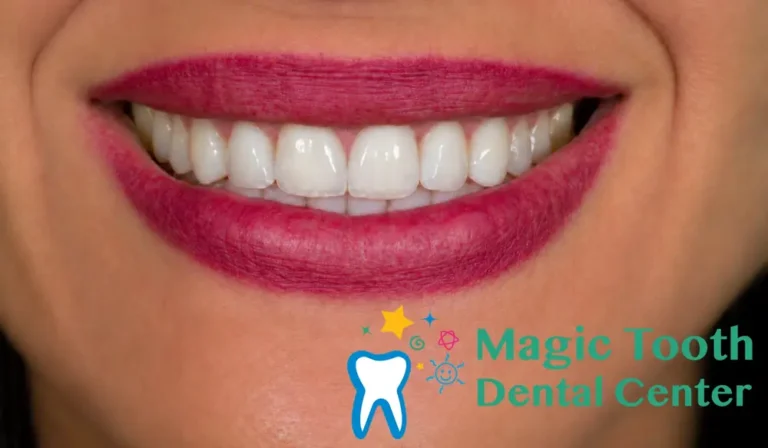 After
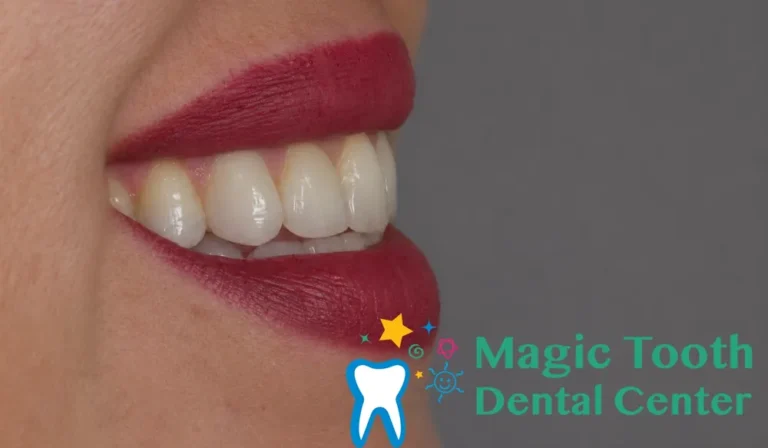 After · side view
Side view
From the side, the edges of the new lithium disilicate veneers sit in harmony with the gum line, so the smile looks as natural in profile as it does from the front.
Before & after · Laser crown lengthening
Longer, better-proportioned front teeth with the Gemini laser
Gum covered part of the two upper front teeth, so they looked short and square. We reshaped the gum around them with the Ultradent Gemini 810 + 980 nm diode laser (laser-assisted crown lengthening). The teeth now show their natural length and the smile looks more balanced. The laser seals the gum as it shapes it, so there is little bleeding, and recovery was fast.
How laser crown lengthening works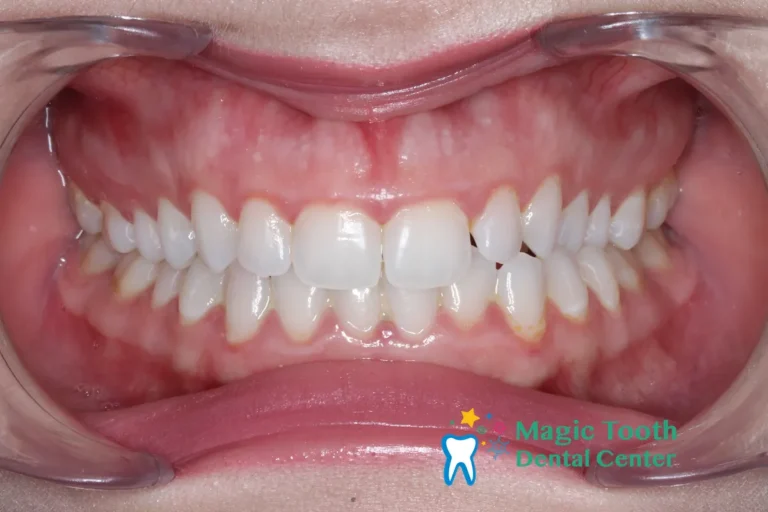 Before
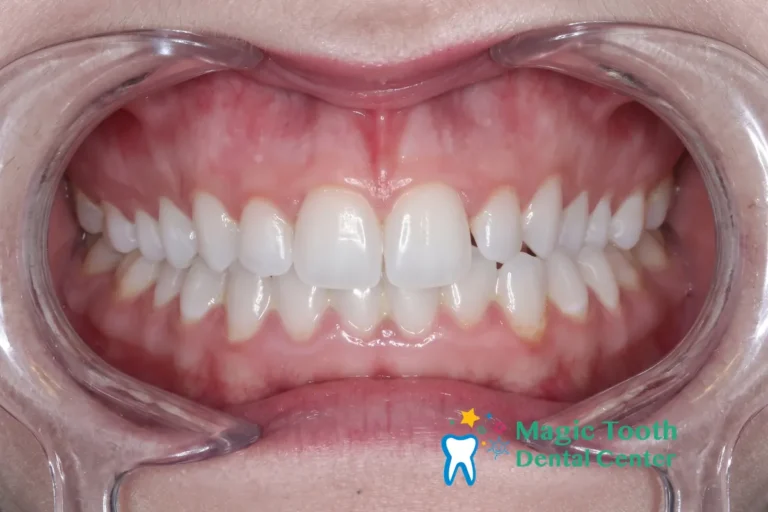 After
Gum treatment · Laser & periodontal surgery · Amman
Healthy gums and a balanced smile with the gentle Gemini dual-wavelength laser and modern gum surgery
From bleeding gums and gum disease to a gummy smile, receding gums or missing bone before an implant, we treat how your gums work and how they look. To reshape gums we use the Gemini 810 + 980 diode laser from Ultradent (USA), which seals as it works, so there is usually less bleeding and often no stitches. Gum grafts and bone rebuilding, however, are done with proven microsurgical techniques.[1][9][11]
- FDA-cleared laser
- Two wavelengths: 810 + 980 nm
- Often no stitches
For adults and teenagers · Your dentist confirms the right treatment after a gum examination
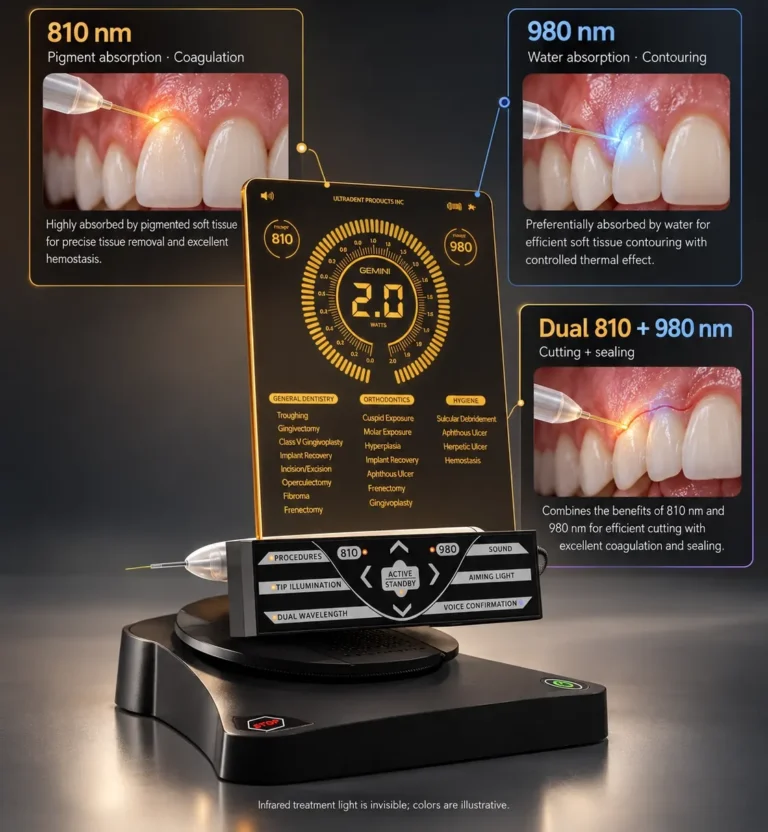
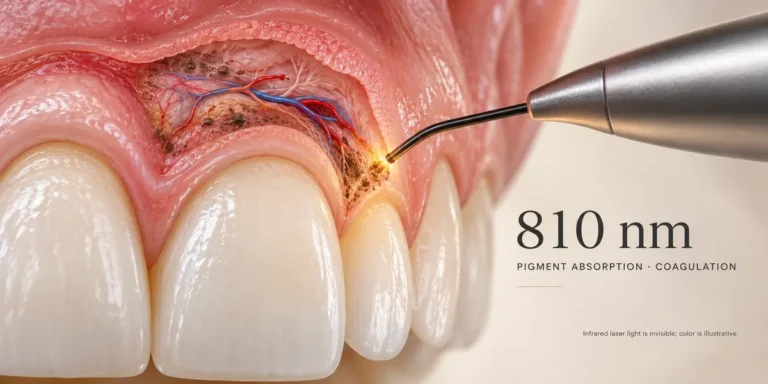
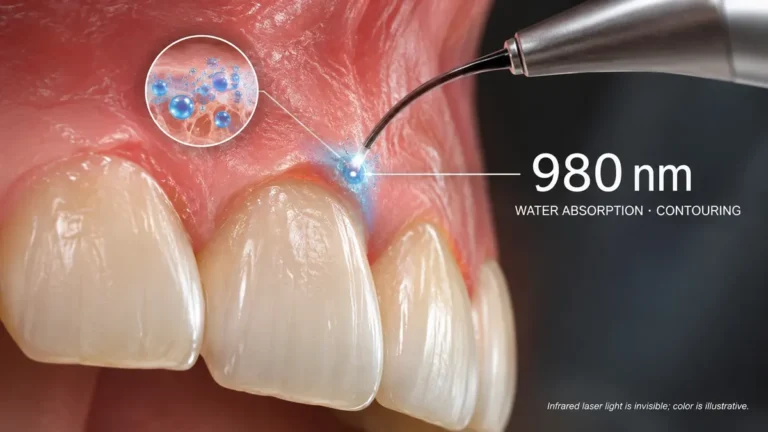
810 nm · the “sealer”
This wavelength is absorbed especially well by the natural pigment (melanin) in gum tissue. So, of the two, it is better at sealing tiny blood vessels as it works, which helps control bleeding.
980 nm · the “sculptor”
In contrast, this wavelength is absorbed strongly by water, which makes up most of the gum. As a result, it is efficient at gently removing and shaping soft tissue.
Dual mode · both at once
Gemini can send both wavelengths through the same fine tip, to target both water and pigment. Its “super-pulsed” light comes in very short bursts with pauses in between, so the tissue can cool between pulses.[1]
Illustration. The treatment light is invisible infrared, so the colors only show which wavelength is active.[1]
A gum specialist on our team
Because gum surgery, grafts and bone regeneration are the specialty of a periodontist, our team includes a consultant periodontist and implantologist.
Honest, evidence-based advice
We use the laser where research shows it helps, and tell you when another treatment is the better choice. See our sources
Start here
Which gum treatment might I need?
Tap the situation that sounds most like yours, then see what usually helps. This is a guide, not a diagnosis, so your dentist confirms the choice after examining your gums.
Gum disease (periodontitis) treatment
It starts with a gum check, then a thorough deep cleaning below the gum line. The laser can help remove inflamed tissue in some pockets, but the cleaning does the main work.
- Deep cleaning first
- Laser where it helps
- Regular maintenance
Gum treatment for a gummy smile
If extra gum covers your teeth, the laser can reshape the gum line, often in a single visit. If the cause is the lip or the jaw, we explain the other options first.
- Cause checked first
- Often 1 visit
- Usually no stitches
Crown lengthening
We uncover more healthy tooth so that a filling or crown can seal properly. If only gum is in the way, the laser can do it; if the bone is too close, a small surgery reshapes it.
- Laser or surgical
- Protects the new crown
Gum graft treatment (connective tissue graft)
A thin layer of your own tissue, usually from the roof of the mouth, is placed under the gum to cover the root and thicken the gum. It is also the best-researched way to cover exposed roots.[18]
- Covers exposed roots
- Thicker, stronger gum
Guided bone regeneration (GBR)
Bone-graft material and a protective membrane give your body the space and time to grow new bone, before or at the same time as the implant.[20]
- 3D scan to measure bone
- Often done with the implant
Laser gum contouring (gingivectomy)
When cleaning has calmed the inflammation, the extra gum is removed and reshaped with the laser. In studies of teenagers with braces, laser gum removal caused less bleeding and pain than the scalpel.[9][10]
- Less bleeding
- Often no stitches
- Suitable for teens
A guide only. We confirm the right treatment after examining your gums and, if needed, X-rays or a 3D scan.
Bleeding gums are not normal. If your gums bleed when you brush or floss, have them checked even if nothing hurts. Gum disease is often painless in its early stages, but early treatment is simpler.
Don’t wait if it’s urgent. A painful swelling on the gum, pus, a fever, or a tooth that has suddenly become loose should be checked promptly, so call or WhatsApp us the same day.
Gemini 810 + 980 diode laser · Ultradent, USA
Light that shapes and seals gum tissue
A diode laser sends a concentrated beam of light through a fine, flexible fiber. When the light reaches the gum it is absorbed and turns into controlled heat, which removes or reshapes a very thin layer of soft tissue and seals small blood vessels at the same time.[1]
Why two wavelengths?
Most dental diode lasers have a single wavelength. Gemini, however, was the first dual-wavelength soft-tissue diode laser available in the United States. It combines 810 nm, which is well absorbed by pigment and is strong at sealing, with 980 nm, which is well absorbed by water and is efficient at cutting. The dentist can use either one, or both together, to suit each procedure.[1]
According to the manufacturer, its “super-pulsed” design delivers energy in very short bursts with rest periods in between, letting the tissue cool between pulses, which is meant to limit heat spreading to nearby tissue.[1]
- 810 nmpigment · sealing
- 980 nmwater · cutting
- 3modes: 810, 980 or both
- FDAcleared for soft tissue
What the laser can and cannot do
- Reshape and contour the gum line
- Remove overgrown gum
- Lengthen teeth when only gum is in the way
- Remove inflamed tissue lining gum pockets
- Release a tight lip or tongue tie (frenectomy)
- Soothe painful mouth ulcers[1]
- Cut or reshape bone or teeth: it is a soft-tissue laser
- Replace deep cleaning in gum disease[4]
- Build new gum or bone on its own: that needs grafts
Less bleeding
The light seals small blood vessels as it works, so the area stays clearer and there is usually less bleeding during and after treatment.[9][11]
Often no stitches
After laser gum reshaping, the area usually heals without stitches because the laser seals as it works. In fact, in one clinical trial, none of the laser cases needed them.[11]
Often less soreness
In studies comparing it with the scalpel for gum reshaping, patients usually reported less pain during the first few days.[9][10]
Fine, controlled shaping
A fine tip removes thin layers at a time, so we can create an even, natural-looking gum line around each tooth.
Pulses that let tissue cool
Short bursts with pauses in between are designed to limit heat build-up in the surrounding tissue, according to the manufacturer.[1]
Sometimes just a numbing gel
For very small procedures, a numbing gel may be enough instead of an injection. In one trial, about 1 in 6 laser procedures needed an injection, compared to 9 in 10 done with a scalpel.[11]
Honest advice: a laser is a tool rather than a treatment plan. Also, it works on soft tissue only. For gum disease, European treatment guidelines found too little evidence to recommend lasers routinely on top of deep cleaning, so we never use the laser instead of cleaning.[4][5]
Safety first: during laser treatment you, your dentist and the assistant all wear protective glasses, the area is numbed, and the settings are chosen for each procedure. The laser also only works on the soft tissue it touches.
Laser vs scalpel
Why we use the laser for gum treatment
For soft-tissue procedures such as gum contouring, this is how the diode laser compares with a traditional scalpel in clinical studies. For bone work and grafts, however, surgical instruments remain the right tool.
| For gum reshaping | Gemini diode laserlight that cuts and seals | Scalpeltraditional surgical blade |
|---|---|---|
| Bleeding | Less during and after, as small vessels are sealed[9][11] | More; controlled with pressure, a dressing or stitches |
| Stitches | Usually none[11] | Often needed |
| Numbing | Always used; for very small procedures a gel may be enough[11] | Local anesthetic injection |
| Soreness in the first days | Usually less[9][10] | Usually more, especially on days 1 to 3[10] |
| Result after 6 months | Similar[10][12] | Similar |
| Reshaping bone | Not possible: soft tissue only[2] | Yes, with surgical instruments |
| Best for | Gum contouring, overgrown gums, soft-tissue crown lengthening, frenectomy, inflamed pocket lining | Gum grafts, bone reshaping, flap surgery, bone regeneration |
Most comparison studies were in teenagers and young adults having gum reshaping around braces, so results can differ for other procedures and people.[9][10][12]
Functional gum treatment · gingivitis & periodontitis
Gum disease treatment: stopping the quiet cause of tooth loss
It starts as gingivitis, when plaque bacteria along the gum line make the gums red, swollen and quick to bleed. If caught early, this is fully reversible. If left alone, it can become periodontitis, where pockets form around the teeth and the bone that holds them slowly breaks down. In fact, severe gum disease affects around 1 in 5 adults worldwide.[3]
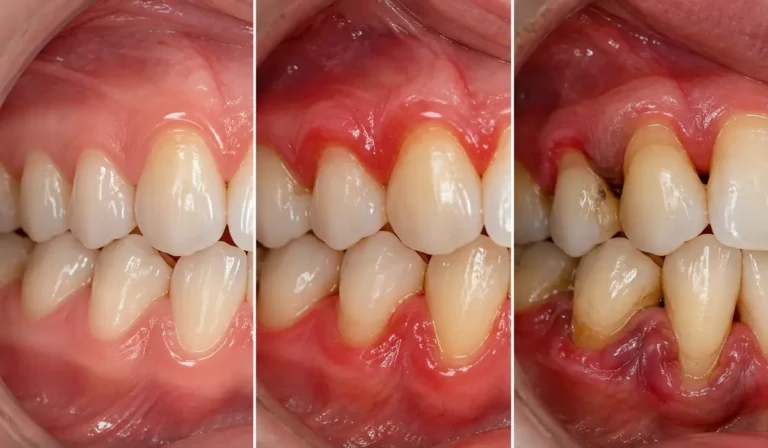 Healthy
Gingivitis
Periodontitis
Healthy: the gum fits snugly around the tooth, while the bone sits high, holding the tooth firmly.Gingivitis: plaque at the gum line makes the gum red, puffy and quick to bleed. The bone is still intact, so this stage can be reversed.Periodontitis: a pocket opens between gum and tooth, tartar builds up on the root and bone is lost. Treatment can stop it, but lost bone does not grow back by itself.
Illustrative photos.
Signs to look out for
- Gums that bleed when you brush or floss
- Red, swollen or tender gums
- Bad breath or a bad taste that keeps coming back
- Gums pulling back from the teeth
- Loose teeth, or front teeth that drift and spread apart
- Pus or a swelling (abscess) on the gum
Smoking and diabetes both raise the risk. Smoking can also hide the warning signs, because it reduces gum bleeding.
Gum disease treatment, step by step
Gum check
We measure the pockets around every tooth and also take X-rays, or a 3D scan, to see the bone.
Daily care & cleaning
We show you how to clean between your teeth then remove plaque and tartar above the gum with our gentle air-polishing clean.[4]
Deep cleaning under the gum
With local anesthetic, we then clean the root surfaces inside the pockets. Where useful, the laser also removes the inflamed lining.[4]
Re-check, surgery if needed
A few weeks later we measure again. Deep pockets that still remain may need gum surgery, sometimes with regeneration of lost bone.[4]
Keeping it under control
After that, regular gum-care visits, at intervals set for you (often every 3 to 6 months), help keep the disease from coming back.[4]
of adults worldwide have severe gum disease[3]
people are living with severe gum disease[3]
average fall in HbA1c (long-term blood sugar) 3 months after gum treatment, in people with diabetes[8]
Where the laser fits in gum disease: the Gemini laser is cleared for removing inflamed tissue inside gum pockets. However, research on its extra benefit is mixed. European guidelines advise against routine use on top of deep cleaning, while a review of studies in people with diabetes found extra improvement when a diode laser was added. So we decide tooth by tooth.[2][4][6]
Gums and diabetes are linked both ways. People with diabetes are more likely to get gum disease, and gum disease also makes blood sugar harder to control. Gum treatment is safe and effective for people with diabetes, so let us know about it, and tell your doctor about your gums.[8]
Cosmetic gum treatment
A gummy smile, and the right gum treatment for it
A smile is called “gummy” when a lot of gum shows above the upper teeth. It is common and harmless, but some people feel self-conscious about it. The right treatment depends entirely on the cause, so we always find the cause first.[23][25]
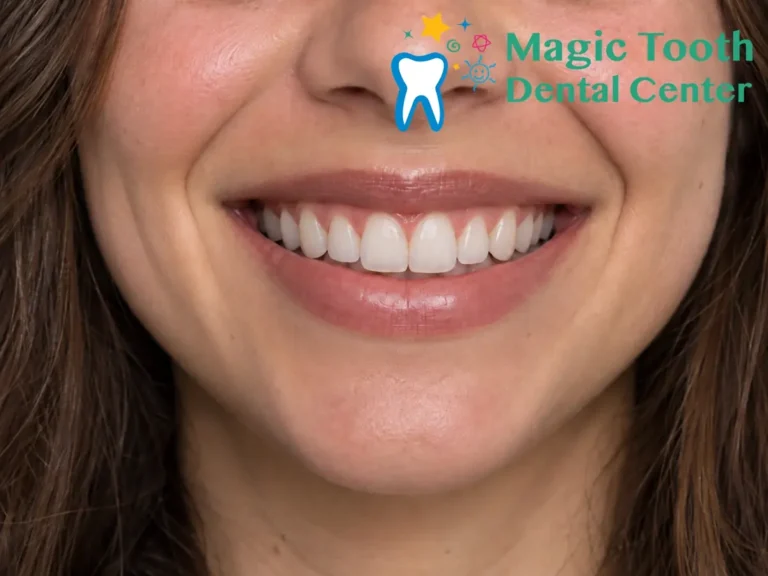
Before: a wide band of gum shows above the upper teeth, and the front teeth look short.After: the gum line sits higher and evenly, so the teeth look longer and the smile more balanced.
Magic Tooth patient photos. Results vary from person to person, and the right treatment depends on the cause.
When extra gum is the cause
Often the gum did not move back fully as the adult teeth came in (dentists call this “altered passive eruption”), so the teeth look short. If there is enough distance between the gum edge and the bone, the Gemini laser can reshape the gum line in one visit, usually without stitches.[15]
If the bone sits too close to the gum edge, the gum would simply grow back. Then a small surgery also reshapes the bone, so the new gum line stays where we put it. We measure this before treatment, so you know which you need.[13][15]
Gum covers part of the teeth
Treated with laser gum contouring, or crown lengthening with bone reshaping when the bone is too close.[15]
The upper lip lifts very high
Lip repositioning surgery removes a thin strip of tissue inside the upper lip so it lifts less. Reviews report about 3 mm less gum on show at 6 months, with some relapse over the following year. Temporary, non-surgical muscle-relaxing injections are another option some people choose.[16][17]
The upper jaw is longer than usual
Small differences can be helped by orthodontics, whereas larger differences need jaw surgery with a maxillofacial surgeon, and we will refer you.
The teeth are short or worn
Crown lengthening as well as ceramic veneers or crowns restores natural tooth length and proportions.
Many smiles have more than one cause. For example, a plan might combine laser gum contouring with whitening, veneers or braces. We show you what is possible before anything is done.
Functional & cosmetic · Crown lengthening
Crown lengthening: gum treatment that uncovers more tooth
Crown lengthening shows more of a tooth by moving the gum, and sometimes the bone, a little higher. It is done to save a tooth that is broken near the gum, to give a new crown enough tooth to grip, or to even out short teeth and an uneven gum line.[14]
Why does the gum need space?
Your gum attaches to the tooth just above the bone, forming a natural seal a few millimeters tall. Dentists call it the supracrestal tissue attachment (you may have heard the older name, “biologic width”).[13]
If the edge of a filling or crown sits inside this seal, the gum around it tends to stay inflamed and bone can be lost. Crown lengthening recreates that space first, so the new crown can last.[13]
Patience pays off. After crown lengthening the gum can creep back a little, mostly in the first three months. For front teeth we usually let it settle before making the final crown or veneer, so the result matches your other teeth.[14]
Soft-tissue (laser) crown lengthening
When there is already enough distance to the bone, the laser removes and reshapes the gum only. Usually no stitches, and quick to heal.[2]
- Short or uneven front teeth with healthy bone
- Preparing teeth for veneers or crowns
- Reaching a cavity just under the gum
Surgical crown lengthening (gum and bone)
When the bone is too close, the gum is gently lifted, a little bone is reshaped with fine instruments, and the gum is stitched back at its new level.[14]
- Teeth broken well below the gum
- Bone sitting too close to the gum edge
- Gummy smiles that need bone reshaping
Gum treatment or a crown?
Gum treatment first, then the crown
The word “crown” can be confusing, because it is used in two ways. Crown lengthening is gum treatment around your own tooth. In contrast, a dental crown is a cap made to cover and protect a tooth. They fix different problems, but often work best together. Tap what you are noticing:
Teeth that look short: gum treatment first
If extra gum is covering teeth of normal size, laser gum contouring or esthetic crown lengthening reveals more of your own tooth. Nothing is drilled, so your natural enamel is kept.[15][23]
Usually not needed if the teeth are healthy and you like their shape and color. However, crowns or veneers placed on gum-covered teeth can end up looking short and square.
- Measure the gum and the bone
- Reshape the gum line
- Whitening or veneers later, only if you want them
An uneven gum line: gum treatment, then veneers if you want them
If only a few teeth are uneven, reshaping the gum around them can even out the line. Where the gum has shrunk back, a gum graft can also cover the root again.[18][22]
Considered when the teeth themselves need a big change in shape, color or structure. However, a crown cannot move the gum. Gum-colored porcelain can hide a gap, but it is harder to clean, so we prefer to rebuild real gum where we can.
- Find out why the gum line is uneven
- Level the gum, with the laser or a graft
- Then plan any veneers or crowns to match
A broken or decayed tooth: crown lengthening, then the crown
Crown lengthening uncovers a collar of healthy tooth, ideally about 1.5–2 mm tall, for the crown to grip. It also keeps the crown edge out of the gum’s natural seal.[13][24]
A crown restores and protects a weak tooth. But if its edge has to sit deep under the gum to reach solid tooth, the gum around it tends to stay red, bleed easily and lose bone.[13]
- Check that the tooth can be saved
- Crown lengthening, if needed
- Let the gum settle, then make the final crown
Sometimes gently raising the root with braces, or an implant, is a better choice than surgery. Either way, we will tell you honestly.[24]
Gum shrinking around a crown: find the cause first
In suitable cases, a connective tissue graft can cover the exposed root and the dark crown edge, and thicken the gum so it is less likely to shrink again.[18][19]
However, a new crown on its own does not stop the gum shrinking. In fact, pushing the new edge deeper to hide it can irritate the gum.
- Find the cause: hard brushing, thin gum or gum disease
- A gum graft, if it suits your case
- Replace the crown once the gum is stable, if needed
Bleeding gums or bone loss: gum treatment before any crown
Gum disease treatment, starting with deep cleaning, controls the infection and also protects the bone that holds your teeth.[4]
No crown, whether porcelain, zirconia or metal-ceramic, treats gum disease. Crowns made while the gums are inflamed may fit less well and look worse.
- Treat the gums
- Re-check that they have healed
- Then crowns, veneers or implants
Why healthy gums help a crown last
Room for the gum’s seal
The crown edge stays out of the few millimeters of gum that seal the tooth, so the gum stays calm and healthy.[13]
A firm grip
About 1.5–2 mm of solid tooth all the way round (the “ferrule”) helps the crown and tooth resist breaking.[24]
Easy to keep clean
A crown edge at, or just under, a healthy gum line is also easy to reach with your toothbrush and floss.
Your own enamel first
When “short” teeth are really teeth hidden by gum, reshaping the gum can avoid crowns altogether.[23]
Choosing the crown itself? If so, read our crowns & veneers and cosmetic & restorative guides.
Functional & cosmetic · Receding gums
Gum graft treatment for receding gums
When gums recede, part of the root is left exposed. The root can feel sensitive, wears and decays more easily than enamel, and makes the tooth look longer. Several things can play a part, including brushing too hard, thin gums and gum disease.[13]
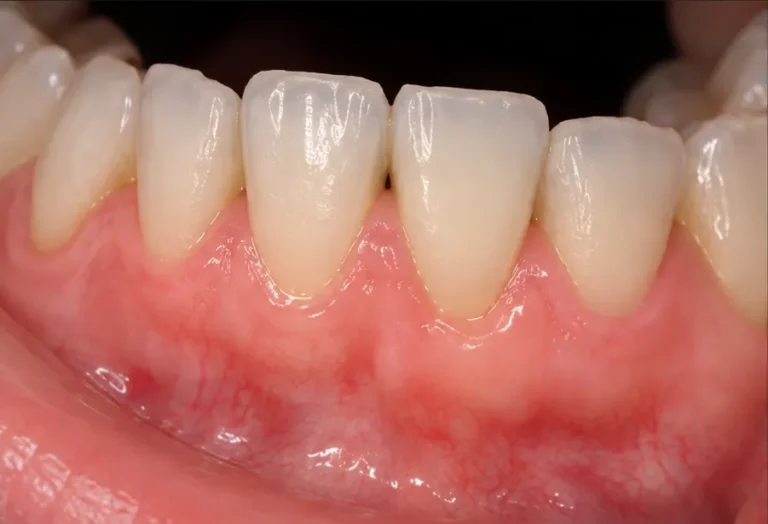
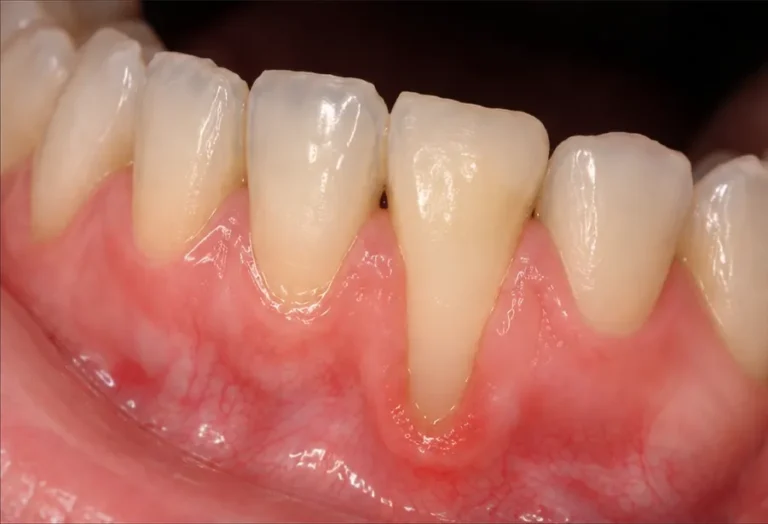
Before: the gum has shrunk back on one lower front tooth, leaving a long section of root exposed. It can feel sensitive, and the tooth looks longer than its neighbors.After a gum graft: the root is covered again and the gum line is even, so the tooth looks its natural length.
Magic Tooth patient photos. How much of the root can be covered depends mostly on the bone and gum between the teeth.
How a connective tissue graft works
A thin piece of connective tissue, usually taken from just under the surface of the roof of your mouth, is slipped under the gum around the exposed root. The gum is then moved up over it and held with very fine stitches. As it heals, the graft joins your own gum, covering the root while making the gum thicker.
In large reviews of the research, moving the gum up together with a connective tissue graft gave the best root coverage of all the techniques studied.[18][19]
Honest note: this is delicate microsurgery done with fine surgical instruments rather than the laser.
Covers the root
Bringing the gum back over the root protects it and also makes the tooth look its natural length again.[19]
Thicker, sturdier gum
Graft-based techniques also increase the band of firm gum around the tooth, which is more resistant to further recession.[19]
Often less sensitivity
Exposed roots are what usually make teeth sensitive, so covering them can make cold drinks and brushing more comfortable.
Will the roof of my mouth hurt? The area the graft is taken from is usually the most tender part for a few days, so we give you a plan for pain relief and soft foods. In some cases a collagen substitute can be used instead, although your own tissue still gives the most predictable root coverage. Smoking reduces the results, so stopping helps.[18][19]
Functional · Before or with dental implants
Guided bone regeneration: rebuilding bone for implants
After a tooth is lost, the jawbone around it slowly shrinks, and gum disease or infection can also destroy bone. However, an implant needs enough bone all around it. Guided bone regeneration (GBR) is a well-established way to rebuild it when it is missing.[20]
How it works
Gum grows faster than bone. If gum fills a gap first, bone has no room to grow. In GBR the gap is filled with bone-graft material that acts as a scaffold, then covered with a thin membrane that keeps the faster-growing gum out. Meanwhile, underneath, your own bone cells gradually fill the space with new bone.[20]
It can be done at the same time as the implant, or a few months before it when more bone is needed. Overall, studies of implants placed in rebuilt bone found survival similar to implants in natural bone, at roughly 92% to 100%.[21]
Honest note: GBR is surgery with fine instruments, graft materials and membranes. The laser, however, does not build bone.
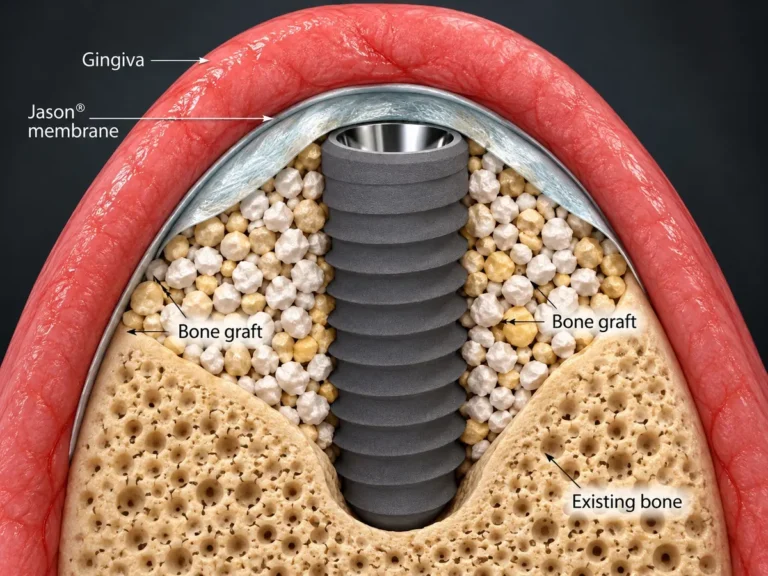
Tap a number on the picture, or a name above, to see what each part does.
1. Gum
The gum is stitched closed over the area, so the graft can heal undisturbed underneath. The gum itself usually heals within 1–2 weeks.
2. Membrane
A thin barrier membrane covers the graft and keeps the faster-growing gum out, so bone has time to fill the space. Collagen membranes like this one are absorbed by the body over time, so they usually do not need removing.
3. Bone graft
Graft granules fill the gap beside the implant and act as a scaffold. Over the following months, your own bone cells grow into it and new bone gradually forms around the granules.
4. Implant
The implant is anchored in your existing bone. Because part of the bone wall is missing, some of its threads are exposed, so the graft rebuilds bone around them.
5. Existing bone
Your own jawbone holds the implant firmly. It also supplies the blood vessels and cells that build new bone into the graft.
How it heals
- The bone gap: part of the bone wall is missing, so some of the implant threads have no bone around them.
- Graft and membrane: bone-graft granules fill the gap, and a membrane covers them to keep the faster-growing gum out.
- New bone: over the following months your own bone grows into the scaffold, and the implant ends up fully surrounded.
Illustration, not to scale. The gum is closed over the area while it heals.
Planned in 3D
A 3D (CBCT) scan shows how much bone you have and exactly where more is needed before surgery.
The right graft for you
Depending on your case, the graft may be your own bone, a specially processed natural bone mineral, or a synthetic material. We then explain which we recommend and why.[21]
A clear timeline
When bone is rebuilt before the implant, it usually needs a few months to mature. Your written plan shows each step and when it happens.
Planning an implant? If so, read our dental implants page and the step-by-step implant guide.
At a glance
Compare all six gum treatments
Filter by what matters to you. Recovery times are typical, but yours may be shorter or longer.
Laser gum contouring
Removes and reshapes extra or overgrown gum.
- The laser’s role
- The main tool
- Stitches
- Usually none
- Usual recovery
- Tender for a day or two
Gum treatment for a gummy smile
Shows less gum and more tooth when you smile.
- The laser’s role
- When extra gum is the cause
- Stitches
- None with the laser; yes if bone or lip surgery is needed
- Usual recovery
- 1–2 days with the laser; 1–2 weeks after surgery
Crown lengthening
Uncovers more healthy tooth for a filling or crown, or evens out short teeth.
- The laser’s role
- When only gum is in the way; bone needs surgery
- Stitches
- None with the laser; yes when bone is reshaped
- Usual recovery
- A few days to 2 weeks; the final crown waits for the gum to settle
Gum disease treatment
Controls the infection and protects the bone around your teeth.
- The laser’s role
- An optional helper, never instead of cleaning
- Stitches
- None for deep cleaning
- Usual recovery
- Tender for a few days, then regular maintenance visits
Connective tissue graft
Covers exposed roots and thickens thin gum.
- The laser’s role
- Not used for the graft itself
- Stitches
- Yes, fine stitches for 1–2 weeks
- Usual recovery
- Roof of the mouth tender for a few days; soft food for a week or two
Guided bone regeneration (GBR)
Rebuilds missing bone, usually so a dental implant can be placed.
- The laser’s role
- Not used: the laser does not build bone
- Stitches
- Yes
- Usual recovery
- Gum heals in 1–2 weeks; new bone matures over several months
Words you may hear, in plain language
- Periodontist
- A dentist who specializes in the gums and the bone around the teeth.
- Gingivitis
- Early gum inflammation: red gums that bleed easily. It can still be fully reversed.
- Periodontitis
- Gum disease that has started to damage the bone that holds the teeth.
- Gum pocket
- A gap between gum and tooth where bacteria collect. Deeper pockets generally mean more disease.
- Gingivectomy
- Removing extra gum, often with the laser.
- Crown lengthening
- Uncovering more of a tooth by moving the gum, and sometimes the bone.
- Biologic width
- The gum’s natural seal just above the bone. Dentists now call it the supracrestal tissue attachment instead.
- Ferrule
- The collar of solid tooth that a crown wraps around and grips.
- Connective tissue graft
- A thin layer of your own tissue, usually from the roof of the mouth, placed under the gum.
- Guided bone regeneration
- Graft material under a protective membrane, so that new bone can grow.
Your visit
What to expect from gum treatment
This is how a typical visit goes. Your own plan may differ, and we explain every step before we start.
Check and plan
We examine your gums and measure the gum and bone levels. For cosmetic work, we also take photos and plan the new gum line with you.
Comfort and safety
The area is numbed with a gel or a small injection, and then everyone puts on laser-safety glasses.
Laser treatment
A few minutes for one tooth, longer for a whole smile line. You may notice a faint smell while the tissue is treated.
Home the same day
Most people return to normal activities straight away. The area may feel tender for a day or two.
Review
We then check the healing at a follow-up visit. Meanwhile, the gum keeps maturing over the next few weeks.
Detailed planning
X-rays or a 3D scan, careful measurements, and a written plan with timing and costs.
Local anesthetic
The area is fully numbed: you are awake but comfortable. Feeling nervous? Ask us about laughing gas.
The procedure
Fine instruments and very small stitches. How long it takes depends on how many teeth are treated, but we tell you beforehand.
The first week
Some swelling and soreness, usually worst during the first 2 to 3 days. Cold packs, soft food and the medicines we prescribe all help, especially early on.
Stitches out, then healing
Stitches then usually come out after 1 to 2 weeks. Gums settle over weeks, while new bone matures over months.
After laser treatment
- Choose soft, lukewarm food for a day or two, and avoid very spicy, hot or crunchy food on that area until it heals.
- Brush gently around the treated area while keeping the rest of your mouth clean as usual.
- Use simple pain relief if you need it, as we advise.
After gum or bone surgery
- Do not brush or floss the treated area until we tell you to; use the mouthwash we prescribe.
- Avoid smoking, because it slows healing and reduces the results of grafts.[19]
- Call us if bleeding does not stop with gentle pressure, if swelling increases after day 3, or if you have a fever.
Always follow the written aftercare instructions we give you, because they are tailored to your treatment.
FAQs
Questions patients ask about gum treatment
Can’t find your question? Call us on 06 593 7076 or send us a WhatsApp message.
Does laser gum treatment hurt?
The area is numbed first, so you should not feel pain during treatment. Afterwards most people feel mild tenderness for a day or two. In studies comparing the laser with the scalpel for gum reshaping, patients generally reported less pain in the first days.[9][10]
Low-power laser light applied after gum surgery has also been linked with less pain in the following days, although the evidence is still limited.[7]
Is the Gemini laser safe?
Yes, when used correctly. It is also cleared by the US FDA for soft-tissue dental procedures. It only affects the soft tissue it touches and cannot cut teeth or bone, and everyone in the room wears protective glasses during treatment.[2]
Will I need stitches after gum treatment?
Usually not after laser gum reshaping, because the laser seals the tissue as it works. Gum grafts, surgical crown lengthening and bone regeneration do need fine stitches, which usually come out after one to two weeks.[11]
Can children and teenagers have laser gum treatment?
Yes, for suitable procedures such as removing overgrown gum around braces, or releasing a tight lip or tongue tie. In fact, most studies comparing laser and scalpel gum reshaping were done in teenagers with braces. Our pediatric dentistry team will advise what suits your child.[9][12]
Can laser treatment cure gum disease on its own?
Can gum disease come back after treatment?
Yes, because periodontitis is a long-term condition. However, daily cleaning between the teeth, not smoking and regular maintenance visits keep it under control for most people.[4]
Is gum disease linked to diabetes?
Yes, in both directions. People with diabetes are more likely to get gum disease, and gum inflammation also makes blood sugar harder to control. In fact, in people with diabetes, gum treatment lowered HbA1c by about 0.3 to 0.5% on average after three months.[8]
Will my gums grow back after gummy smile treatment?
Does a gummy smile always need surgery?
Can I have whitening or veneers after gum contouring?
Yes. In fact, gum contouring is often the first step of a smile makeover, followed by whitening or ceramic veneers. We let the gum settle first, especially around front teeth, so the final result lines up.[14]
Why do I need crown lengthening before my new crown?
When a break or cavity reaches the gum, there is not enough solid tooth above the gum for a crown to grip. A crown edge pushed deep under the gum also sits inside the gum’s natural seal, where it keeps the gum inflamed. Crown lengthening uncovers a collar of healthy tooth, ideally about 1.5–2 mm tall, so the crown holds firmly and the gum around it stays healthy.[13][24]
How soon after crown lengthening can I have my final crown?
It depends on the type. For example, after laser-only gum reshaping, the gum settles quickly. When bone is reshaped, we usually wait at least 6 weeks for back teeth and around 3 months for front teeth, because the gum line can shift a little while it heals. If needed, you wear a temporary crown in the meantime.[14]
Can’t a longer or deeper crown fix the problem instead?
Sometimes, however, a crown alone is the right answer. But when its edge has to go deep under the gum to reach solid tooth, the gum around it tends to stay red and bleed. Making crowns extra long, or adding gum-colored porcelain to hide an uneven gum line, can also look less natural and be harder to clean. When the real problem is the gum, treating the gum usually gives a healthier, more natural result.[13]
Can I have gum treatment just for the look of my smile?
How long does a gum graft take to heal?
The roof of the mouth is usually tender for a few days. The grafted area looks settled within a few weeks, while the gum keeps maturing and blending in over the following months.
What is the bone graft made of?
How long after bone regeneration can I have my implant?
Does smoking affect gum treatment?
Yes. Smoking raises the risk of gum disease, slows healing and reduces the results of gum grafts. Stopping, even if only for a few weeks around surgery, helps.[19]
When should I contact you urgently?
Contact us the same day for a painful swelling on the gum, pus, a fever, a tooth that has suddenly become loose, or bleeding after treatment that does not stop with steady pressure on a piece of gauze.
Book a gum check
Let’s plan your gum treatment
A gum check shows what is going on below the gum line and which treatment, if any, you need. If you have recent X-rays, bring them along.
Message us in one tap. What would you like to ask about?
- Visit usBuilding 192, first floor, Princess Basmah Street, Abdoun, Amman
- Opening hoursSaturday to Wednesday, 9 am to 7 pm · Thursday, 9 am to 2 pm · Friday closed
- PaymentCash and credit cards, in JOD and USD
Good questions to ask about your gum treatment
- “Is the laser right for my case, or do I need surgery?”
- “How far is the bone from my gum line, and what does that mean for my result?”
- “How many visits will I need, and how long is healing?”
- “Do I need gum treatment before my crown or veneers?”
- “What can I do at home to keep the result?”
References & further reading
Ultradent: Gemini 810 + 980 Soft Tissue Laser, product announcement
Dual-wavelength, super-pulsed soft-tissue diode laser; the first dual-wavelength soft-tissue diode laser in the USA; 810 nm and 980 nm used alone or together. Manufacturer information.US FDA: 510(k) premarket notification K192617, Gemini 810+980 Soft Tissue Laser
Cleared in 2020 for oral soft-tissue procedures, including soft-tissue crown lengthening, reduction of gum overgrowth and removal of inflamed tissue in gum pockets.World Health Organization: Oral health, fact sheet
Severe periodontal disease affects around 19% of adults worldwide, more than 1 billion cases.Sanz M, et al. Treatment of stage I–III periodontitis: the EFP S3 level clinical practice guideline. J Clin Periodontol 2020;47(Suppl 22):4–60
European stepwise treatment guideline; suggests not using lasers as a routine add-on to deep cleaning (recommendation 2.4).Salvi GE, et al. Adjunctive laser or antimicrobial photodynamic therapy to non-surgical mechanical instrumentation in untreated periodontitis. J Clin Periodontol 2020;47(Suppl 22):176–198
Systematic review behind the guideline: few controlled studies and highly variable results for adjunctive lasers.Zhao P, et al. Effect of adjunctive diode laser in the non-surgical periodontal treatment in patients with diabetes mellitus: a systematic review and meta-analysis. Lasers Med Sci 2021;36:939–950
Nine randomized trials: adding a diode laser to deep cleaning gave extra pocket and blood-sugar (HbA1c) improvements at 3 and 6 months.Mikami R, et al. Patient-reported outcomes of laser-assisted pain control following non-surgical and surgical periodontal therapy: a systematic review and meta-analysis. PLoS One 2020;15:e0238659
Low-power diode laser light after gum surgery reduced pain 2–7 days later in two trials; evidence still limited.Sanz M, et al. Scientific evidence on the links between periodontal diseases and diabetes: consensus report of the IDF and EFP. J Clin Periodontol 2018;45:138–149
Two-way link between gum disease and diabetes; gum treatment lowers HbA1c by 0.27–0.48% after 3 months.Maboudi A, et al. Gingivectomy with diode laser versus the conventional scalpel surgery and nonsurgical periodontal therapy in orthodontic treatment-induced gingival enlargement: a systematic review. Photobiomodul Photomed Laser Surg 2023;41:449–459
Seven randomized trials: less bleeding and pain during and after diode laser gum removal than with the scalpel.Rihawi H, et al. Comparison of two treatment modalities in the management of gingival enlargement during orthodontic treatment: a randomized clinical trial. Quintessence Int 2025;56:226–235
Laser and scalpel gum removal gave similar results at 6 months, but pain was higher with the scalpel on days 1 and 3.Ize-Iyamu IN, et al. Comparing the 810 nm diode laser with conventional surgery in orthodontic soft tissue procedures. Ghana Med J 2013;47:107–111
Randomized comparison: fewer anesthetic injections, less bleeding and pain, and no stitches with the 810 nm diode laser.Lione R, et al. Conventional versus laser gingivectomy in the management of gingival enlargement during orthodontic treatment: a randomized controlled trial. Eur J Orthod 2020;42:78–85
In teenagers with braces, laser and scalpel gingivectomy were similarly effective over 6 months.Jepsen S, et al. Periodontal manifestations of systemic diseases and developmental and acquired conditions: consensus report of workgroup 3 of the 2017 World Workshop. J Clin Periodontol 2018;45(Suppl 20):S219–S229
“Biologic width” renamed supracrestal tissue attachment; restoration margins inside it are linked with inflammation; effects of gum recession.Pilalas I, et al. Pre-restorative crown lengthening surgery outcomes: a systematic review. J Clin Periodontol 2016;43:1094–1108
Crown lengthening adds about 1.4–3.3 mm of crown length; the gum may creep back, mostly in the first 3 months.Mele M, et al. Esthetic treatment of altered passive eruption. Periodontol 2000 2018;77:65–83
Review of the causes, classification and treatment of gummy smiles caused by excess gum (altered passive eruption).Dos Santos-Pereira SA, et al. Effectiveness of lip repositioning surgeries in the treatment of excessive gingival display: a systematic review and meta-analysis. J Esthet Restor Dent 2021;33:446–457
Gum display fell by about 2.9 mm at 3 months, but with roughly 25% relapse by 12 months.Mendoza-Geng A, et al. Clinical efficacy of lip repositioning technique and its modifications for the treatment of gummy smile: systematic review and meta-analysis. Clin Oral Investig 2022;26:4243–4261
Thirteen studies: about 3 mm less gum display at 6–12 months, as well as good patient satisfaction.Cairo F, et al. Efficacy of periodontal plastic surgery procedures in the treatment of localized facial gingival recessions: a systematic review. J Clin Periodontol 2014;41(Suppl 15):S44–S62
Fifty-one randomized trials: a coronally advanced flap with a connective tissue graft gave the best root coverage.Chambrone L, Tatakis DN. Periodontal soft tissue root coverage procedures: a systematic review from the AAP Regeneration Workshop. J Periodontol 2015;86(2 Suppl):S8–S51
Connective tissue graft procedures gave the best root coverage and the largest gain in firm gum; however, smoking can affect results.Retzepi M, Donos N. Guided bone regeneration: biological principle and therapeutic applications. Clin Oral Implants Res 2010;21:567–576
How membranes keep soft tissue out so bone can regenerate, before or together with dental implants.Donos N, et al. Clinical outcomes of implants following lateral bone augmentation: systematic assessment of available options. J Clin Periodontol 2008;35(8 Suppl):173–202
Implant survival was 91.7–100% in rebuilt bone, compared to 93.2–100% in natural bone.American Academy of Periodontology: Surgical procedures (patient information)
Plain-language guide to gum grafts, crown lengthening and procedures that help rebuild lost bone and gum.American Academy of Periodontology: Cosmetic procedures (patient information)
How crown lengthening and gum reshaping can correct a gummy smile or an uneven gum line.Juloski J, et al. Ferrule effect: a literature review. J Endod 2012;38:11–19
A 1.5–2 mm collar of tooth (ferrule) improves the fracture resistance of root-treated teeth; when too little tooth is left, raising the root with braces may be preferred to surgery.Tatakis DN, Silva CO. Contemporary treatment techniques for excessive gingival display caused by altered passive eruption or lip hypermobility. J Dent 2023;138:104711
Esthetic crown lengthening and lip repositioning are the established treatments for the two main gum and lip causes of a gummy smile.
Sources checked: 30 October 2026. Links open in a new tab, and the sources themselves are in English. However, research figures describe groups of patients and are not a guarantee for any individual case.
