
Save your natural tooth with gentle, precise root canal treatment Modern rotary files, electronic root measurement, digital X-rays and bioceramic sealers
When the soft tissue inside a tooth (the pulp, or “nerve”) becomes inflamed or infected, root canal treatment removes it, cleans the tiny canals inside the roots and seals them, so you keep your own tooth. We do this with ProTaper® and VDW® rotary files, the J. Morita Root ZX® II apex locator with its OTR handpiece, the Dürr Dental VistaRay 7 digital X-ray sensor and bioceramic sealers.
Root canal treatment · Amman
- FDA-cleared & registered root canal tools
- Brands from the USA, Germany & Japan
- Usually 1–2 visits
- Rubber dam on every root canal
Feeling nervous? Tell us. We’ll explain each step, make sure the tooth is numb before we start, and agree on a signal you can use whenever you need a pause.
For adults and children · Your dentist confirms whether you need a root canal after an examination and X-ray
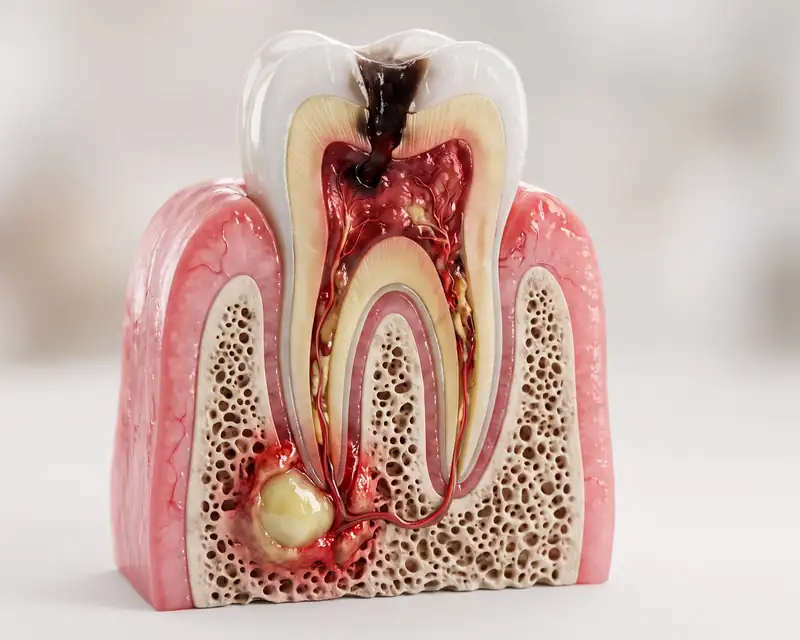
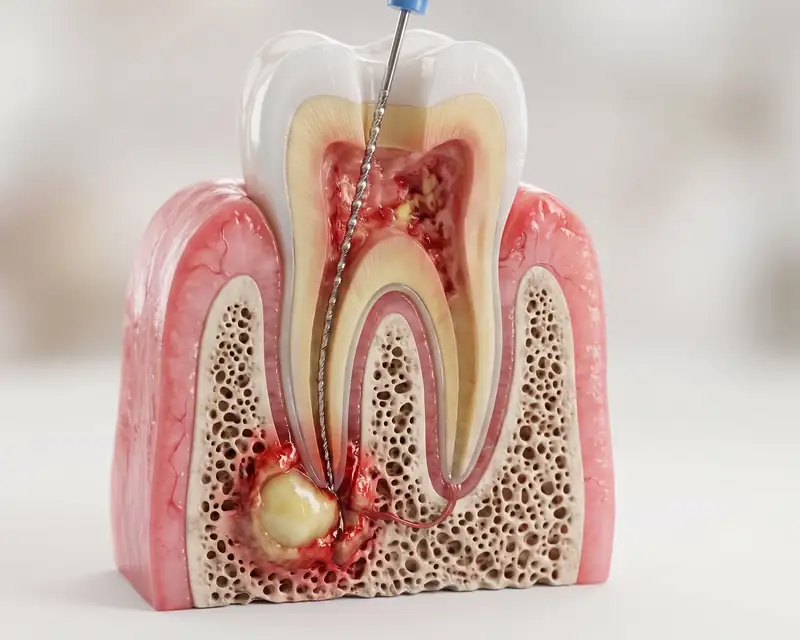
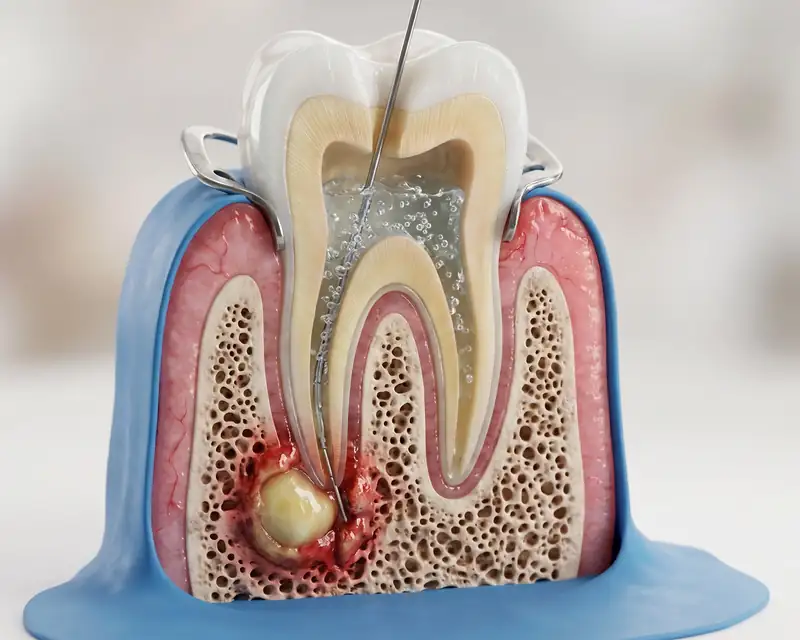
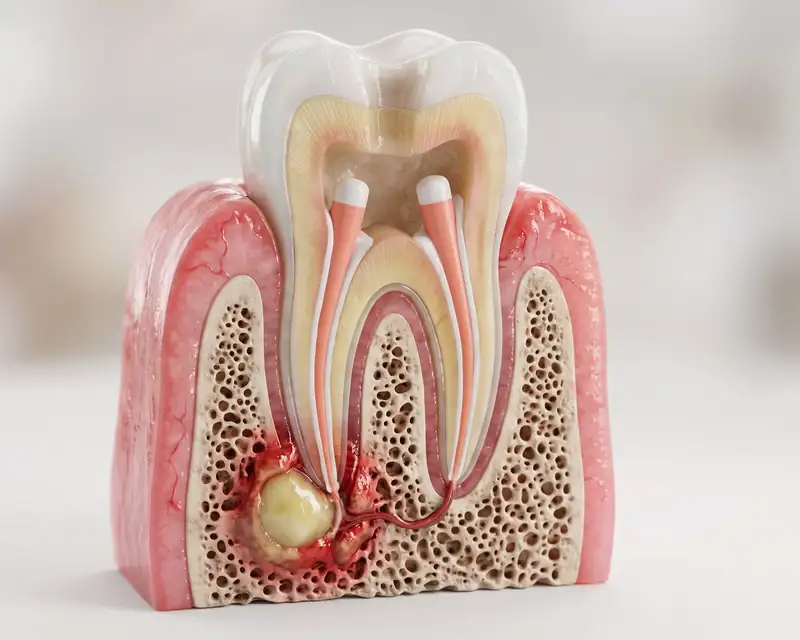
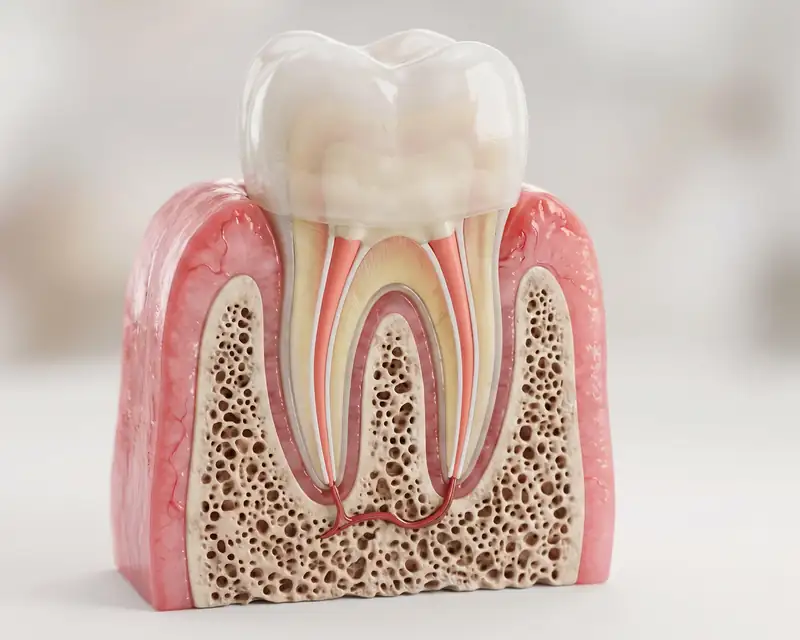
An inflamed or infected nerve
When deep decay, a crack or a knock lets bacteria reach the pulp, it becomes inflamed. This can then cause pain and, at the root tip, an infection in the bone.
Clean and shape the canals
Flexible nickel-titanium rotary files remove the pulp and shape each canal, while an electronic apex locator shows where the root ends.
Disinfect from the inside
Then disinfecting solutions rinse the canals to kill remaining bacteria in places the files cannot reach.
Seal with bioceramic
After that, the clean canals are filled with gutta-percha and a bioceramic sealer that flows into tiny gaps and sets with the moisture inside the tooth.
Rebuild and protect
A filling, onlay or crown restores the tooth so you can chew normally again. Back teeth also usually need a crown.
Illustration of a back tooth with two roots; steps simplified. Afterwards, healing of the bone at the root tip takes weeks to months.
FDA-cleared & registered tools
Our J. Morita Root ZX II apex locator and its OTR handpiece are FDA-cleared, and our ProTaper® and VDW® files are FDA-registered instruments. What this means[19][22][24][25]
The simple explanation
A root canal doesn’t cause pain. It relieves it.
Inside every tooth is soft tissue called the pulp, which contains nerves and blood vessels. Deep decay, a crack or a knock can let bacteria reach it, so the pulp becomes inflamed or infected. In fact, that is what causes the toothache.
Root canal treatment, also called endodontic treatment, gently removes the damaged pulp, cleans and disinfects the narrow canals inside the roots, then fills and seals them. So the goal is simple: stop the problem and keep your own tooth.[1]
- The pulp is the living part of the tooth: nerves and blood vessels
- Usually finished in one or two visits, then a filling or crown
- Afterwards you chew, bite and smile with your own natural tooth[1]
Myth or fact?
Tap a card to see the facts
“Root canal treatment is very painful.”
Most patients are comfortable. Local anesthetic numbs the tooth, so you may feel pressure but not sharp pain. It’s the infection that hurts, and treatment then relieves it.[2]
“It’s easier to just pull the tooth out.”
Usually not in the long run. That is because the gap usually needs an implant or bridge, which means extra visits and can cost more. When a tooth can be saved, keeping it is usually best.[3]
“A root-treated tooth won’t last long.”
Most last for many years. In a US study of 1.46 million teeth, 97% were still in place 8 years later. Also, most of the teeth that were lost had never been given a crown.[9]
“Antibiotics can cure a tooth infection.”
Not on their own, because antibiotics don’t remove the source of the infection inside the tooth. Instead, treating the tooth itself is what solves the problem.[8]
Start here
Signs that a tooth may need root canal treatment
The pulp can become inflamed or infected after deep decay, repeated work on the same tooth, a crack or a knock. So tap any signs you’ve noticed to see what we suggest. The earlier we see a tooth, the easier it usually is to save.[1]
Tap the signs you’ve noticed
We’ll suggest how soon to see us. You can choose more than one.
General guidance only, not a diagnosis. Only an examination and X-ray can tell whether a tooth needs a root canal.
Swelling of your face, a fever, or trouble swallowing or breathing? Call us the same day, and see our emergency dentist page for what to do until you arrive. If swelling is spreading quickly or breathing is difficult, go to the nearest emergency department.
Knocked or broken a tooth? Follow our Tooth Trauma SOS first-aid guide, then call us. Injured teeth sometimes need root canal treatment later, so we check them over time.
Our technology, explained simply
The tools inside your root canal treatment, and what each one does for you
Root canals are tiny, usually narrower than a pencil lead, and they curve and branch inside the root. So these four technologies help us clean every canal fully, measure it exactly and seal it well.
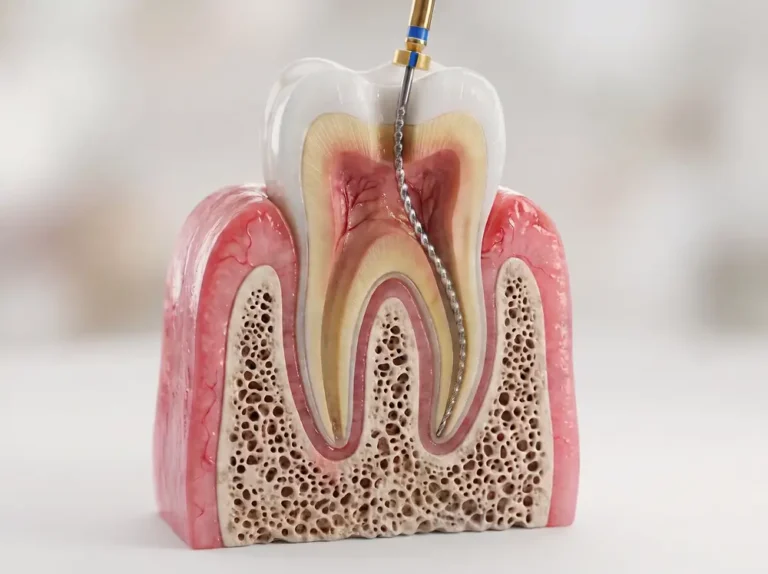
ProTaper® and VDW® rotary files
ProTaper® · Dentsply SironaVDW · Munich, Germany
Our files are made of nickel-titanium, a metal flexible enough to follow a curved root instead of straightening it. A precise electric motor turns them at a set speed and force, so each canal is cleaned and shaped smoothly and evenly.
- Follows curved canals and keeps their natural path
- A smooth, even shape that is easier to disinfect and seal
- In a hospital study of molars, nickel-titanium rotary files caused half as many procedural errors as steel hand files (19% vs 39%), and more teeth healed (77% vs 60%)[12]
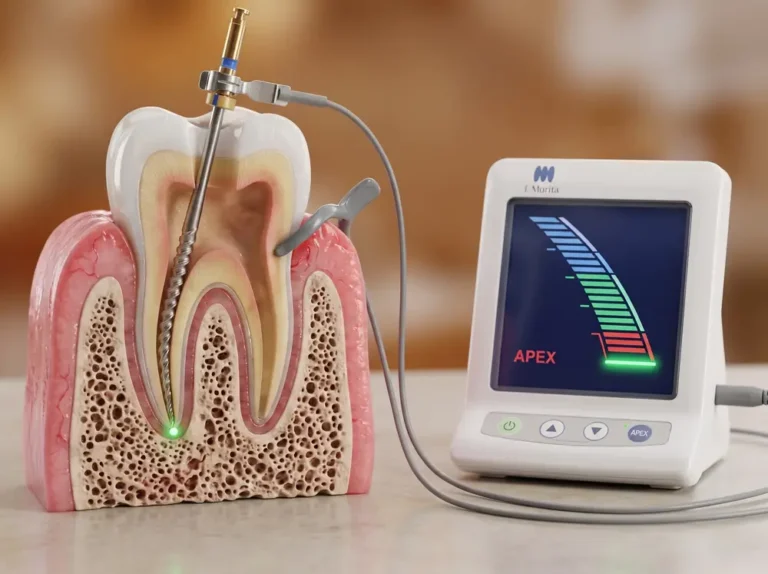
J. Morita Root ZX® II apex locator & OTR handpiece
J. Morita · Japan
Every root has its own length, so we measure each one. Our J. Morita Root ZX® II apex locator uses a very weak electrical signal you will not feel to show on a screen when the file reaches the end of the root. Its OTR handpiece connects to the Root ZX II, so it slows the file down near the root end and stops and reverses it at the measured length. Its OTR motion also turns the file back slightly whenever it meets too much resistance, which helps reduce strain on the file and the chance of it breaking.[30][31]
- Each canal is cleaned and sealed to its full length, no more and no less
- In clinical trials, length measurements were acceptable in 87–92% of cases with apex locators, compared with 74–83% with X-rays alone[13]
- We still confirm the result with a digital X-ray, because research supports using both together[14]
Dürr Dental VistaRay 7 digital X-ray sensor
Dürr Dental · Germany
Our VistaRay 7 is a small sensor, made in Germany, that sits in your mouth and sends the X-ray image straight to our screen. We can enlarge it and adjust the contrast to see fine details, such as the tip of a root canal file inside the root.[32]
- Images in seconds, so we can check each step during your visit
- Digital imaging may need less radiation than traditional film[18]
- For complex roots, our in-clinic 3D CBCT scan can show canals in three dimensions
Fine detail, even at low X-ray doses[32]
Bioceramic sealers & gutta-percha
After cleaning, each canal is then filled with gutta-percha, a rubber-like filling made from a natural tree latex, together with a bioceramic sealer. Bioceramic (calcium-silicate) sealers come ready-mixed, flow into tiny gaps and side branches, and set using the natural moisture inside the tooth.
- Designed to be biocompatible, which means gentle on the tissues around the root
- Ready-mixed, so it is the same consistency every time
- In research reviews, success was at least as good as with traditional sealers, with no extra pain afterwards[16][17]
Root canal sealers: FDA Class II, cleared before sale[23][33]
Also part of careful treatment: a rubber dam (a thin rubber sheet) keeps the tooth clean and dry, disinfecting rinses reach where files cannot, and for hidden or narrowed canals our dental microscope magnifies the view.
Root canal treatment has changed
If you remember an old root canal, today’s treatment is different. So here is what has changed.
Hand files and other traditional methods still have a place, and your dentist chooses what suits your tooth.
Infection control & safety
A rubber dam for every root canal treatment
A rubber dam (also called a dental dam) is a thin, stretchy sheet that isolates the tooth being treated. At Magic Tooth we use one for every root canal treatment, because the American Association of Endodontists considers it the standard of care.[34]
Only the treated tooth shows through
A small clip holds the sheet around the tooth, so saliva stays out of the clean canals, and rinses and tiny instruments can’t reach your mouth or throat.[34]
An open tooth, unprotected
Without isolation, saliva and its bacteria can get into the open tooth, and small instruments or rinses could slip into the mouth. So we never skip this step.[34]
Simplified illustration; the sheet’s color and the clip’s shape vary.
Our rubber dam protocol for root canal treatment
Numb first
We place the dam once the tooth is numb, so you feel only a little pressure from the clip.
Fit the sheet
A small clip holds a thin sheet around the tooth, and a light frame keeps it smooth. As a result, only the tooth being treated shows through.
Seal and check
We check the edges and close any tiny gaps, so saliva can’t leak in around the tooth.
Clean the area
The tooth and the sheet around it are wiped with disinfectant before we open the tooth.
Keep it on until sealed
The dam stays on until the canals are sealed and the tooth is closed. Then it comes off in seconds.
- Breathe and swallow normally. The sheet covers only your mouth, so you breathe through your nose. Tell us if your nose feels blocked.
- Allergic to latex? Tell us before your visit, and we’ll use a latex-free dam.
- Need a break? Raise your hand at any time, and we’ll pause.
The American Association of Endodontists says rubber dam isolation is essential for every non-surgical root canal treatment.[34]
of teeth were still in place about 3½ years after root canal treatment, with a rubber dam compared with without, in a study of 517,234 teeth[35]
of patients in a Saudi study wanted a rubber dam again at their next visit; preventing swallowed instruments was the benefit they valued most[36]
What to expect
Your root canal treatment, step by step
Most treatments take one or two visits. We explain each step before we start, and you can raise your hand at any time if you need a break.
Step 1 of 6
Examination & digital X-ray
We test the tooth, take a digital X-ray with our Dürr Dental VistaRay 7 sensor and, for complex roots, may add a 3D scan. You get a clear plan and cost before treatment begins.
Then we show you the X-ray on screen and explain, in plain words, what is happening and what we plan to do.
Step 2 of 6
Numbing & comfort
Local anesthetic numbs the tooth, so you may feel pressure but should not feel pain. We check that the tooth is numb before we begin. Anxious patients and children can also have laughing gas.[2]
Step 3 of 6
Opening & measuring
With a rubber dam in place, we then make a small opening in the top of the tooth, find each canal and measure its length with the J. Morita Root ZX II apex locator.
Step 4 of 6
Cleaning & shaping
ProTaper® and VDW® rotary files, turned by the OTR handpiece, remove the inflamed or infected pulp and shape the canals. The handpiece slows the file near the root end and stops it at the measured length, while disinfecting rinses wash away bacteria.[31]
Step 5 of 6
Sealing
We fill the canals with gutta-percha and a bioceramic sealer, then check the result on an X-ray. If there is a lot of infection, however, we may place a medicine first and seal at a second visit.
Step 6 of 6
Rebuilding the tooth
A filling, onlay or ceramic crown restores strength and shape. Back teeth also usually need a crown to protect them from cracking.[10]
- Numb before we startWe check that the tooth is numb, and we also add more anesthetic if you need it.
- Raise your hand to pauseYou stay in control and can ask for a break at any time.
- Tell us if anything hurtsPressure or vibration is normal. Pain isn’t, so we pause and adjust.
Caring for a child, or for someone who needs extra support? See our children’s dentistry page and our page on dental care for people with disabilities.
Why save your tooth
Root canal treatment or extraction? Keeping your own tooth is usually best
Nothing works quite like your natural tooth. So here is how saving it compares with taking it out.
Save it with root canal treatment
What the research shows
Root canal treatment: a reliable way to keep your own tooth
Large studies show that root canal treatment works well, and that protecting the tooth afterwards matters just as much.
of first-time treatments were successful one to two years later, across 84 studies[11]
of root-canal-treated teeth were still in place 8 years later, in a US study of 1.46 million teeth[9]
more often lost: root-treated teeth left without a crown, compared with crowned teeth, in one study[10]
days of mild tenderness is typical afterwards, while infection pain usually eases soon[2]
Research figures describe groups of patients and are not a guarantee for any single tooth.
After your visit
After root canal treatment: a little care helps your tooth recover
Always follow the personal advice your dentist gives you. Generally, this is what to expect.[4]
- Right after
While you are still numb
For the first hour, don’t chew or have hot or cold drinks. Take care not to bite your lip, cheek or tongue while they are numb.[4]
- The first few days
Mild tenderness is normal
The tooth may feel sore, especially when biting, usually improving within three to five days. Meanwhile, pain relief taken as we advise is usually enough.[2]
- Until it’s restored
Protect the tooth
Avoid hard food and heavy biting on that side until your final filling or crown is in place. Also keep brushing and cleaning between your teeth. Also call us if a temporary filling comes out or your bite feels high.[4]
- Weeks to months later
Check that it has healed
Keep your review visits. Later, a follow-up X-ray shows whether the bone around the root has healed, which can take weeks to months.
Questions patients ask
Root canal treatment FAQs
Can’t find your question? Call us on 06 593 7076 or send us a WhatsApp message.
How do I know if I need root canal treatment?
Only an examination can tell. So we look at your symptoms, test how the tooth responds to cold and tapping, and take a digital X-ray. Some teeth hurt a lot, while others have no symptoms and show the problem only on an X-ray. If the pulp can still recover, a simpler treatment may be enough.[1]
How many visits does root canal treatment take?
Usually one or two. In fact, many teeth can be cleaned and sealed in one visit. When there is a lot of infection, or the tooth has several curved canals, we may place a medicine inside and finish at a second visit. The filling or crown on top, however, is often a separate appointment.[6]
Wouldn’t it be easier to just pull the tooth?
Removing a tooth can seem quicker, but it leaves a gap that usually needs a bridge or an implant to stop the neighboring teeth from drifting and to keep chewing comfortable. When a tooth can be saved, keeping your own tooth is usually the better long-term choice. If a tooth cannot be saved, however, we will tell you honestly and explain the options.[3]
How long will my tooth last after root canal treatment?
With good care, often for many years. In a US study of 1.46 million teeth, 97% were still in the mouth eight years later. Most teeth that were later lost had never received a crown, which is why we protect back teeth well after treatment.[9]
Can root canal treatment be redone if there is a problem later?
Yes, often. If a treated tooth becomes painful or infected again, for example because of new decay or a leaking filling, it can usually be retreated: the old filling material is removed, the canals are cleaned again and resealed. Otherwise, a small surgical procedure at the root tip is sometimes the better option.[5]
Can antibiotics replace root canal treatment?
Usually, no. Antibiotics don’t remove the source of the infection inside the tooth, so for most toothaches and tooth infections, treating the tooth itself is what solves the problem. In fact, the American Dental Association advises against antibiotics for most of these conditions. They may still be needed if an infection is spreading or you have a fever, and your dentist decides based on your health and examination.[8]
Does root canal treatment hurt?
Modern root canal treatment relieves toothache rather than causing it. According to the American Association of Endodontists, most patients are comfortable during the procedure: with good local anesthesia you may feel pressure or vibration, but not sharp pain.[2]
Is the rubber dam uncomfortable? Can I breathe?
Most people get used to it within a few minutes, because it covers only your mouth, so you breathe normally through your nose and can still swallow, and the tooth is numb before the small clip goes on. In patient surveys, most people also said they would prefer a rubber dam at their next visit. Then, if anything feels tight, raise your hand and we’ll adjust it.[36][37]
I’m nervous. Can I have laughing gas?
Yes. Laughing gas (nitrous oxide) helps many adults and children feel calm while staying awake, and its effect wears off within minutes after the appointment. Read more on our laughing gas page, and tell us about your worries so we can plan short breaks and go at your pace.
What will I feel after root canal treatment?
The tooth may feel tender, especially when biting, for a few days, usually improving within three to five days. Over-the-counter pain relief, taken as we advise, is also usually enough. Call us if you have severe pain, swelling, or pain that keeps getting worse.[2]
What are rotary files, and why are they better than hand files?
They are very fine, flexible nickel-titanium instruments turned by a controlled electric motor. Because they bend, they follow curved canals instead of cutting a straight path through them. In a study of molar treatments, teeth shaped with nickel-titanium rotary files had about half as many procedural errors as those shaped with steel hand files, and they also healed more often.[12]
What is an apex locator, and is it safe?
It is a small device that measures how long each root canal is, using a very weak electrical signal passed through the file. You will not feel it. It tells us when the file has reached the end of the root, so we clean and seal the whole canal without going beyond it. Then we confirm the measurement with a digital X-ray.[13][14]
Are dental X-rays safe?
The radiation from a dental X-ray is low, and digital sensors may need less than traditional film. We follow the ALARA principle (as low as reasonably achievable) and take X-rays only when they help your treatment. If you are, or might be, pregnant, please tell us so we can plan carefully.[18]
What is a bioceramic sealer?
It is a calcium-silicate paste that seals the space between the gutta-percha filling and the canal walls. It also comes ready-mixed, flows into small gaps and sets using the moisture in the tooth. Research reviews found that teeth sealed this way do at least as well as with traditional sealers, without extra pain afterwards.[16][17]
Why do you always use a rubber dam?
It keeps saliva and its bacteria out of the clean canals, stops tiny instruments and disinfecting rinses from reaching your mouth or throat, and gives us a clear, dry view. The American Association of Endodontists calls it the standard of care for every root canal treatment, and in a study of more than 500,000 teeth, root-treated teeth were kept slightly more often when a rubber dam was used.[34][35]
Are your instruments and materials FDA approved?
“FDA approved” is the phrase most people use, but for dental devices like these the US Food and Drug Administration uses other terms, and each status belongs to a specific product, not to a whole brand:[19]
FDA-cleared: the maker showed the FDA that the device is as safe and effective as similar devices already sold in the USA. Our J. Morita Root ZX II apex locator and its OTR handpiece module are cleared this way, and root canal sealers are Class II devices that need clearance.[21][23][24][25]
FDA-registered (Class I): simple, low-risk instruments such as root canal files, including ProTaper® and VDW® files, are exempt from premarket review. Their makers must still register with the FDA and follow its quality rules. Registration on its own is not an approval.[20][22][26][27]
Ask us which exact products are planned for your treatment, and we’ll gladly tell you.
Can children have root canal treatment?
Yes. In baby teeth, a gentler “nerve treatment” (a pulpotomy or pulpectomy) treats the pulp so the tooth can stay until it falls out naturally. Young permanent teeth also have their own special treatments. Our consultant pediatric dentists use child-friendly techniques and, when helpful, laughing gas. Apex locators can also be used in baby teeth, where studies suggest acceptable accuracy.[15]
Learn more about our children’s dentistry.
Why treat a baby tooth that will fall out anyway?
Baby back teeth usually stay until about age 10 to 12. They also help your child chew and speak, and hold space for the adult teeth. Losing one too early can let other teeth drift, causing crowding later, and an infection left untreated can cause pain and swelling and may affect the adult tooth developing underneath.
Will I need a crown after root canal treatment?
Back teeth usually do. They take strong chewing forces and have often lost a lot of tooth to decay, so they can crack. In one study, root-treated teeth without a crown were lost about six times more often. However, a front tooth that has lost very little may need only a filling. Our crowns are made from high-quality German ceramic.[9][10]
How do I look after the tooth afterwards?
Avoid chewing hard foods on that side until the final filling or crown is in place, because the tooth can break. Brush twice a day, clean between your teeth, and keep your check-ups so we can confirm that the area around the root has healed.[4]
How much does root canal treatment cost?
It depends on the tooth (front teeth usually have one canal, molars three or more), whether the tooth was treated before, and how it will be rebuilt. After examining you, we give you a clear plan and cost before any treatment begins. We accept cash and credit cards, in JOD and USD.
What should I bring to my appointment?
First of all, please bring a list of your medicines and allergies, any health conditions, and recent dental X-rays if you have them. Tell us about your symptoms, any earlier treatment on the tooth, and anything that makes dental visits hard for you, so we can plan around it.
No questions match your search. Try another word, or call us on 06 593 7076.
Appointments
Toothache or a tooth that worries you? Let’s save it together
At your visit we examine the tooth, take a digital X-ray, and explain whether it can be saved and how. You get a clear plan and cost before anything begins, and we try to see patients in pain as soon as possible.
- Visit usBuilding 192, first floor, Princess Basmah Street, Abdoun, Amman
- Opening hoursSaturday to Wednesday, 9 am to 7 pm · Thursday, 9 am to 2 pm · Friday closed
- PaymentCash and credit cards, in JOD and USD
Good questions to ask your dentist
- “Can this tooth be saved, and what is its long-term outlook?”
- “How many visits will it take?”
- “Will I need a crown afterwards, and what will it be made of?”
- “What should I do if I have pain or swelling afterwards?”
Bring to your visit
Your list of medicines and allergies, any health conditions, and recent dental X-rays. Tell us about your symptoms, earlier treatment, and anything that makes dental visits difficult for you.
References & further reading
37 linked sources: patient guides, research, US FDA records, manufacturers and rubber dam guidance
Patient guidance
American Association of Endodontists: What is a root canal?
Patient guide to the pulp, why it becomes inflamed or infected, and how treatment saves the tooth.American Association of Endodontists: Root canal pain & comfort
Most patients are comfortable during treatment; mild tenderness usually improves within three to five days.American Association of Endodontists: Root canal vs extraction
Saving a natural tooth compared with removing and replacing it.American Association of Endodontists: Post-treatment care
Don’t chew or have hot or cold drinks for the first hour; avoid biting heavily on the tooth until it is restored.American Association of Endodontists: Other endodontic treatment options
Endodontic retreatment and endodontic surgery for teeth that need further care.NHS (UK): Root canal treatment
Patient guide to anesthetic, appointments and recovery.NHS (UK): Dental abscess
When a dental infection needs urgent or emergency care, for example swelling that makes it hard to breathe or swallow.American Dental Association: Antibiotics for dental pain and swelling
Clinical guideline (2019) recommending against antibiotics for most toothaches and tooth infections; dental treatment comes first.
Research
Salehrabi R, Rotstein I. Endodontic treatment outcomes in a large patient population in the USA: an epidemiological study. J Endod, 2004
1,462,936 teeth followed for 8 years: 97% retained; 85% of the teeth later extracted had no full crown. DOI: 10.1097/01.don.0000145031.04236.caAquilino SA, Caplan DJ. Relationship between crown placement and the survival of endodontically treated teeth. J Prosthet Dent, 2002
Root-treated teeth not crowned were lost at a 6.0 times greater rate than crowned teeth. DOI: 10.1067/mpr.2002.122014Mushtaq A, et al. Effect of root canal filling techniques and materials on endodontic treatment outcomes: a systematic review and meta-analysis. Sci Rep, 2026
84 studies, 11,965 samples: primary treatment success 87.2% at 12 months and 92.0% at 24 months. DOI: 10.1038/s41598-026-37936-7Cheung GSP, Liu CSY. A retrospective study of endodontic treatment outcome between nickel-titanium rotary and stainless steel hand filing techniques. J Endod, 2009
225 molars: procedural errors in 19% (rotary NiTi) vs 39% (steel hand files); healing 77% vs 60%. DOI: 10.1016/j.joen.2009.04.016Alarifi NA, et al. Comparative accuracy of electronic apex locators and conventional radiography for working length determination in permanent teeth: a systematic review. Cureus, 2025
16 studies: acceptable length in 87.0–92.1% with apex locators vs 74.0–83.1% with radiographs in randomized trials. DOI: 10.7759/cureus.93997Kaur G, et al. Efficacy of electronic apex locators in comparison with intraoral radiographs in working length determination: a systematic review and meta-analysis. BMC Oral Health, 2024
Apex locators gave 10% better length adequacy, radiographs slightly better accuracy; very low-certainty evidence, supporting use of both. DOI: 10.1186/s12903-024-04259-wVitali FC, et al. Are electronic apex locators accurate in determining working length in primary teeth pulpectomies? A systematic review and meta-analysis. Int Endod J, 2022
29 clinical studies in baby teeth: acceptable accuracy, though the certainty of the evidence is very low. DOI: 10.1111/iej.13798Donnermeyer D, et al. Short- and long-term clinical outcomes of hydraulic calcium silicate-based sealers: a systematic review and meta-analysis. J Dent, 2026
55 articles, 5,913 teeth: no increased postoperative pain, and success comparable to other sealers. DOI: 10.1016/j.jdent.2026.107002Zamparini F, et al. The efficacy of premixed bioceramic sealers versus standard sealers on root canal treatment outcome, extrusion rate and post-obturation pain: a systematic review and meta-analysis. Int Endod J, 2024
15 clinical studies: similar survival, success and post-operative pain to standard sealers. DOI: 10.1111/iej.14069American Dental Association with the US FDA: Dental radiographic examinations, recommendations for patient selection and limiting radiation exposure (2012)
Digital imaging may offer reduced radiation exposure; X-rays should follow the ALARA principle.
US FDA records
US FDA: Is it really “FDA approved”?
Explains approval (for higher-risk Class III devices) and clearance through 510(k) (for most Class II devices).US FDA: Are there “FDA registered” or “FDA certified” medical devices?
Registering a company or listing a device does not mean the FDA has approved or cleared it.US Food and Drug Administration: Premarket Notification 510(k)
How a device is shown to be as safe and effective as a legally marketed device and “cleared” for sale in the USA.US FDA product classification: File, pulp canal, endodontic (product code EKS)
Class I, exempt from 510(k); manufacturers must register with the FDA.US FDA product classification: Resin, root canal filling (product code KIF)
Class II device category used for root canal sealers, including bioceramic sealers; 510(k) clearance is needed before sale in the USA.US FDA 510(k) K071190: J. Morita USA, Root ZX II (cleared 2007)
FDA clearance record for the Root ZX II (product code EKX).AccessGUDID (US FDA device database): Root ZX II OTR Module
Model DP-ZX-VL, listed under FDA product code EKX and 510(k) K071190.AccessGUDID (US FDA device database): ProTaper Ultimate rotary file
Dentsply Sirona’s current ProTaper® generation, listed under FDA product code EKS.AccessGUDID (US FDA device database): VDW RECIPROC® blue files
Example of VDW files listed in the USA under FDA product code EKS.
Manufacturers
Dentsply Sirona: ProTaper Ultimate rotary files
Manufacturer information on the current ProTaper® generation.Dentsply Sirona: VDW.ROTATE rotary files
Manufacturer information on a VDW rotary file system.J. Morita: Root ZX II OTR Module
Low-speed handpiece module for the Root ZX II; OTR helps reduce file fatigue and the possibility of file breakage. Manufacturer information.J. Morita: Root ZX II OTR handpiece brochure (PDF)
Auto apical slow down and reverse at the set working length, automatic torque reverse, and Optimum Torque Reverse (OTR) file motion. Manufacturer information.Dürr Dental: VistaRay intraoral sensors, product information
Fast image availability and high detail, for example showing fine endodontic files. Manufacturer information.American Association of Endodontists: Bioceramic usage in endodontics
Overview for dental professionals on calcium-silicate (bioceramic) sealers.
Rubber dam
American Association of Endodontists: Position statement on dental dams (2024, PDF)
Dental dam isolation is the standard of care and essential for any non-surgical root canal treatment; it limits contamination by oral bacteria and the risk of swallowing or inhaling instruments and rinses.Lin PY, Huang SH, Chang HJ, Chi LY. The effect of rubber dam usage on the survival rate of teeth receiving initial root canal treatment: a nationwide population-based study. J Endod, 2014
517,234 teeth: 90.3% survival after a mean 3.43 years with a rubber dam vs 88.8% without; hazard ratio for extraction 0.81. DOI: 10.1016/j.joen.2014.07.007Madarati A, et al. Dental-dam for infection control and patient safety during clinical endodontic treatment: preferences of dental patients. Int J Environ Res Public Health, 2018
305 patients in Madinah, Saudi Arabia: 74.3% preferred a dental dam at their next visit; preventing instrument swallowing was the most-valued advantage. DOI: 10.3390/ijerph15092012Stewardson DA, McHugh ES. Patients’ attitudes to rubber dam. Int Endod J, 2002
206 patients in the UK: most would prefer a rubber dam at their next appointment and had a positive opinion of it. DOI: 10.1046/j.1365-2591.2002.00571.x
Sources checked: 4 November 2026. Links open in a new tab, and the sources themselves are in English. Manufacturer and FDA links describe each company’s products; the exact models used for your treatment are chosen for your case. Research figures describe groups of patients and are not a guarantee for any individual case.
