Special needs dentistry · Amman
Dental care that adapts to you. Not the other way around.
Special needs dentistry at Magic Tooth means gentle, complete dental care for children and adults who find a usual dental visit hard, because of a disability, a medical condition, sensory needs, anxiety or life circumstances. Our consultants take the time to plan every visit around the person, so care stays safe and dignified.[1][2]
- Children and adults
- Consultant-led team
- No rush, ever
- Wheelchair accessible
- Laughing gas and general anesthesia if needed
Every plan starts by listening, first to the patient and then to the people who know them best.
What is special needs dentistry?
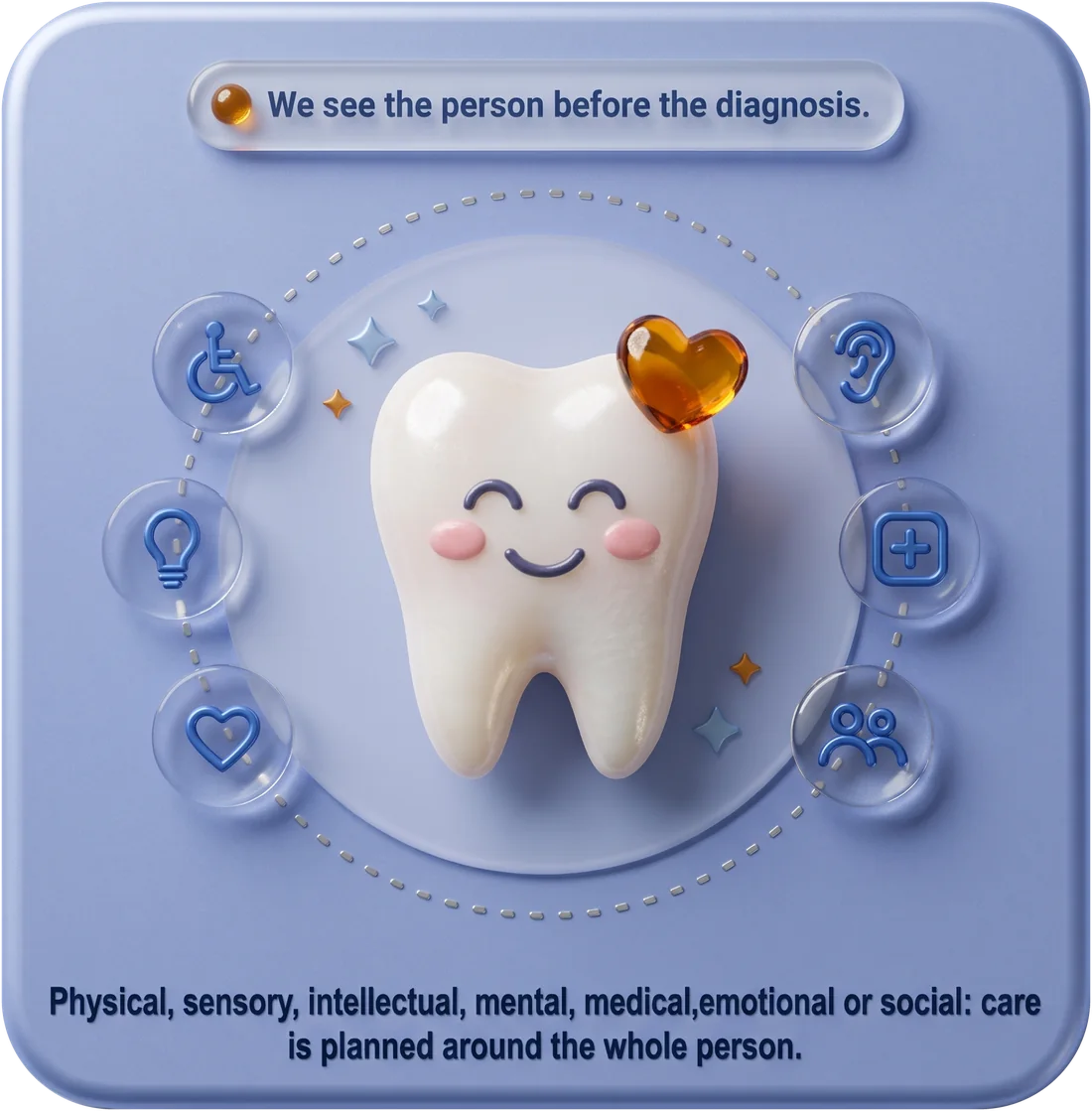
Special needs dentistry, also called special care dentistry, helps people who find a usual dental visit difficult. This may be because of a physical, sensory, intellectual, mental, medical, emotional or social difficulty, or a mix of these. It is a recognized dental specialty in several countries, and caring for children with special health care needs is also a core part of pediatric dentistry.[1][3][15]
You do not need a label to ask for help. In fact, no referral or formal diagnosis is needed. Just tell us what helps you, or your family member, feel safe and comfortable, and then we will plan around it.
Not just for children, but for adults too. Our special needs dentistry continues from early childhood into adult life, so a young person can stay with a team they already know and trust, with adult specialists joining in when needed.[4]
Why a healthy mouth matters even more
- Brushing can be hard because of movement, sensory or understanding difficulties
- Some medicines also cause a dry mouth or swollen gums
- Pain may be hard to describe, so problems can be found late
- As a result, gum disease and untreated decay are more common
The good news: most of these problems can be prevented when care is regular and well planned.[7][8][9]
Who we care for
Special needs dentistry for every kind of need
About 1 in 6 people worldwide lives with a significant disability, and many more also live with long-term medical conditions. Choose a group below, then see how special needs dentistry adapts care. Of course, many people fit more than one.[6]
Physical disabilities and limited mobility
For example cerebral palsy, spina bifida, muscle conditions, a stroke or an injury. Because of this, getting into the dental chair, lying back or keeping still may be hard. We plan the position, support and timing so treatment feels safe and comfortable, and we can book a longer appointment when it helps. Our center is also wheelchair accessible and designed for smooth access.[7]
How we adapt
- Treatment in the position that suits the patient
- Short breaks and soft supports for comfort
- Tell us about wheelchair and transfer needs before the visit
Hearing, vision and sensory sensitivities
For example, some patients cannot hear or see us clearly. Others, including many autistic people, find bright lights, noise, smells, tastes or touch overwhelming. Research shows that softer lighting, calmer sounds and gentle, firm pressure can lower stress during dental care.[10][11]
How we adapt
- We face the patient, speak clearly and also use pictures and gestures
- We explain each sound and touch before it happens
- You can also bring sunglasses, headphones or a favorite comfort item
Autism, ADHD, Down syndrome and intellectual disabilities
Knowing what will happen, and why, makes a big difference. So we use simple words, pictures and “tell-show-do”, and build trust one small step at a time. Gum problems and untreated decay are more common in people with intellectual disabilities and in autistic people, so prevention always comes first.[5][8][9]
How we adapt
- A get-to-know-us visit before any treatment
- The same faces and the same routine each time, where possible
- Small steps, with praise for every success
Heart, blood, kidney, cancer and other medical conditions
Heart disease, bleeding disorders, epilepsy, diabetes, kidney disease, cancer treatment, an organ transplant or a weak immune system can all change how dental care is planned. A small number of heart conditions need antibiotics before some procedures. Blood thinners should never be stopped without your doctor’s advice: most dental treatment can go ahead while you keep taking them, with a plan agreed in advance. So we plan all of this together with your doctors.[3][12][13]
Please bring
- An up-to-date list of medicines and doses
- Recent reports or letters from your doctors
- Details of any allergies, including latex
Severe anxiety, phobia and mental health conditions
Fear of the dentist, a frightening past experience, anxiety, depression, dementia or other mental health conditions can make it hard to come in or to stay in the chair. We go at the patient’s pace, agree a stop signal, and offer laughing gas or general anesthesia when reassurance and gentle steps are not enough.[2][5]
How we adapt
- A clear plan before anything starts
- A raised hand always means stop
- Read our laughing gas guide
- Read about treatment under general anesthesia
Older adults, carers and difficult life circumstances
Frailty, living alone, depending on a carer, or social and money pressures can all make dental care harder to reach. So we keep plans realistic, focus on comfort and prevention, and also show family members and carers how to help with daily mouth care.[2][7]
How we adapt
- Treatment plans that fit your life and budget
- A clear, written cost estimate before treatment
- Hands-on brushing tips for carers
Myth or fact?
Special needs dentistry: four myths and facts
Tap a card to see the answer, then tap again.
Your comfort plan
Tell us what matters, then see how special needs dentistry can help
Choose anything that sounds like you or your family member. Then you will see what we can do, what to bring, and a ready message to send us.
Your comfort plan 0
Here is what every patient gets. Then choose what applies to add personal tips.
What we can do
- Time to settle in, with no rush
- A get-to-know-us visit with no treatment
- A stop signal agreed before we start
- A clear written plan with costs, explained in Arabic or English
What to bring or tell us
- An up-to-date list of medicines and doses
- Anything that helps the patient feel calm
WhatsApp opens with a ready message. Nothing is sent until you press send, and nothing is saved on this page.
What we offer
Complete special needs dentistry, planned around the person
From the first hello to long-term prevention, every part of special needs dentistry can be adapted.
A gentle first visit
Meet the team, look around and sit in the chair, with no treatment unless the patient is ready. Some patients need a few short visits before they feel at home, and that is fine.[7]
Prevention first
Fluoride varnish, fissure sealants, diet advice and a personal home-care plan help stop problems before they start, which means less treatment later.[2][7]
The full range of treatment
We also offer check-ups, cleaning, fillings, crowns, root canal treatment, gum care, extractions, orthodontics and replacing missing teeth, all under one roof.
Working with your doctors
When needed we speak with your family doctor, pediatrician, cardiologist, hematologist, neurologist or therapist, so dental care fits safely with the rest of your health care.[3]
Comfort options for every stage
Gentle behavior guidance, local anesthetic, laughing gas or outpatient general anesthesia, chosen together with you before each part of the treatment.[5]
Care that continues
Check-ups timed to each person’s risk, then a smooth move from children’s care to adult care as patients grow up.[4]
The Magic Tooth advantage
Special needs dentistry led by consultants who do this every day
Special needs dentistry at Magic Tooth is led by two consultant pediatric dentists in special care dentistry, who are also supported by specialists in gums, root canals and orthodontics.
Dr. Mai Altayeh
Consultant pediatric dentist and special care dentistry
- MSc Pediatric Dentistry, University of Liverpool, UK (2002)
- 20+ years in pediatric dentistry
- Children with special health care needs, laughing gas and general anesthesia
- Member of the AAPD, IAPD and Special Care Dentistry Association; 2023 AAPD Annual Session speaker
Dr. Farouk Rihani
Consultant pediatric dentist and special care dentistry
- Jordanian Board in Pediatric Dentistry (2004)
- BDS, Jordan University of Science and Technology (1995)
- 30+ years in dentistry
- Special health care needs, medical conditions and dental anomalies
With specialist support, under the same roof
Dr. Mutaz Altayeh
Consultant periodontist and implantologistGum care, which matters even more when brushing is difficult.
Dr. Mohammed Bsoul
Endodontist (root canal specialist)Saving natural teeth with root canal treatment.
Dr. Bashar Momani
Consultant orthodontistBraces, clear aligners and craniofacial orthodontics.
Why consultant-led special needs dentistry makes a difference
- Advanced training
Postgraduate specialist training in pediatric and special care dentistry, and also decades of everyday experience.
- Safer planning for medical conditions
Used to reading medical reports, understanding how medicines affect the mouth, and then adjusting treatment safely.
- The right comfort option, first time
Experience in judging when patience, laughing gas or general anesthesia is the kindest choice.
- Everything under one roof
Pediatric, gum, root canal and orthodontic specialists work side by side, so there are fewer referrals and, when suitable, fewer visits.
- Continuity as the patient grows
The same trusted team from childhood until adult life.
- Time and clear communication
Unhurried appointments, explanations in Arabic or English, and also a written plan with costs.
Comfort and technology, explained simply
Special needs dentistry tools that make visits easier
In special needs dentistry, the right tools can shorten visits, reduce discomfort and keep treatment precise. Tap each one, then see how it helps.
The comfort ladder
Many patients need only the first steps. We move up a step only when it will genuinely help, and always agree it with you first.[5]
Picture stories and “tell-show-do”
Simple picture stories, short videos and the “tell-show-do” approach explain each step before it happens: we tell, we show on a finger or a toy, then we do. Research in autistic children also shows that visual supports and video modeling can lower anxiety and improve cooperation.[5][11]
Why it helps: when people know what comes next, the unknown becomes familiar.
A calmer sensory setting
Turning the bright overhead light away, offering sunglasses or headphones, keeping noise low and using gentle, firm pressure are small changes, but they have a big effect. In a large randomized trial, autistic children showed less stress and distress during dental cleaning in a sensory-adapted room.[10]
Why it helps: when the senses are calm, the patient can cope with more, for longer.
Laughing gas
A mix of laughing gas and oxygen, breathed through a small, soft nose mask, helps nervous patients relax while staying awake and able to talk. It also wears off within minutes once the mask is removed. Before using it, the dentist checks that it suits the patient’s health and that they can breathe through the nose mask.[5]
Why it helps: it suits patients who can cooperate a little but are held back by worry.
Read our laughing gas guideOutpatient general anesthesia
When treatment while awake is not possible, the patient can sleep through it under the care of a dedicated anesthesiologist, with breathing, heart rate and oxygen watched all the time, and usually go home the same day. Before any of this, a medical check always comes first.[5][14]
Why it helps: no struggle, no memory of the procedure, and complete care in a single session.
Read about treatment under general anesthesiaPanoramic and 3D imaging
Our digital panoramic X-ray and Castellini X-Radius Trio 3D scanner take pictures from outside the mouth, so they can be much easier for patients who cannot hold a small X-ray sensor inside. A 3D scan is used only when the extra detail will change the plan, for example before a difficult extraction.
Why it helps: a full picture of the teeth, quickly, even when X-rays inside the mouth are not possible.
Read about 3D dental imaging3D digital scans instead of impression trays
When we need a mold of the teeth, for example before a crown or orthodontic treatment, our 3Shape TRIOS scanner takes a 3D picture with a small wand instead of a tray full of thick paste. There is no sticky material and no taste, we can pause at any moment, and many patients also enjoy seeing their teeth on the screen. In fact, studies show that most patients prefer scanning, with less gagging, discomfort and unpleasant taste.[17]
Why it helps: it is ideal for people with a strong gag reflex, as well as those sensitive to taste and texture.
Quieter Swiss electric handpieces
The high-pitched whine of a traditional air drill is a common trigger for dental fear and sound sensitivity. Instead, our Bien-Air electric handpieces from Switzerland run with a lower, smoother sound and a steady, controlled speed. Measurements show that electric handpieces are quieter than air-turbine drills.[18]
Why it helps: a calmer sound helps patients with sound sensitivity, including many autistic patients, stay relaxed for longer.
Gentle air-polishing
Instead of long scraping, a fine spray of water, air and soft powder lifts plaque and stains away quickly. If the sound or spray is too much for someone, we simply choose another way to clean.
Why it helps: when cleanings are shorter and more comfortable, regular check-ups are easier to keep up.
Read about our cleaningNot every tool suits every patient. So we suggest only what will genuinely help, after looking at the dental need, the medical history and the other options.
What to expect
Your first special needs dentistry visit, step by step
We plan before you arrive, so the visit feels calm and has fewer surprises.
- 1
Tell us first
Call or WhatsApp us, then share the diagnosis, medicines, what helps and what upsets the patient, and the best time of day.
- 2
Meet and settle in
A calm welcome, a look around and, if the patient is ready, a gentle look in the mouth.
- 3
A clear plan
Then we explain what we found, the options, the comfort choices and the costs, in writing, and answer every question.
- 4
Treatment and follow-up
Treatment at the right pace and in the right setting, then regular check-ups and a home-care routine.
Before your special needs dentistry visit: a quick checklist
Tick each item while you prepare. Nothing here is sent anywhere.
Home care tips from our special needs dentistry team
Small daily habits protect teeth between visits. We will also show you what works best for your family.[7]
- Brush twice a day with fluoride toothpaste. If they cannot brush well, do it for them.
- Find a steady position, such as standing behind them with the head supported.
- A thicker handle or an electric brush can also make brushing easier.
- Floss holders or floss picks help when flossing is hard.
- Keep sweet drinks and snacks to mealtimes, and also ask about sugar-free medicines.
- Tell us early about bleeding gums, bad breath, or changes in eating or behavior, because they might mean pain.
Frequently asked questions
Special needs dentistry: your questions answered
Choose a topic, then tap a question to open the answer.
Who is special needs dentistry for?
Do you offer special needs dentistry for adults as well?
Yes, we see children, teenagers and adults with disabilities, medical conditions and severe dental anxiety. Young people who grow up with us can continue their care here, with our periodontist, endodontist and orthodontist joining in when their needs change.[4]
Can we have a get-to-know-us visit before any treatment?
Yes, and in fact a short, no-pressure visit to meet the dentist, look around and sit in the chair can make the next visit much easier. Some patients need two or three of these visits, and that is fine.[7]
Can I stay with my child or relative during treatment?
Usually, yes, because a familiar face often helps, and you know the patient best. We will show you how you can help, for example by holding a hand or giving a signal they understand. For adult patients, however, we follow their own wishes about who stays with them.
Can my relative be treated if they use a wheelchair?
Yes, because our center is wheelchair accessible and designed for smooth access. It is on the first floor of Building 192, Princess Basmah Street, Abdoun. Please tell us before the visit so we can plan the timing and have everything ready. Simple check-ups can often be done in the wheelchair, and when treatment needs the dental chair, we plan a safe transfer together with you and any carers.[7]
How do I book, and what should I tell you?
Call 06 593 7076 or send a WhatsApp message to +962 79 660 0883. Then tell us the patient’s age, the main worry, any medical conditions and medicines, how they communicate, and anything that makes visits easier or harder. The comfort plan on this page can also prepare the WhatsApp message for you.
Is special needs dentistry more expensive?
Not necessarily: longer appointments, laughing gas or general anesthesia can add fees, but early prevention often saves money by avoiding bigger treatment later. We always give a clear, itemized estimate before treatment starts.
Does my child have to be treated under general anesthesia?
Usually not, because many children with special needs are treated awake, with time, familiar routines and small changes, sometimes with laughing gas. General anesthesia is considered when these are not enough, or when a lot of treatment is needed, after a careful medical check. Also, having a disability does not by itself mean anesthesia is needed.[5]
What can you do if my child is autistic, has ADHD or is very sensitive to noise, light and touch?
Before the visit, tell us what bothers your child and what calms them. Then we can turn the bright light away, keep the room quiet, offer sunglasses or headphones, explain each touch first, keep the visit short and book a calmer time of day. You are also welcome to bring a comfort item or a favorite video.[10][11]
What if the patient will not open their mouth or cannot stay still?
We never force treatment. We may pause, try again another day, break the work into shorter steps, use a soft mouth rest so the patient does not have to hold their mouth open, or consider laughing gas or general anesthesia. Any technique used to keep someone safe is explained and agreed with you before it is used.[2][5]
Is general anesthesia safe and right for everyone?
No medical procedure is completely risk-free, and general anesthesia is also not needed or suitable for everyone. When it is considered, a medical check comes first, a dedicated anesthesiologist looks after the patient, and breathing, heart rate and oxygen are watched all the time. We explain the benefits, risks and other options so you can decide together with us.[5][14]
Can all the treatment be done in one visit?
Yes, in many cases. When a lot of treatment is needed and visits while awake are not possible, everything can often be done in one session under general anesthesia. Otherwise, some care is best spread over a few short visits, depending on the patient’s comfort and health.[5]
Is dental treatment safe if I have a heart condition or take blood thinners?
Yes, with good planning, so please bring your medicine list and your doctor’s details. A small number of heart conditions need antibiotics before some procedures. Never stop a blood thinner on your own: most dental treatment can go ahead safely while you keep taking it, and we agree any changes with your doctor first.[12][13]
What should we do if the patient takes several medicines or has a complex condition?
Bring an up-to-date list of all medicines, because some cause a dry mouth or swollen gums, and some contain sugar, so we may suggest extra fluoride or more frequent check-ups. We may contact the patient’s doctor when needed. Please do not stop or change any medicine unless the doctor who prescribed it tells you to.[3][7]
How often should we come for check-ups?
Usually every 3 to 6 months for a check-up and a professional clean, depending on each person’s risk. That way small problems are caught early and visits stay familiar.
How can we keep teeth healthy between visits?
Brush twice a day with fluoride toothpaste, and help with brushing if needed. Also clean between the teeth, keep sugary snacks and drinks to mealtimes, and come for regular check-ups. If swallowing problems, a dry mouth or medicines make mouth care harder, ask us for a personal plan.[7]
Let’s plan together
Talk to our special needs dentistry team
Dr. Mai Altayeh and Dr. Farouk Rihani will listen first, then build a plan around the patient’s needs, pace and comfort. Call us or send a WhatsApp message when you are ready to book a first special needs dentistry visit.
- Visit usBuilding 192, first floor, Princess Basmah Street, Abdoun, Amman
- Opening hoursSaturday to Wednesday, 9 am to 7 pm · Thursday, 9 am to 2 pm · Friday closed
Helpful things to tell us
- “What has made past dental or medical visits easier, or harder?”
- “How does the patient show pain or worry?”
- “What time of day usually works best?”
- “Are there any medicines, allergies or recent hospital stays?”
References & further reading
General Dental Council (UK): Special Care Dentistry
Definition of the specialty and the needs it covers.NHS England: Special Care Dentistry Clinical Standard (2022, PDF)
Reasonable adjustments, levels of care, prevention and shared decisions.American Academy of Pediatric Dentistry: Management of Dental Patients with Special Health Care Needs
Higher oral health risk, care coordination with medical providers.American Academy of Pediatric Dentistry: Transitioning from a Pediatric to an Adult Dental Home for Individuals with Special Health Care Needs
Continuity of care from childhood into adulthood.American Academy of Pediatric Dentistry: Behavior Guidance for the Pediatric Dental Patient
Tell-show-do, laughing gas and general anesthesia.World Health Organization: Global Report on Health Equity for Persons with Disabilities (2022)
1.3 billion people, about 1 in 6, live with a significant disability.National Institute of Dental and Craniofacial Research: Developmental Disabilities & Oral Health
Common oral problems, home-care and dental visit tips for caregivers.Ward LM, et al. Oral health of adults with intellectual disabilities: a systematic review. J Intellect Disabil Res, 2019
High levels of gum disease and untreated decay. DOI: 10.1111/jir.12632Uliana JC, et al. Autistic individuals have worse oral status than neurotypical controls: systematic review and meta-analysis. Clin Oral Investig, 2024
More plaque, gingivitis and caries experience. DOI: 10.1007/s00784-024-05500-0Stein Duker LI, et al. Sensory adaptations to improve distress during dental visits in autistic children: a randomized crossover trial. JAMA Netw Open, 2023
Lower stress and distress in a sensory-adapted dental room. DOI: 10.1001/jamanetworkopen.2023.16346Prynda M, et al. Dental adaptation strategies for children with autism spectrum disorder: a systematic review of randomized trials. J Clin Med, 2024
Video modeling and sensory adaptations reduce anxiety. DOI: 10.3390/jcm13237144American Dental Association: Antibiotic Prophylaxis Prior to Dental Procedures
Which heart conditions need antibiotics before dental care.Scottish Dental Clinical Effectiveness Programme: Management of Dental Patients Taking Anticoagulants or Antiplatelet Drugs
Dental treatment while continuing blood thinners.American Academy of Pediatric Dentistry / American Academy of Pediatrics: Monitoring and Management of Pediatric Patients Before, During and After Sedation
Health checks and continuous monitoring for sedation and anesthesia.International Association for Disability and Oral Health (iADH)
The international society for oral health care for people with disabilities.Special Care Dentistry Association (SCDA)
Professional association for dentists who care for people with special needs.de Paris Matos T, et al. Patient-related outcomes of conventional impression making versus intraoral scanning for prosthetic rehabilitation: a systematic review and meta-analysis. J Prosthet Dent, 2023
Patients preferred scanning, with less discomfort, nausea and unpleasant taste. DOI: 10.1016/j.prosdent.2021.08.022Pei DD, et al. Comparison of crown fit and operator preferences between tooth preparation with electric and air-turbine handpieces. J Prosthet Dent, 2021
Electric handpieces produced less noise than air-turbine drills. DOI: 10.1016/j.prosdent.2019.11.001
Sources checked: 27 October 2026. Links open in a new tab, while the sources themselves are in English. Research articles are listed via PubMed.
