
Fix, protect and beautify your teeth while keeping as much of your own tooth as we can
Whether you need a small tooth-colored filling or a full ceramic crown, we always choose the smallest repair that will last. Fillings are made with 3M™ Filtek™ Z350 XT nanocomposite, while inlays, onlays, veneers and crowns are made from high-quality German ceramic, designed and milled digitally.
Cosmetic & restorative dentistry · Amman
- FDA-cleared materials
- Made in the USA or Germany
- Dental Advisor award-winning
For adults and children · Your dentist confirms the best option after an examination
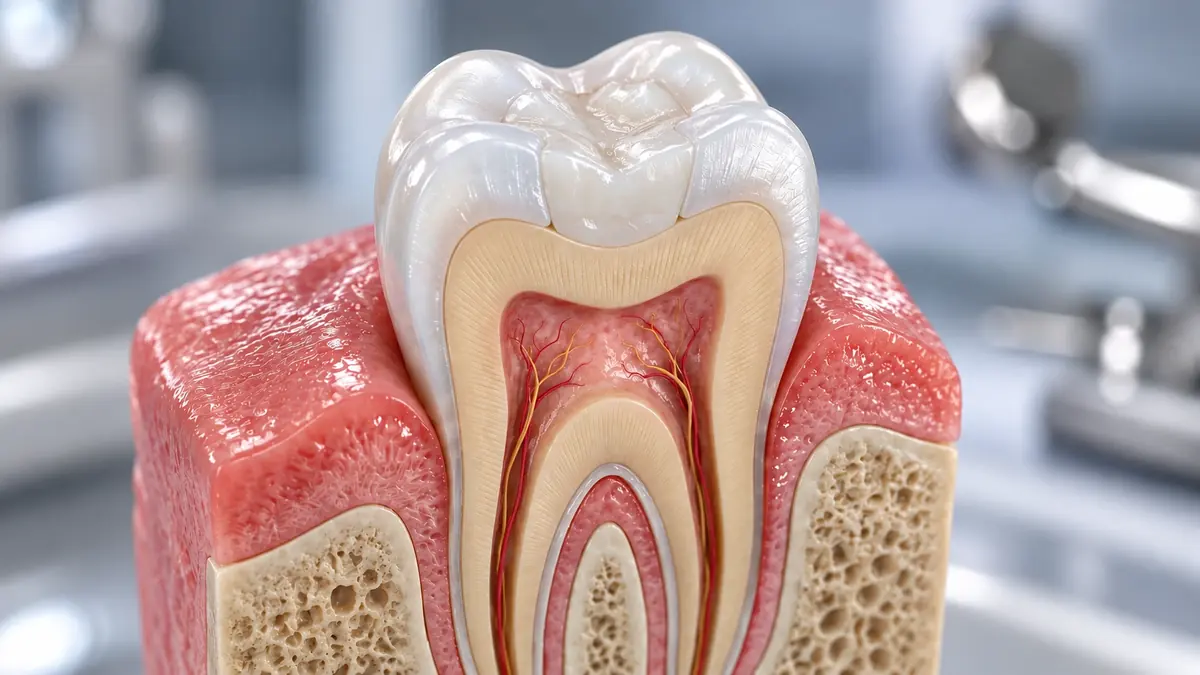
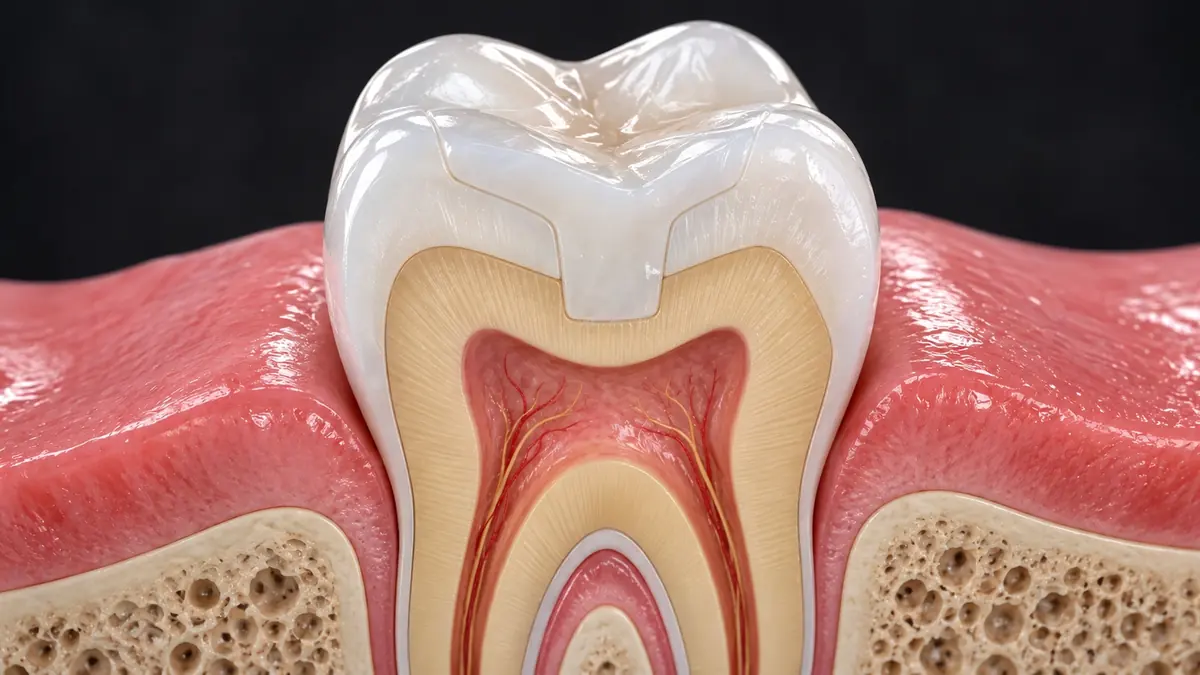
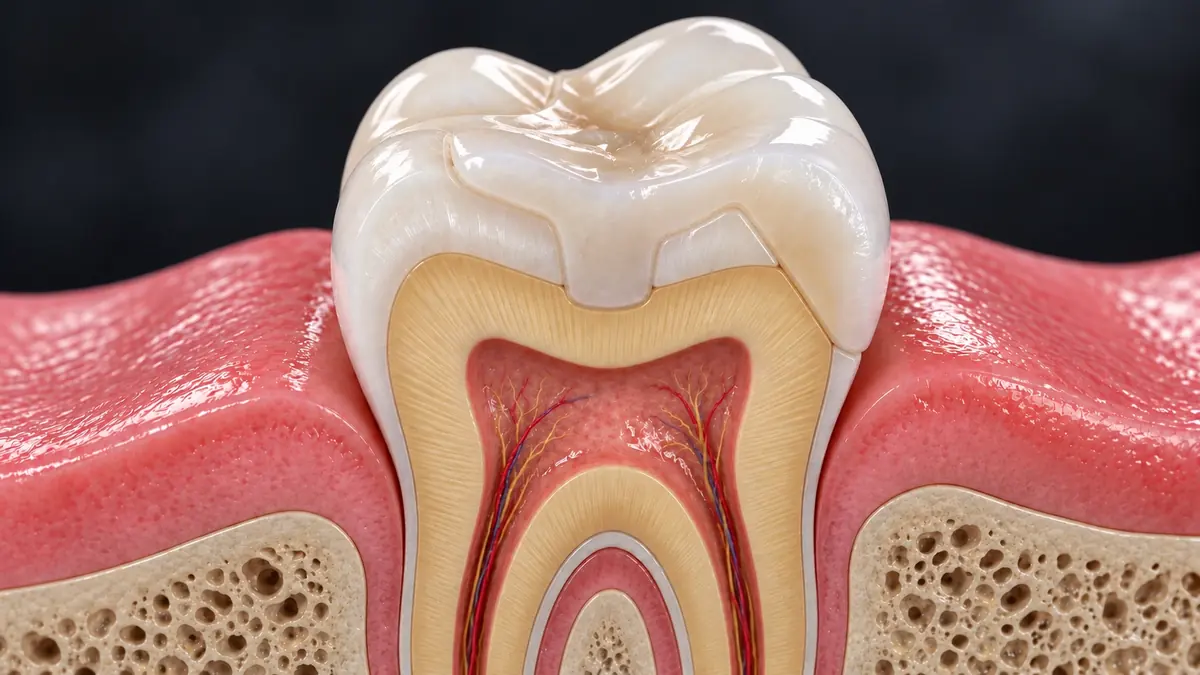
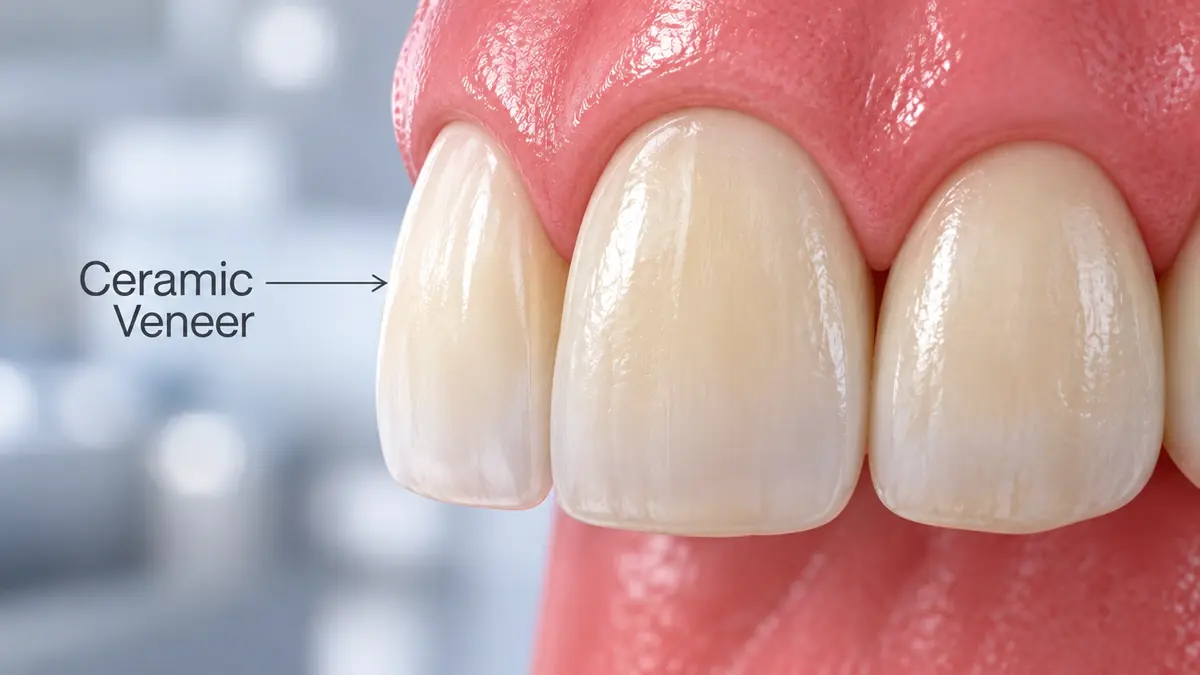
Composite filling
A tooth-colored filling that is shaped and then hardened right inside the tooth.
Ceramic inlay
A ceramic piece made to measure outside the mouth, then fitted inside the tooth between its raised points (cusps).
Ceramic onlay
Like an inlay, but it also covers and protects one or more weak cusps.
Ceramic veneer
A thin ceramic shell bonded to the front of a tooth to change, for example, its color or shape.
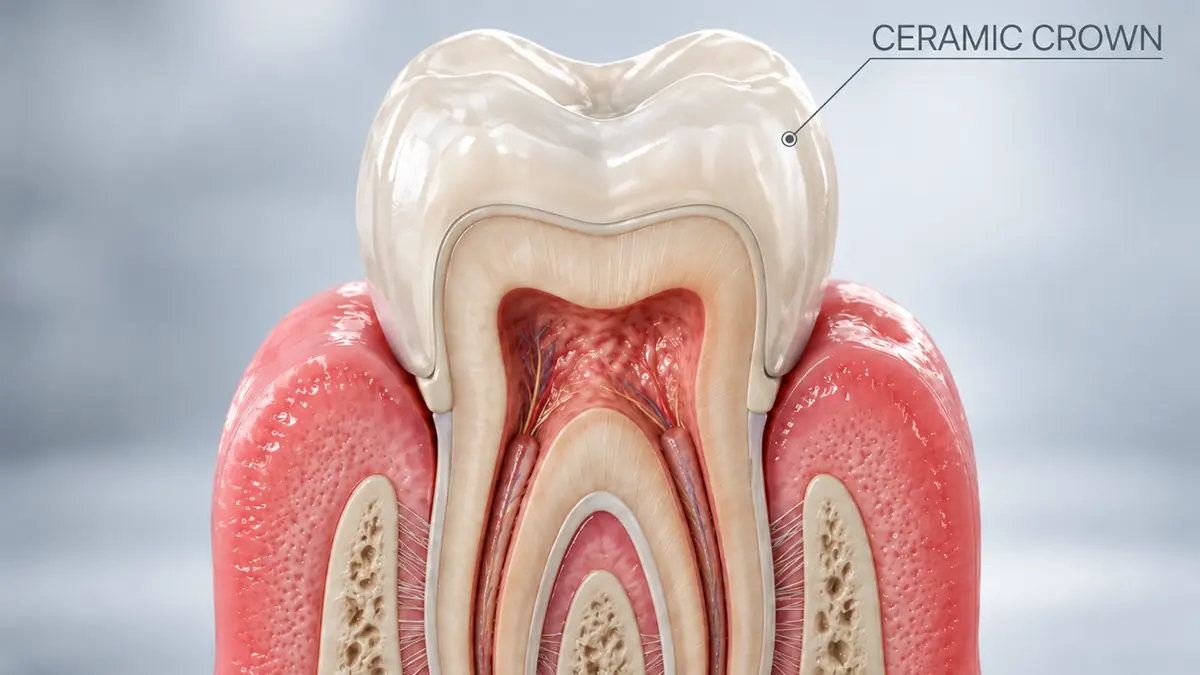
Ceramic crown
A full cover for a tooth that is badly broken or cracked, especially after root canal treatment.
Illustration. “Tooth removed” = the share of the visible tooth removed in typical preparations, measured in laboratory studies.[9][10]
Cleared by the US FDA
Every filling and ceramic material we use is cleared by the US Food and Drug Administration, so you know what goes into your tooth.
Made in the USA or Germany
Our composite and ceramic materials also come from established manufacturers in the USA and Germany.
Dental Advisor award-winning
They are also recognized by The Dental Advisor, an independent US product-testing publication. See the awards
Real results · Before & after
Real patients, natural-looking results
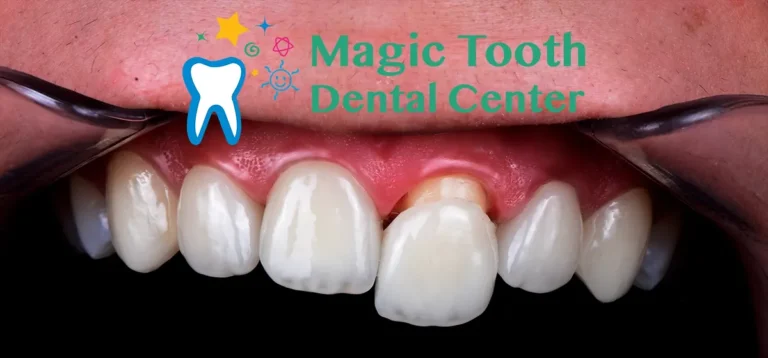
Three real cases from our clinic: a broken front tooth rebuilt in composite, old silver fillings replaced with ceramic inlays and onlays, and a fractured front tooth restored with a ceramic crown.
Case 1 · Composite bonding
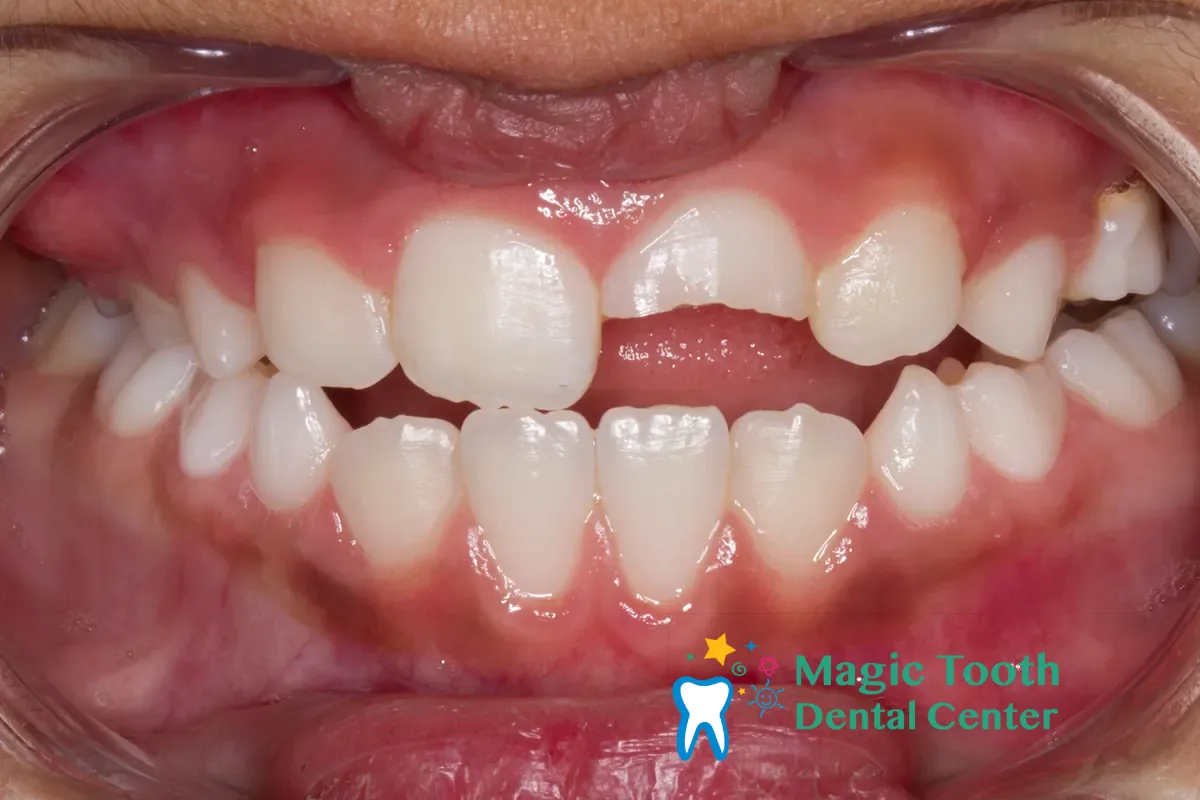
A broken front tooth, rebuilt to look natural again
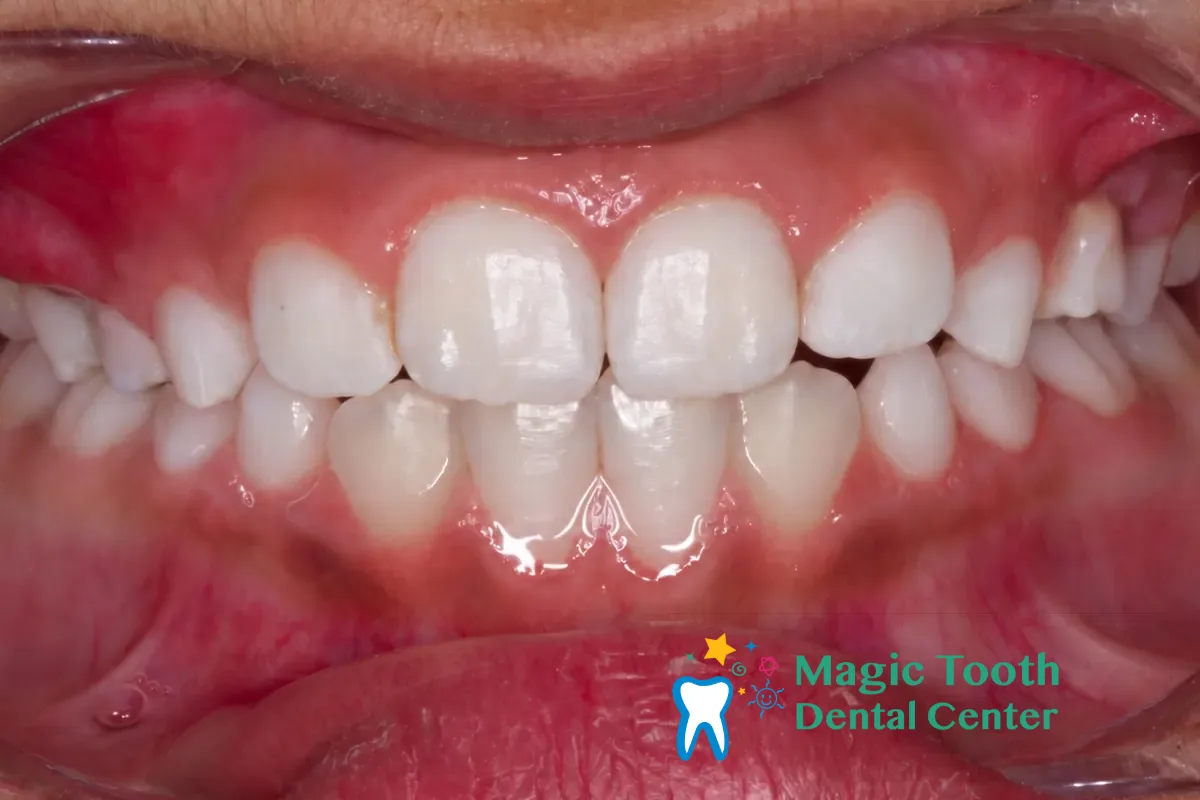
A fractured permanent front tooth rebuilt in tooth-colored 3M™ Filtek™ Z350 XT nanocomposite. Drag the slider to see the difference.
Case summary
The problem
Part of a permanent upper central incisor had broken off, leaving the tooth short and uneven.
The repair
We rebuilt it directly on the tooth with tooth-colored 3M™ Filtek™ Z350 XT nanocomposite. No crown needed.
The result
A natural-looking tooth that matches its neighbors in shape, shade and shine.
Chipped or broken a tooth?
Just happened? Follow our Tooth Trauma SOS first-aid guide.
Case 2 · Ceramic inlays & onlays
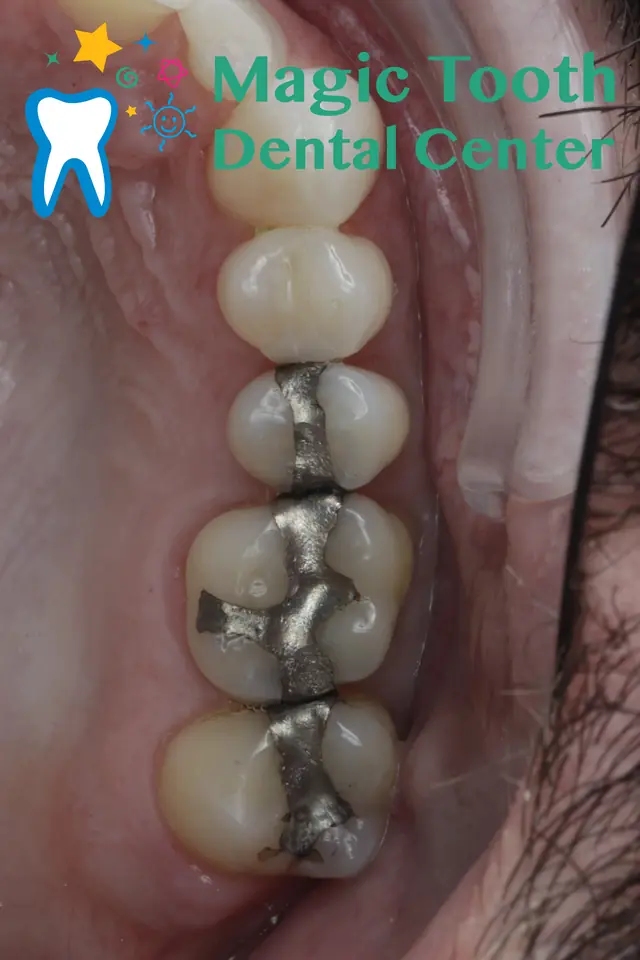
Old silver fillings replaced with natural-looking ceramic
Three heavily restored upper back teeth: their large amalgam fillings were replaced with custom-made ceramic inlays and onlays that blend naturally with the tooth surface.
 Before
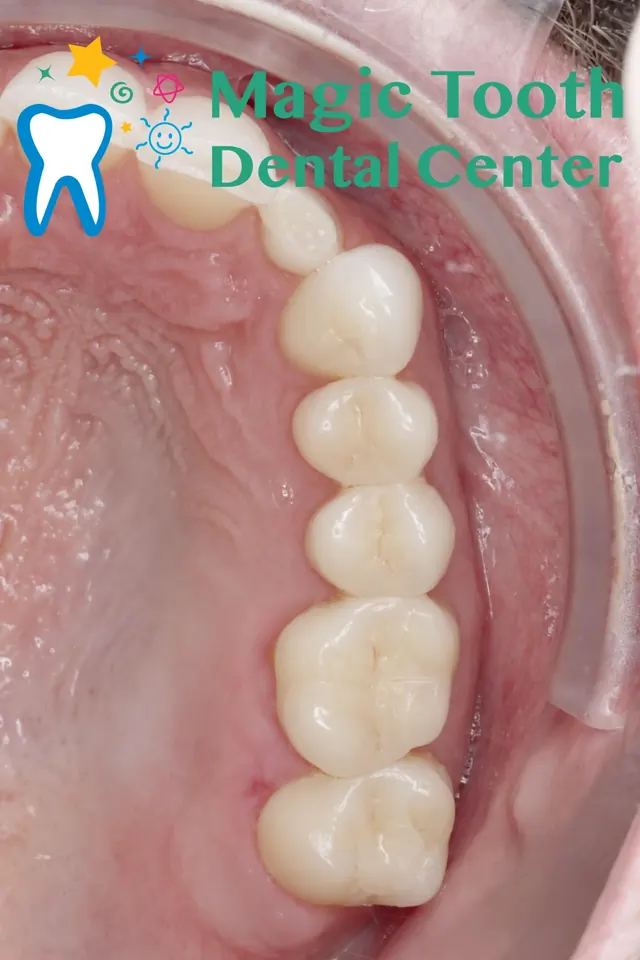 After
Case summary
The problem
Three upper back teeth (a premolar and two molars) were heavily restored with large, dark silver amalgam fillings. Fillings this big leave the remaining tooth walls weaker.
The repair
We replaced the old amalgam with German ceramic inlays and onlays, each made outside the mouth to fit its tooth precisely, then bonded in place. The onlays also cover and protect weakened cusps.
The result
Tooth-colored back teeth that blend naturally with the tooth surface, restored in strong, durable ceramic built for everyday chewing.[8]
Have old silver fillings?
Wondering whether yours need replacing? Read Should I replace my old silver fillings?
Case 3 · Ceramic crown
A fractured front tooth, restored with a lifelike ceramic crown
A young patient’s fractured upper central incisor, restored with a durable ceramic crown that matches the neighbouring central incisor in shade and translucency.
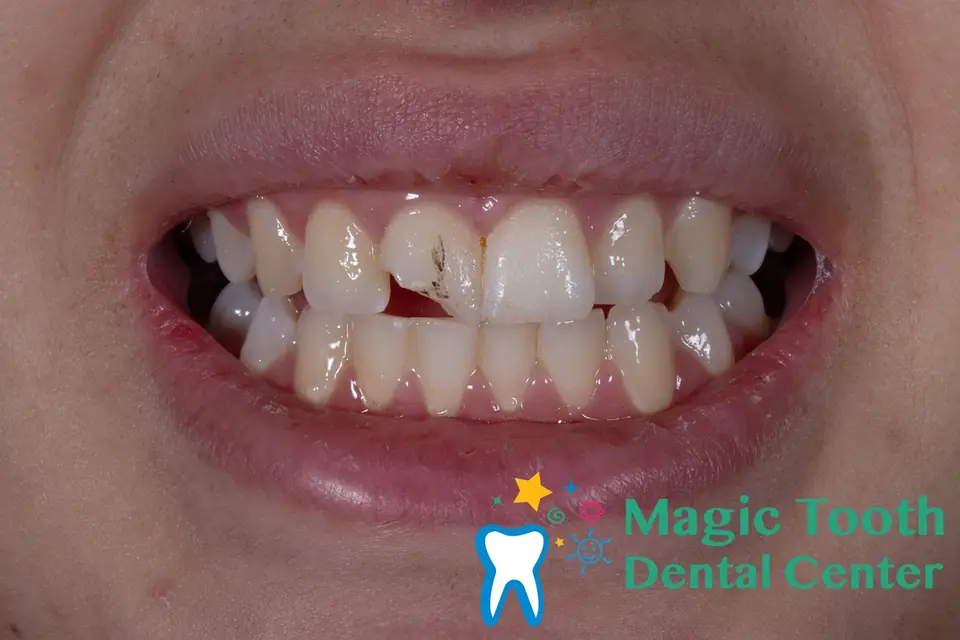 Before
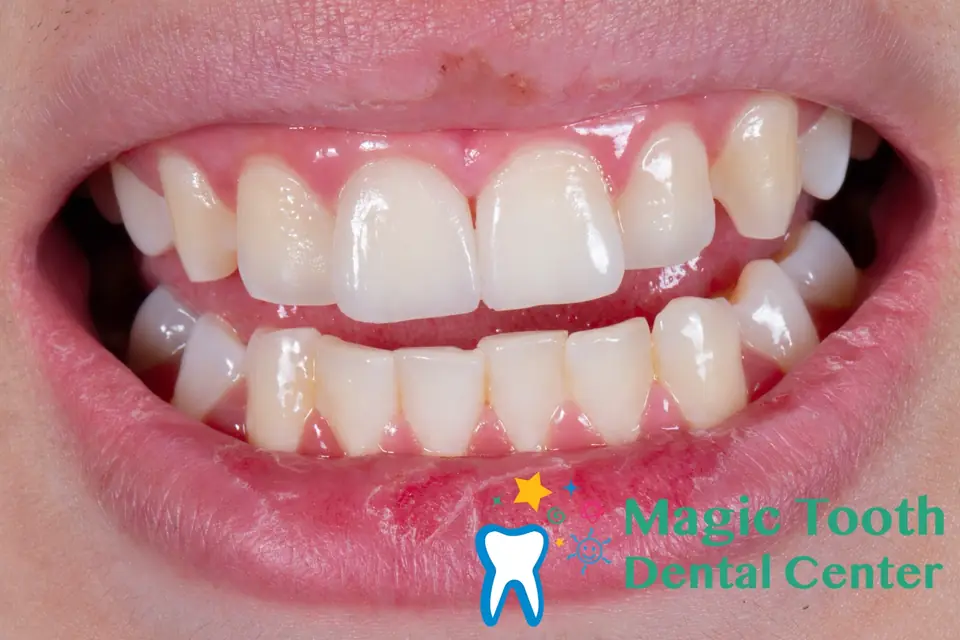 After
Case summary
The problem
A young patient had broken off a large part of a permanent upper central incisor, leaving the tooth short, uneven and stained along the fracture.
The repair
We restored it with a durable crown of high-quality German ceramic, designed digitally and shaded to match the neighbouring central incisor.[12]
The result
The new crown has the same lifelike shade and translucency as the natural central incisor beside it, so the two front teeth look like a matching pair.
Broken a front tooth?
See more crown and veneer results on our Ceramic Crowns & Veneers page.
Clinical photos of Magic Tooth Dental Center patients; results vary from person to person. How our composite fillings work · How ceramic inlays & onlays work · How ceramic veneers & crowns work
Start here
Filling, inlay or crown: which repair does my tooth need?
Tap the situation that sounds most like yours, and then read our suggestion. This is a guide, not a diagnosis, so your dentist always confirms the choice after examining your teeth.
A composite filling
We repair it in one visit with Filtek™ Z350 XT, a tooth-colored nanocomposite, and because we remove only the decay, most of your tooth stays as it is.
- Usually 1 visit
- Metal-free
- Only the decay removed
A ceramic inlay
When a filling would be too big, a made-to-measure piece of German ceramic is stronger and keeps its shape and color for years.
- Usually 2 visits
- Saves more tooth than a crown
A ceramic onlay
It covers and protects the weak part of the tooth, while keeping the healthy rest. It can often be used instead of a full crown.
- Usually 2 visits
- Holds a weak tooth together
Veneers, ceramic or composite
Veneers change color and shape while keeping most of the tooth. Sometimes teeth whitening alone is enough, so we always check that first.
- Usually 2 or more visits
- Teeth and gums must be healthy first
A ceramic crown (sometimes an onlay)
A crown covers the whole tooth like a helmet, so it holds the tooth together and protects it from splitting when you chew.
- Usually 2 visits
- Strong for back teeth
An all-ceramic crown
When an old crown is failing or shows a gray edge at the gum, a metal-free crown can replace it. However, if it is still sound, we may advise keeping it.
- No gray line at the gum
- Metal-free
This is only a guide, because we confirm the right repair after an examination and, if needed, X-rays.
Chipped a front tooth in a fall or knock? Keep any broken piece, see Tooth Trauma SOS for first aid, then call us. Many chipped teeth can then be rebuilt with composite in one visit.
Tooth-colored fillings · 3M™ Filtek™ Z350 XT
Fillings that blend in with your tooth
A composite filling is a tooth-colored material that sticks (bonds) to your tooth and is then hardened with a blue light. In particular, we use 3M™ Filtek™ Z350 XT, the premium universal nanocomposite in 3M’s Filtek™ family. According to 3M, Filtek™ materials have been used in more than a billion fillings worldwide.[1][3]
What does “nano” mean?
To begin with, a nanometer is one millionth of a millimeter. Filtek™ Z350 XT is filled with tiny silica and zirconia particles, as well as small bundles of them called “nanoclusters”. 3M calls this mix TRUE nanotechnology. Because the particles are so small, the filling polishes smoothly and keeps its shine.[2]
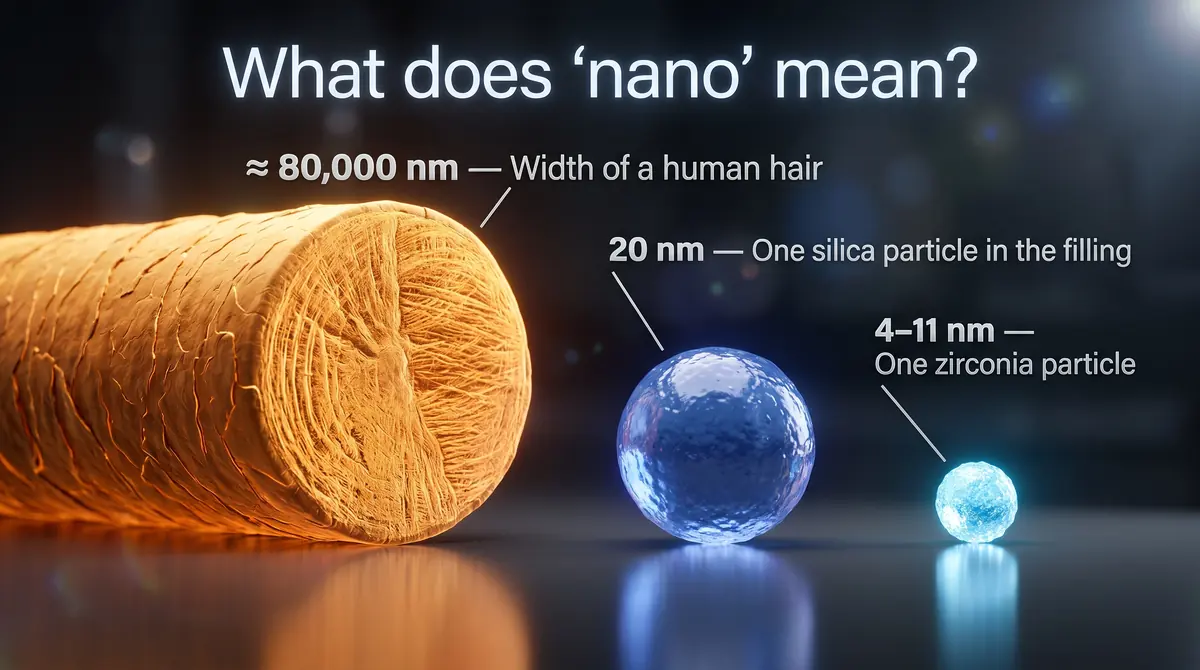
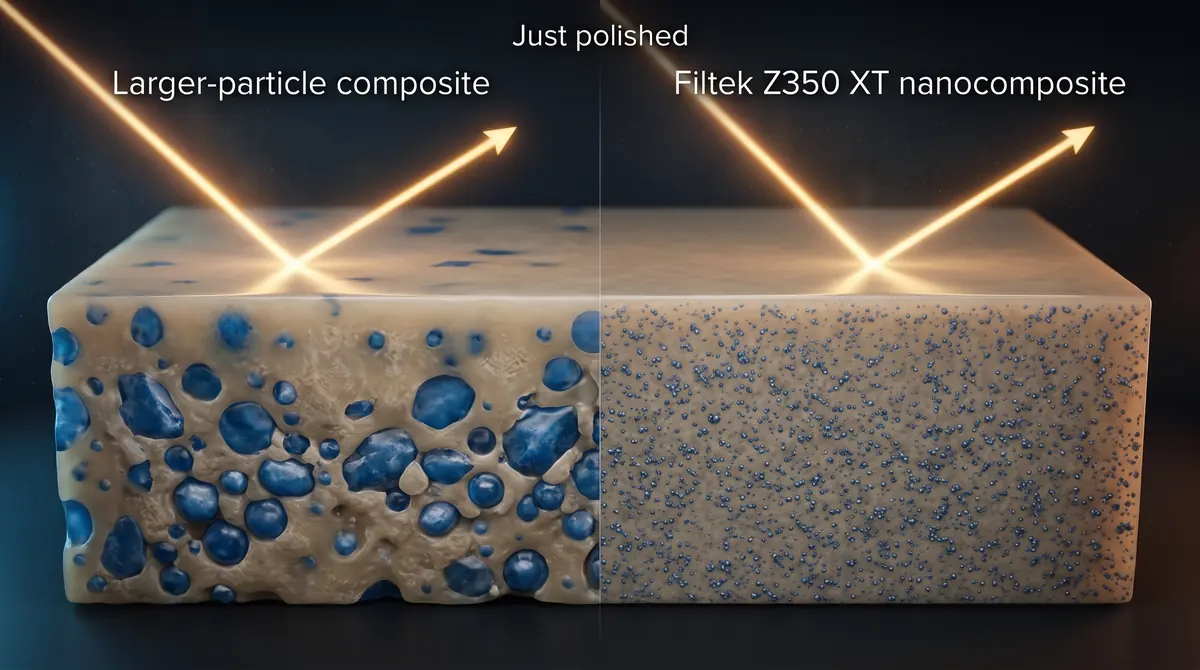
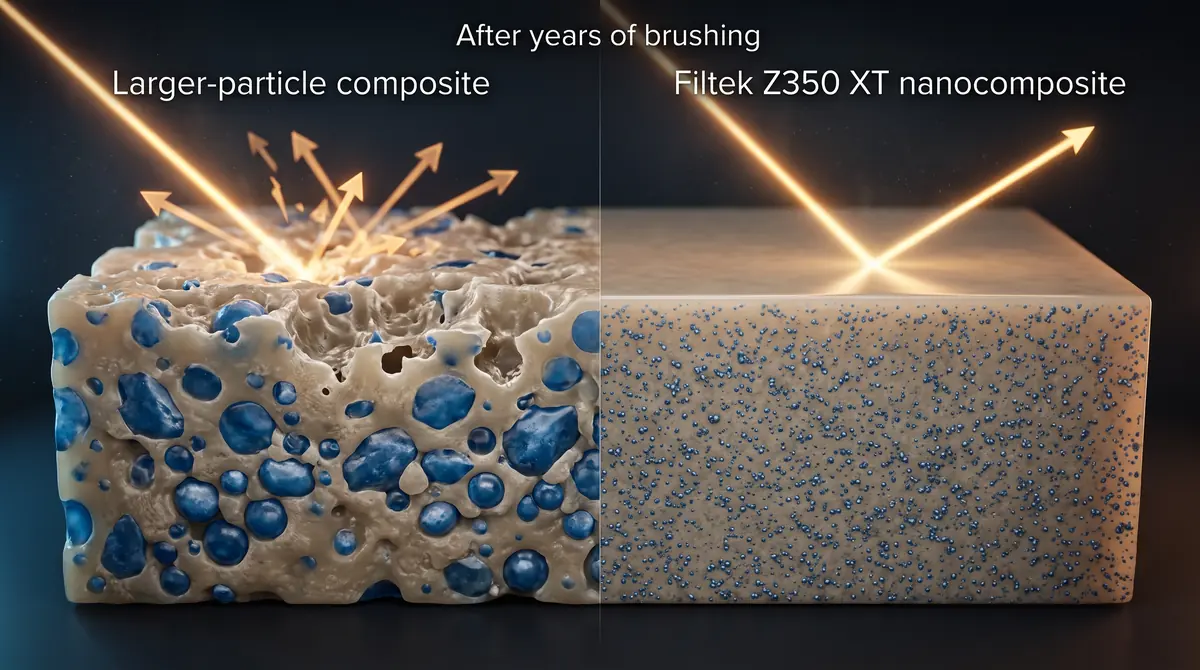
Freshly polished, both fillings are smooth and reflect light like a mirror, so both look shiny on day one.Over time, bigger particles can fall out and leave tiny pits, so the filling looks dull and stains more easily. Nano particles wear away slowly and evenly, so the surface stays smooth and shiny.[4][2]
Illustration, not to scale.
A shine that lasts
In laboratory brushing tests it kept its polish better than older (hybrid) composites, and it wore down less.[4]
A close color match
36 shades in four levels of see-through also let us build the filling in layers, just like a natural tooth.[1]
Natural in any light
Like real enamel, it glows and reflects light in a natural way, so it looks real in daylight, indoor light and photos.[1]
Strong for front and back teeth
In a five-year clinical trial of back-tooth fillings, 92% made with this nanocomposite family were still working well.[5]
Easy to check on X-rays
It shows clearly on X-rays, so we can check its edges for new decay at your check-ups.[1]
Kinder to your tooth
It bonds to the tooth, so we remove only the decay. It contains no mercury, and a small chip can often be repaired instead of replaced.
shades in 4 levels of see-through[1]
Dental Advisor clinical performance rating after 6 years (598 fillings)[18]
of back-tooth fillings still working well after about 5 years, in a randomized clinical trial[5]
Filtek™ Z350 XT uses the same TRUE-nanotechnology filler as products sold as Filtek™ Supreme Ultra (USA) and Filtek™ Supreme XTE or Ultimate in other countries, so studies of those products are included. All figures come from published research rather than from our own clinic.
Honest advice: composite is excellent for most small and medium cavities, but very large cavities in back teeth, or teeth with weak cusps, may last longer with a ceramic inlay or onlay. Fillings usually fail because of new decay or a crack, so brushing, flossing and check-ups matter as much as the material.[6]
For children too: tooth-colored composite is widely used for children’s teeth, including baby teeth, when the tooth can be kept dry during treatment. Our pediatric team will also advise what suits your child. Visit our pediatric dentist page.
Ceramic inlays & onlays
The smart step between a filling and a crown
Sometimes a back tooth has lost too much for a big filling, but still has too much healthy tooth to cover with a crown. Then an inlay or onlay is often the best repair. It is made outside the mouth from solid German ceramic and then bonded into your tooth like a puzzle piece.[13]
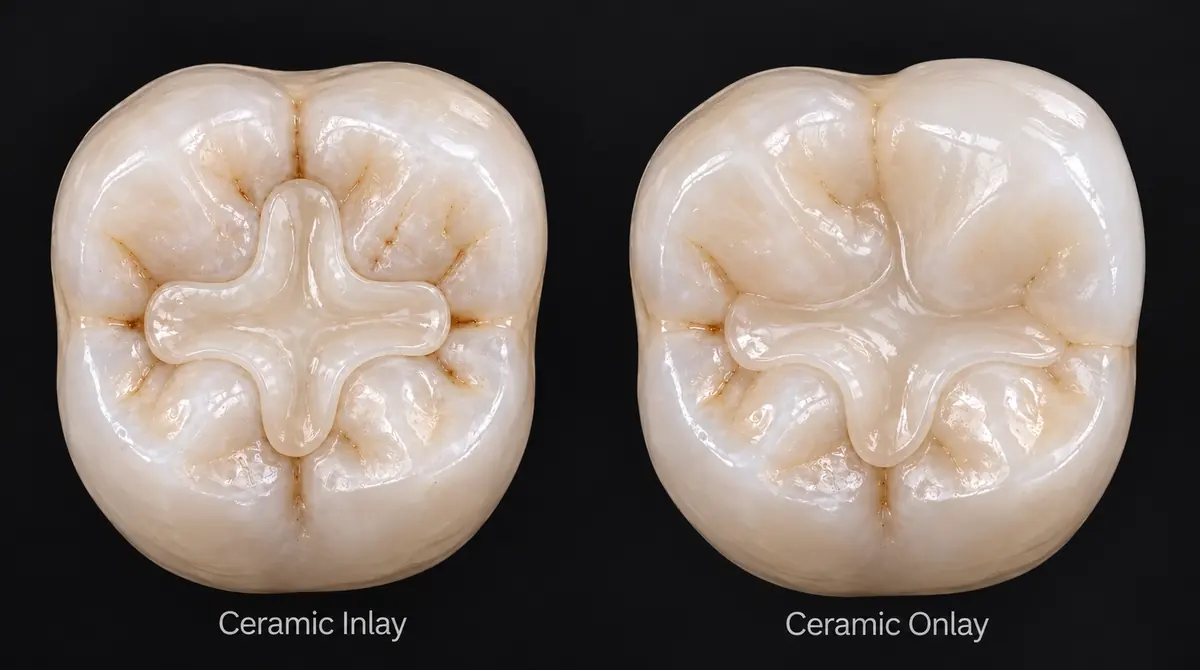
Ceramic inlay
Sits inside the tooth, between the cusps (the raised points of a back tooth), so the cusps stay untouched. Good for a large cavity, or for replacing a big old filling, while the cusps are still strong.
- Large cavities between the cusps
- Replacing big, worn or leaking fillings
Ceramic onlay
Like an inlay, but it also covers one or more cusps, holding a weak or cracked tooth together. It can often be used instead of a full crown.
- Cracked, chipped or thin cusps
- Many back teeth after root canal treatment
How much of the tooth is removed?
The less healthy tooth we remove, the stronger your tooth stays, so compare typical repairs below.
Share of the visible tooth (its crown) removed in typical preparations, as measured in laboratory studies; however, your own tooth may differ.[9][10]
Saves healthy tooth
An inlay removes at most about a quarter of a back tooth’s crown, whereas a full crown removes about two-thirds to three-quarters.[9]
Built to last
In a review of 14 clinical studies, 92–95% of ceramic inlays and onlays were still in place after 5 years, and 91% after 10 years.[8]
Precise, from a solid block
It is milled from a factory-made ceramic block, so its shape, its contacts with neighboring teeth and your bite can be perfected before it is bonded.[15]
Stays beautiful
Glazed ceramic is smooth and very stable, so it keeps its color and resists stains for years.[14]
Good to know: an inlay or onlay usually takes two visits, with a temporary in between, because it is made outside the mouth. The most common problem in studies was a chip or crack (about 4%), so tell us if you grind or clench your teeth: a night guard helps protect your new restoration.[8]
Ceramic veneers & crowns
German ceramic, designed on a computer, made for your smile
Veneers change how front teeth look, while crowns protect teeth that are too damaged for a filling. We make both from high-quality German ceramic, and each one is then designed digitally and precision-milled.
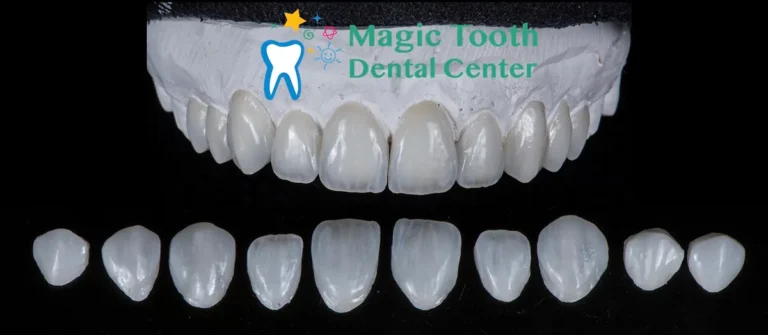
Ceramic veneers
A thin ceramic shell bonded to the front of a tooth to fix, for example, color, chips, worn edges or small gaps. It usually removes only about 3–30% of the visible tooth, whereas a crown removes about 63–72%.[10]
About 97% of glass-ceramic veneers were still in place after about ten years, in a review of 29 studies. Veneers are a permanent change, so teeth and gums must be healthy first.[11][16]
Ceramic crowns
A full cover over the visible tooth, like a protective helmet, so it holds a weak tooth together and gives back its shape, strength and color. It can also sit on a dental implant or be part of a bridge.[13]
Single-piece ceramic crowns had 96.8–98.5% survival at five years, the same as metal-ceramic crowns (97.1%), and they also chipped less.[12]
Choosing a crown
Why all-ceramic crowns?
Crowns can be made of metal, of porcelain on a metal core (metal-ceramic), of resin, or of ceramic all the way through. Each has its place, but when a tooth is too damaged for a filling, all-ceramic crowns usually give the best mix of looks, strength and comfort.[13]
The most natural look
Light passes into an all-ceramic crown, like natural enamel, instead of being blocked by a metal core.[13][14]
No gray line at the gum
There is no metal edge to show if your gums move back with age, and there is also no metal to show through if the surface chips.[13][14]
Lasts just as long
In fact, in a 2026 review of 64 clinical studies, single-piece glass-ceramic (98.5%) and zirconia (96.8%) crowns matched metal-ceramic crowns (97.1%) at five years.[12]
Less chipping
Crowns made from one solid piece of ceramic chipped much less than crowns with a layered porcelain surface, which is how metal-ceramic crowns are built.[12][13]
Metal-free and gentle
They are especially good if you are sensitive to metals. Zirconia is also gentle on the teeth it bites against, whereas porcelain on metal can slowly wear them down.[13]
Often less drilling
In a laboratory study, preparing a back tooth for an all-ceramic crown removed about 68% of its crown, whereas preparing it for a metal-ceramic crown removed about 76%.[9]
See the difference
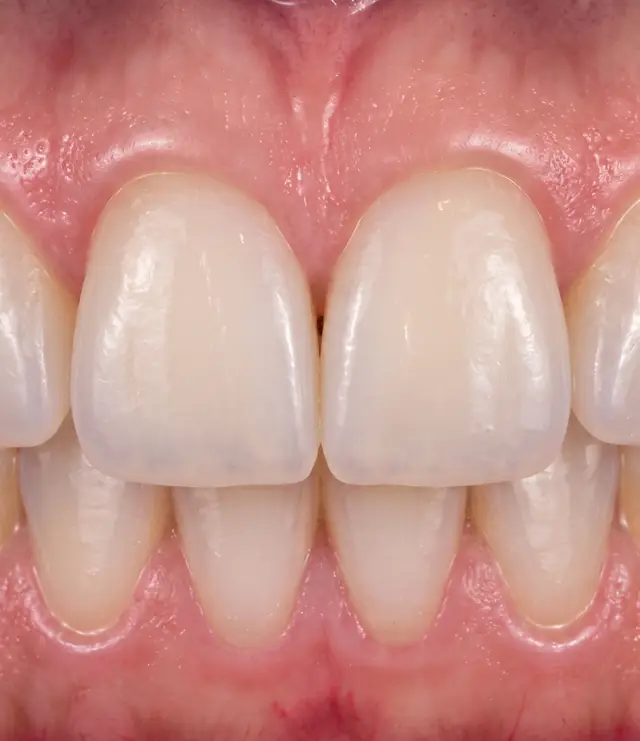
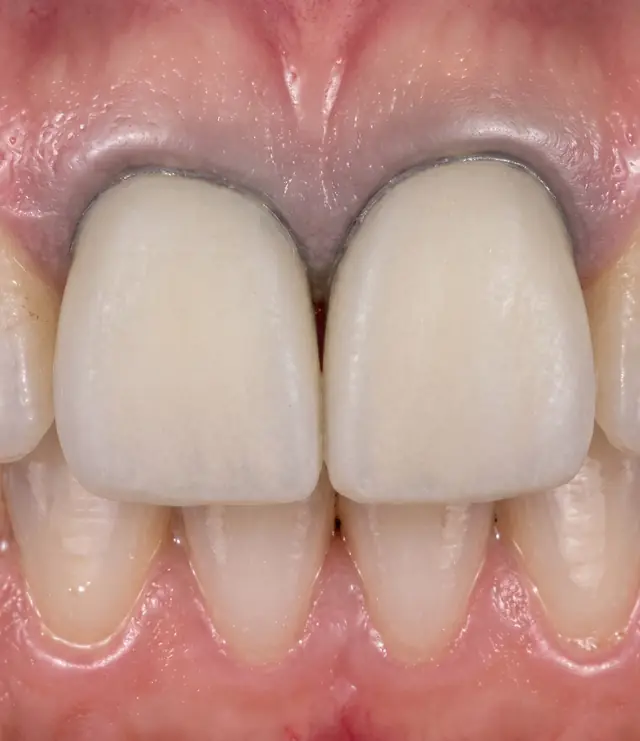
What happens at the gum line
The metal core of a metal-ceramic crown can show as a gray line at the gum, especially if the gum moves back over the years. An all-ceramic crown is tooth-colored all the way through, so the gum line stays pink and natural.[13]
Crown types at a glance
| Feature | All-ceramicGerman ceramic: glass-ceramic or zirconia | Metal-ceramicPorcelain on a metal core | Full metalGold or other alloys | ResinPlastic-based |
|---|---|---|---|---|
| Look | Most natural, because light passes through like enamel | Tooth-colored, but the metal core blocks light | Metal-colored | Tooth-colored at first, but it can stain and dull |
| Gum line | No metal edge | A gray edge may show | Metal is visible | No metal |
| Strength | Strong for front and back teeth, and zirconia especially suits the heaviest bites | Strong, but the porcelain layer can chip | Very tough, so it rarely chips or breaks | Fragile, so it is more likely to break |
| How long it lasts | 96.8–98.5% at 5 years (single-piece) | 97.1% at 5 years | Very long-lasting | Mostly temporary; about 3–5 years |
| Metal-free | Yes | No | No | Yes |
| Usually best for | Most front and back teeth, especially for people sensitive to metals | Some bridges and special cases | Hidden back teeth, where looks matter less than strength | Temporary crowns while the final one is made |
Survival figures come from a 2026 review of 64 clinical studies, while other details come from Cleveland Clinic patient information. Metal and metal-ceramic crowns still have a place, and we will explain if one would suit a particular tooth better.[12][13]
Materials we trust: FDA-cleared, made in the USA & Germany, award-winning
What goes into your tooth matters, so every filling and ceramic material we use is cleared by the US Food and Drug Administration (FDA) and made in the USA or Germany. In addition, our materials are recognized with product awards from The Dental Advisor.
Cleared by the US FDA
In the USA, dental filling and ceramic materials need FDA clearance before they can be sold. The FDA therefore checks that a product is as safe and effective as similar products already on the market.[20]
Made in the USA or Germany
Our 3M™ Filtek™ composite and our high-quality German ceramics come from established manufacturers in the USA and Germany, rather than from unknown or unbranded sources.
Dental Advisor awards
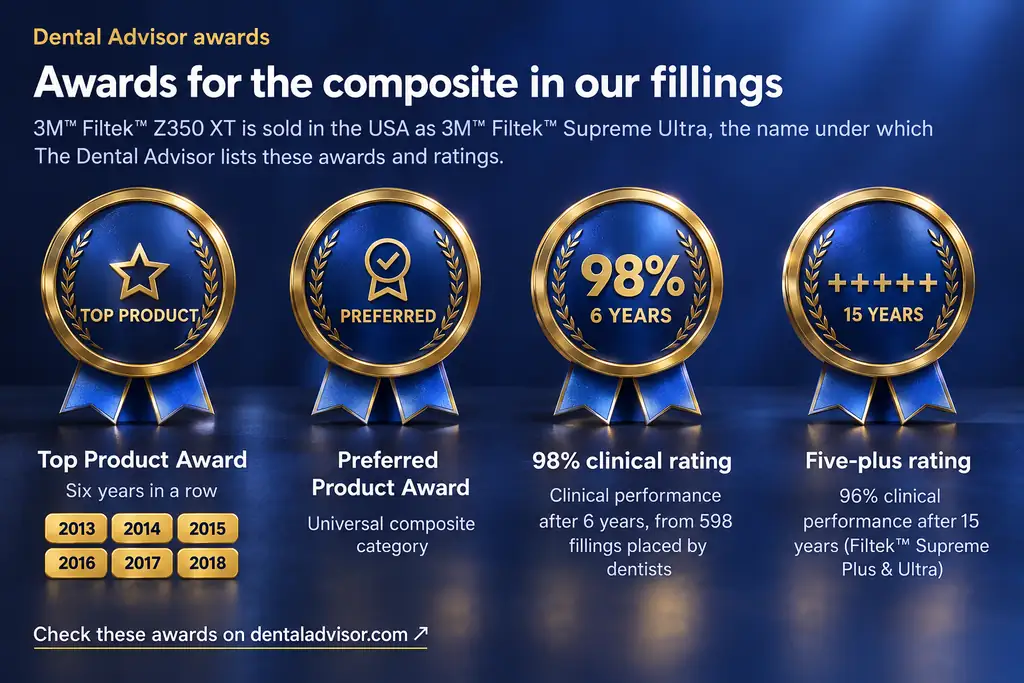
Awards for the composite in our fillings
In the USA, 3M™ Filtek™ Z350 XT is sold as 3M™ Filtek™ Supreme Ultra, so The Dental Advisor lists these awards and ratings under that name.[17]
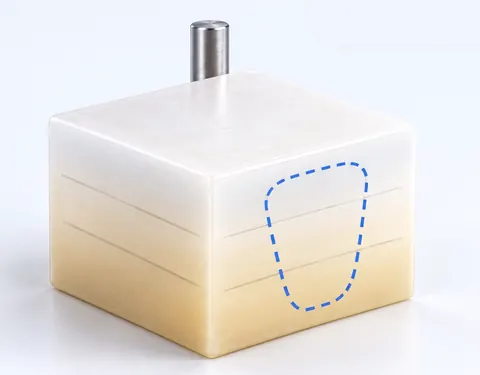
Our German ceramic
Made in Germany and FDA-cleared. Each inlay, onlay, veneer and crown is milled from a solid block like this, so it fits precisely.
What does “FDA-cleared” mean?
Before most dental materials can be sold in the USA, the maker must show the FDA that the product is as safe and effective as similar products already on the market. When the FDA agrees, it “clears” the product for sale. “Cleared” is the FDA’s official word for dental filling and ceramic materials, whereas “approved” is used for a different group of higher-risk devices.[20]
How does The Dental Advisor test products?
To begin with, products are sent to a group of practicing dentists, chosen from more than 300 clinical consultants around the USA. They use the product in their daily work and report back, and the editors then publish a rating. In addition, long-term evaluations follow real fillings for years.[21][18]
Award names and ratings belong to The Dental Advisor and relate to the products rather than to our clinic. Magic Tooth Dental Center is also not affiliated with The Dental Advisor, 3M or Solventum.
What to expect
How your repair is made, step by step
Composite is built inside your tooth in one visit, whereas ceramic is made outside the mouth, so it usually takes two. Choose one to see the steps.
Numbing and cleaning
We numb the tooth when needed and remove only the decay or the old filling.
Choosing the shade
We then pick from 36 shades, often mixing a deeper shade with an enamel shade for a natural look.
Bonding
A gentle gel and a bonding liquid prepare the tooth so the filling grips it firmly.
Building in layers
The composite is shaped in thin layers, and then a blue light hardens each one in seconds.
Shaping and polishing
Finally, we check your bite and polish to a natural shine. You can eat as soon as the numbness wears off.
Plan and prepare
We first examine the tooth, take X-rays if needed and then shape it as gently as possible.
A precise record
Then we record the prepared tooth and your bite precisely and match the shade.
A temporary
You leave with a temporary cover while your ceramic piece is being made.
Digital design and milling
Your restoration is designed on a computer and then milled from a solid block of German ceramic.[15]
Try-in and bonding
We check the fit, shape and shade with you, then bond it firmly to your tooth and polish it.
Feeling nervous? If so, ask us about laughing gas for a calmer, more relaxed visit.
Questions patients ask
Frequently asked questions
Can’t find your question? Then call us on 06 593 7076 or send a WhatsApp message to +962 79 660 0883.
Is a composite filling as strong as a silver (amalgam) filling?
For most small and medium cavities, modern composites work very well: in a five-year trial of back-tooth fillings, 92% of nanocomposite fillings were still working well. Amalgam is also very durable. For very large cavities, we may suggest a ceramic inlay or onlay instead.[5]
Should I replace my old silver fillings?
Only if they are broken, leaking or have decay under them, or when there is a medical reason. The US FDA does not recommend removing amalgam fillings that are in good condition, because removal briefly releases mercury vapor and can take away healthy tooth. When an old filling needs replacing anyway, we can replace it with tooth-colored composite or ceramic.[7]
Will the filling match my tooth color?
Yes. With 36 shades in four levels of see-through we can layer the filling like a natural tooth, and the way it handles light also helps it blend in under different lighting.[1]
Tip: fillings, veneers and crowns do not get lighter with whitening, so if you would like whiter teeth, whiten first, and we will then match your new restorations to the brighter shade.
How long do composite fillings last, and will they stain?
Can children have Filtek™ Z350 XT fillings?
Yes. Tooth-colored composite is widely used for children’s teeth, including baby teeth, when the tooth can be kept dry during treatment. However, for large decay in baby molars, a children’s crown may last better. In any case, our pediatric dentists will advise what suits your child.
Filling, inlay, onlay or crown: how do you decide?
It depends on how much healthy tooth is left and also on whether the cusps are weak. We choose the smallest repair that will last: a filling if possible, an inlay or onlay when the damage is too large for a filling, and a crown only when the whole tooth needs protection.[13]
How many visits does an inlay or onlay take?
Usually two. At the first we prepare and record the tooth and then place a temporary. At the second we try in your ceramic piece and check it with you before we bond it.
Can a ceramic inlay or onlay break?
It is uncommon. In fact, in a review of 14 studies, a chip or crack affected only about 4% of them, although this was the most common problem. So if you grind your teeth, a night guard helps protect them.[8]
Composite or ceramic veneers: which is better?
Composite veneers are quicker, need little or no drilling and are easy to repair, but they pick up stains and lose their shine sooner. Ceramic veneers cost more but stay beautiful for longer: in research, about 97% of glass-ceramic veneers lasted around ten years. We will show you both options so you can choose.[11][14]
Why choose an all-ceramic crown over a metal-ceramic one?
Is ceramic strong enough for my back teeth?
Will I need a crown after root canal treatment?
Back teeth often do, because they have usually lost a lot of tooth and can split when you chew, so a crown or onlay is normally recommended to protect them. On the other hand, a front tooth that has lost very little may need only a filling.
Are your materials FDA approved?
Yes, in the sense patients usually mean: every filling and ceramic material we use is FDA-cleared. “Cleared” is the official FDA term for dental materials like these, which must be shown to be as safe and effective as similar products already on the US market before they can be sold there. Our materials are also made in the USA or Germany.[20]
What is a Dental Advisor award?
The Dental Advisor is an independent US publication that has practicing dentists test products in their daily work. Then, each year, it names Top and Preferred products. The composite we use (sold in the USA as Filtek™ Supreme Ultra) received its Top Product Award every year from 2013 to 2018, as well as a Preferred Product Award and a 98% clinical performance rating after six years.[17][18]
Does it hurt?
We numb the area so you stay comfortable. Afterwards, some sensitivity to hot and cold for a few days, or for a couple of weeks after a crown, is normal and settles by itself. However, call us if pain keeps you awake or your bite feels high.[13]
How do I look after my new fillings, veneers and crowns?
Brush twice a day with fluoride toothpaste, clean between your teeth daily, avoid biting ice, very hard nuts or sticky sweets, wear a night guard if you grind, and also keep up your check-ups and professional cleanings.[13]
How much does treatment cost?
It depends on the tooth, the size of the repair and the material. After examining you, we give you a clear plan and cost before any treatment begins. We also accept cash and credit cards, in JOD and USD.
Appointments
Find the right filling, inlay or crown for your tooth
At your consultation we examine your teeth, listen to what you would like to change and then explain every option, including the more conservative ones. You get a clear plan and cost before anything begins.
Curious how veneers would look on you? Try our free online smile design on your own photo.
- Visit usBuilding 192, first floor, Princess Basmah Street, Abdoun, Amman
- Opening hoursSaturday to Wednesday, 9 am to 7 pm · Thursday, 9 am to 2 pm · Friday closed
- PaymentCash and credit cards, in JOD and USD
Good questions to ask your dentist
- “Can this be fixed with a filling, or do I need an inlay, onlay or crown?”
- “Which material will you use for this tooth, and why?”
- “How much of my tooth will need to be removed?”
- “What can I do to make my restoration last as long as possible?”
References & further reading
Solventum: 3M™ Filtek™ Z350 XT Universal Restorative, product information
For front and back fillings; 36 shades in four opacities; fluorescent, opalescent and radiopaque; polish retention. Manufacturer information.Solventum: 3M™ Filtek™ Supreme Ultra Universal Restorative, Technical Product Profile
The TRUE-nanotechnology filler (20 nm silica, 4–11 nm zirconia and nanoclusters) shared with Filtek™ Z350 XT. Manufacturer document.3M: Filtek™ Dental Restoratives, product comparison chart
Places Filtek™ Z350 XT in the range’s top “versatility & esthetics” tier and states Filtek™ use in more than 1 billion restorations. Manufacturer document.Mitra SB, Wu D, Holmes BN. An application of nanotechnology in advanced dental materials. J Am Dent Assoc, 2003
Laboratory study by the material’s developers at 3M: better polish retention than hybrid composites and lower wear. DOI: 10.14219/jada.archive.2003.0054Schoilew K, et al. Clinical evaluation of bulk-fill and universal nanocomposites in class II cavities: five-year results of a randomized clinical split-mouth trial. J Dent, 2022
92% survival at about five years for back-tooth fillings made with Filtek™ Supreme XTE (same nanocomposite family). DOI: 10.1016/j.jdent.2022.104362Opdam NJM, et al. Longevity of posterior composite restorations: a systematic review and meta-analysis. J Dent Res, 2014
Fillings failed mainly from new decay and fracture, especially in high-caries-risk patients and larger fillings. DOI: 10.1177/0022034514544217US Food and Drug Administration: Recommendations about mercury-containing dental amalgam, 2020
Advises against removing amalgam fillings in good condition unless medically necessary.Morimoto S, et al. Survival rate of resin and ceramic inlays, onlays, and overlays: a systematic review and meta-analysis. J Dent Res, 2016
92–95% survival at five years and 91% at ten years; chips or fractures (about 4%) were the most common failure. DOI: 10.1177/0022034516652848Edelhoff D, Sorensen JA. Tooth structure removal associated with various preparation designs for posterior teeth. Int J Periodontics Restorative Dent, 2002
Inlay preparations removed about 5–27% of a back tooth’s crown; full crowns about 68% (all-ceramic) to 76% (metal-ceramic).Edelhoff D, Sorensen JA. Tooth structure removal associated with various preparation designs for anterior teeth. J Prosthet Dent, 2002
Veneers removed about 3–30% of the visible tooth, whereas crowns removed about 63–72%. DOI: 10.1067/mpr.2002.124094Klein P, et al. Survival and complication rates of feldspathic, leucite-reinforced, lithium disilicate and zirconia ceramic laminate veneers: a systematic review and meta-analysis. J Esthet Restor Dent, 2025
About 97% survival of lithium disilicate veneers at about 10 years, from 29 studies. DOI: 10.1111/jerd.13351Pjetursson BE, et al. Survival, failure and complication rates of metal-ceramic, veneered and monolithic all-ceramic tooth-supported single crowns: systematic review and meta-analysis, Part 1. Int J Prosthodont, 2026
Five-year survival by crown material from 64 clinical studies; single-piece (monolithic) designs chipped less. DOI: 10.11607/ijp.9633Cleveland Clinic: Dental Crowns
Patient guide to crown types (metal, metal-ceramic, all-ceramic, zirconia, resin), alternatives such as inlays and onlays, recovery and care.Pereira RM, et al. An engineering perspective of ceramics applied in dental reconstructions. J Appl Oral Sci, 2023
Strength, biocompatibility, stability and appearance of dental ceramics compared with metal-ceramics. DOI: 10.1590/1678-7757-2022-0421Spitznagel FA, Boldt J, Gierthmuehlen PC. CAD/CAM ceramic restorative materials for natural teeth. J Dent Res, 2018
Digitally milled ceramics: standardized factory-made blocks and conservative, bonded restorations. DOI: 10.1177/0022034518779759American Dental Association (MouthHealthy): Veneers
What veneers are, why treatment is not reversible, and why teeth must be healthy first.The Dental Advisor: 3M™ ESPE Filtek™ Supreme Ultra, clinical evaluation and awards
Lists Top Product Awards 2013, 2014, 2015, 2016, 2017 and 2018 and a Preferred Product Award; 92% clinical rating from 23 consultants and 1,141 restorations.The Dental Advisor: Filtek™ Supreme Ultra Universal Restorative, 6-year clinical performance
598 restorations placed over six years; clinical performance rating of 98% at six years.The Dental Advisor: 3M™ Filtek™ Supreme Plus and Filtek™ Supreme Ultra, 15-year clinical performance
Over 2,300 restorations followed since 2000; 96% clinical performance rating and five-plus (+++++) rating (report reprint, PDF).US Food and Drug Administration: Premarket Notification 510(k)
How a device is shown to be as safe and effective as a legally marketed device, and “cleared” for sale in the USA.The Dental Advisor: Our process
Products are tested by practicing dentists from more than 300 clinical consultants across the USA; Ann Arbor, Michigan.The Dental Advisor: Awards
The yearly Top Product and Preferred Product awards.
Sources checked: 30 October 2026. Links open in a new tab, and the sources themselves are in English. However, research figures describe groups of patients and are not a guarantee for any individual case.
